Historical Eras of Economy: U.S. Industrial Revolution, Economy Insights. Global Impact
yelli
April 20, 2024
4:50 am
A:-
Different Historical Eras of Economy: A Comprehensive Analysis
Throughout history, the global economy has undergone profound transformations, reflecting humanity’s ingenuity, societal shifts, and technological advancements. Each economic era of historical eras of economy has shaped the structure of societies, influenced political systems, and driven technological innovations. This article explores the significant historical global economic periods, highlighting their characteristics, developments, and implications for the modern world, answering questions like “How did the U.S. economy evolve through these eras?” and “What impact did these changes have on U.S. society?”
1. Hunting and Gathering Economy (Prehistoric Era).
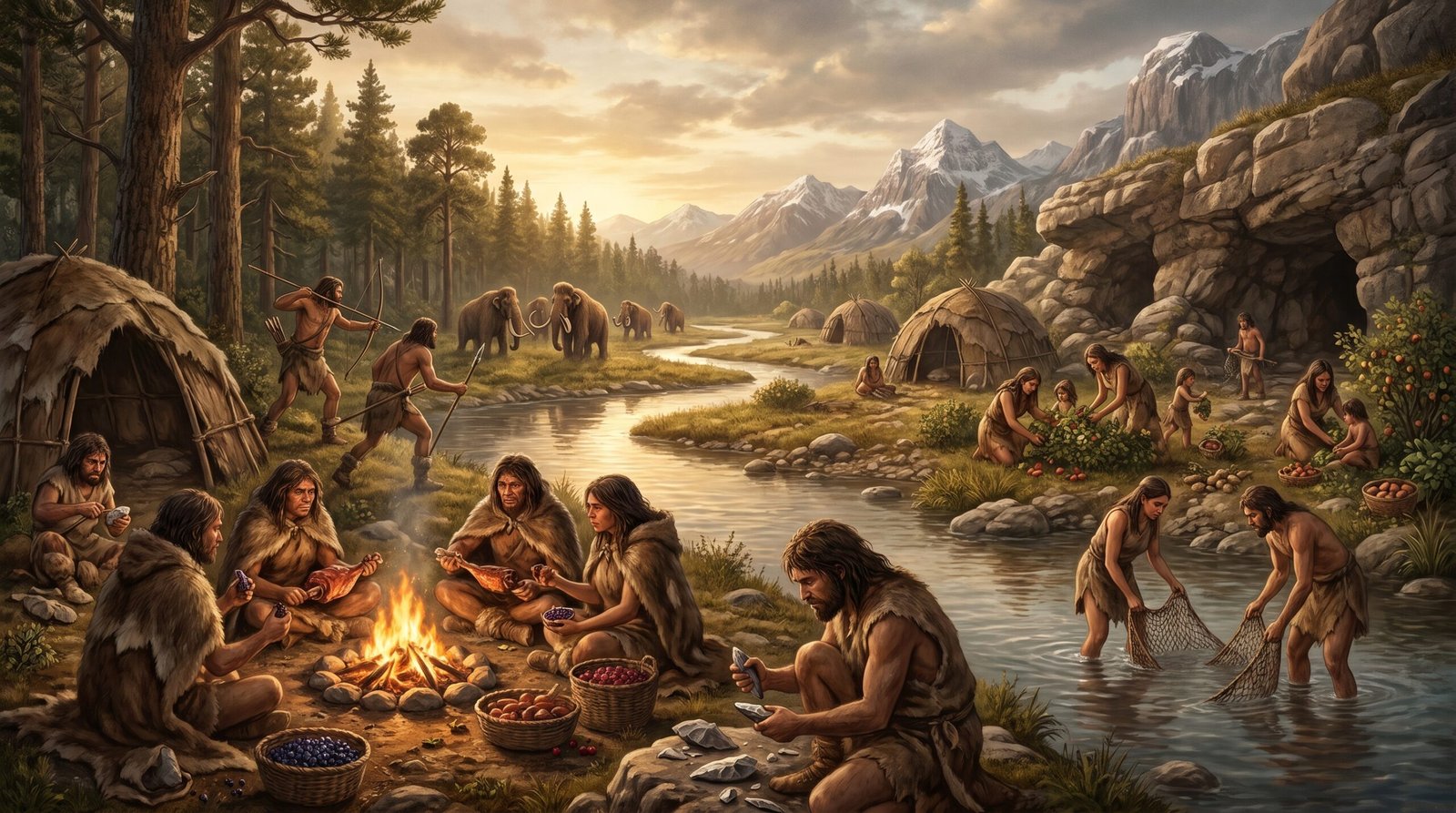
Depicting nomadic lifestyles during the hunting and gathering economy, emphasizing resource sharing and sustainability.
Period: Up to 10,000 BCE
How Did Early Economic Systems Function Without Trade or Currency?
During the early historical eras of economy, survival was the central focus, with humans relying on hunting, fishing, and gathering wild plants. These subsistence-based systems lacked formal trade or currency, instead prioritizing resource sharing within small, nomadic groups. Communities operated on communal basis, pooling resources to collectively meet their needs. This cooperative approach fostered mutual reliance and laid the foundation for egalitarian social structures.
These practices, seen globally, also parallel the communal resource-sharing models of early Native American societies, emphasizing the importance of shared responsibility and environmental harmony.
Impact on Society
The lack of trade or currency fostered egalitarian societies, where resources were distributed equitably, and wealth hierarchies were absent. This unique societal structure had several key characteristics:
Shared Resources: Necessities such as food, tools, and shelter were shared within the group.
Sustainable Living: Dependence on natural resources ensured minimal environmental impact and a deep connection with nature.
Nomadic Lifestyle: Mobility in search of food and resources encouraged adaptability, resilience, and intimate knowledge of the environment.
Despite limited trade and economic complexity, these early systems became a cornerstone of the historical eras of economy, paving the way for humanity’s later economic transformations. They reflected a crucial balance between survival needs and the social harmony necessary for the evolution of trade systems.
2. Agricultural Revolution
(Neolithic Era).
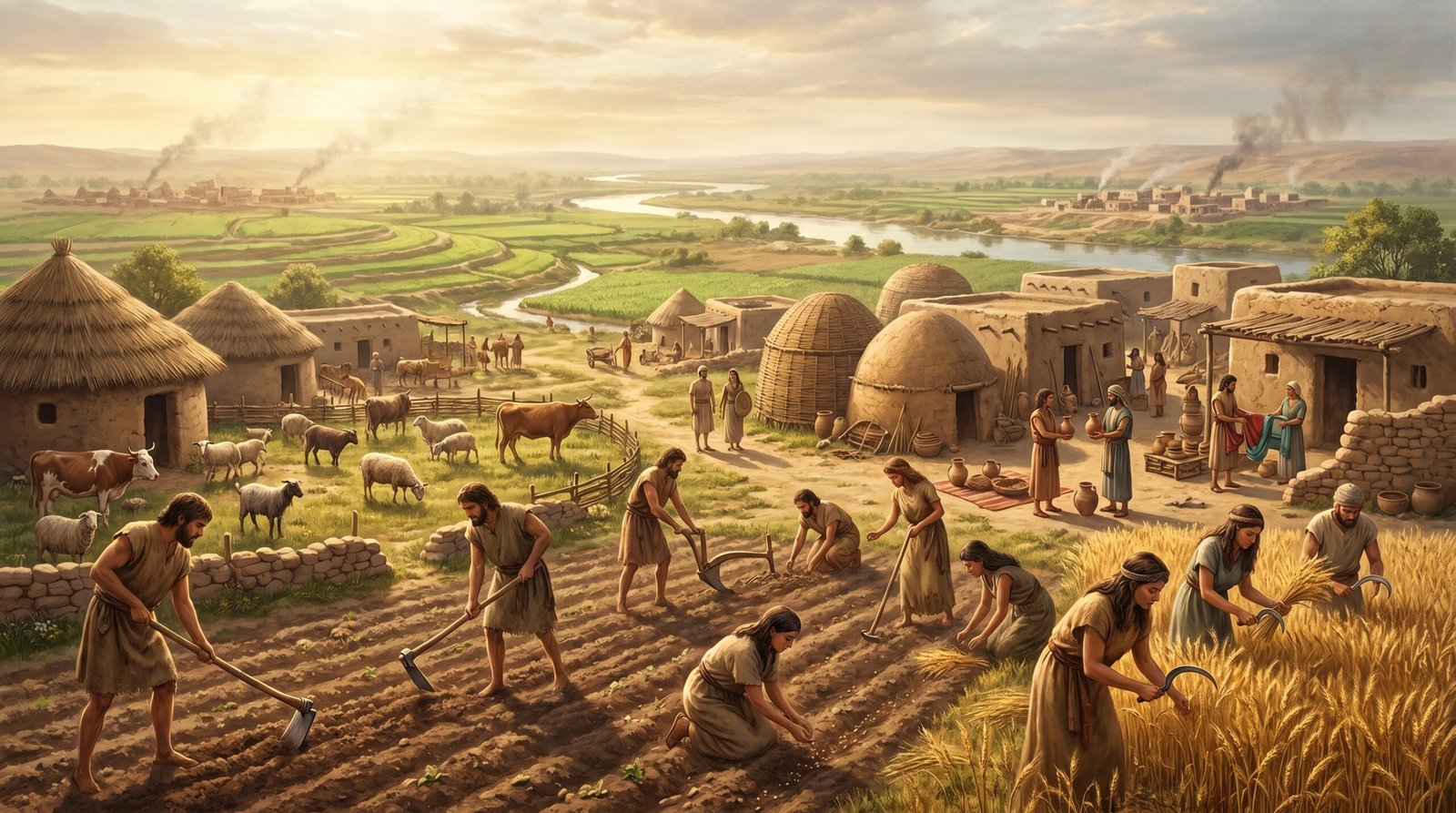
Representing the shift to agrarian economies during the Neolithic era, featuring surplus production and permanent settlements.
Period: 10,000 BCE – 1,500 BCE
What Key Developments Marked the Transition to Farming?
The Agricultural Revolution marked humanity’s transition from nomadic lifestyles to settled agricultural societies, transforming economies through the domestication of plants and animals. This revolution led to the creation of food surpluses, which enabled the establishment of early trade systems, division of labor, and permanent settlements. These advancements laid the foundation for social stratification and future economic systems.
Geo-Specific Context
While these developments occurred worldwide, their influence on specific regions underscores their significance in the historical eras of economy. Early settlements in areas like California and the Mississippi River Valley mirrored these innovations, eventually evolving into agricultural hubs within the U.S. Midwest. The techniques established during the Neolithic Era played a crucial role in shaping these regions into key contributors to global food production and trade.
Economy Type: Agrarian economy focused on farming and animal husbandry.
Key Developments: Surplus production, division of labor, early trade systems, and permanent settlements.
The Agricultural Revolution stands as a pivotal moment in economic history, transforming societies and economies by driving stability, technological innovation, and interconnected trade networks.
3. Ancient Economy (Bronze Age to Classical Antiquity).
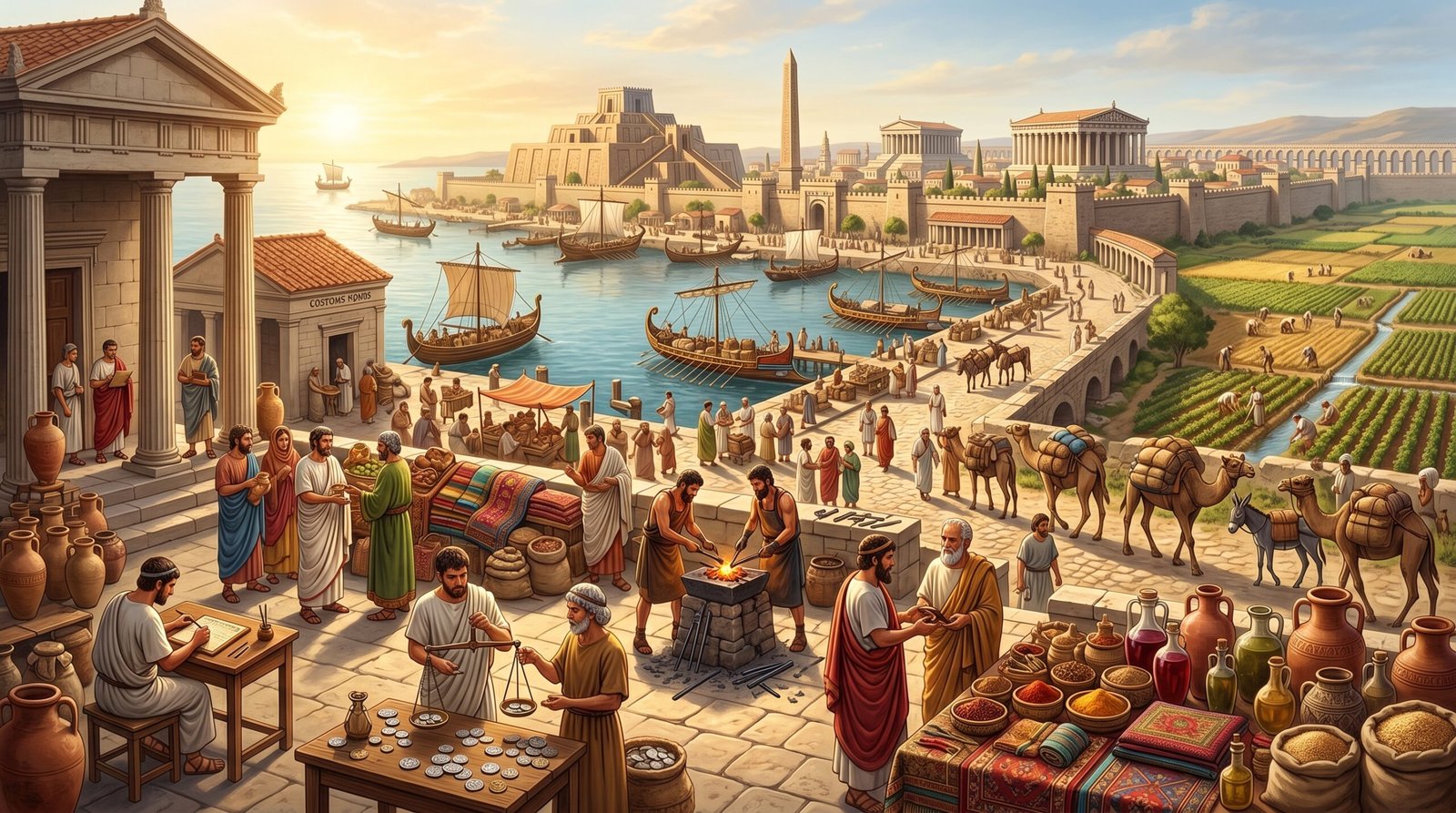
Depicting early civilizations like Mesopotamia and Rome, highlighting trade routes, monetary systems, and urbanization during the Bronze Age and Classical Antiquity.
Period: 3,000 BCE – 500 CE
How Did Ancient Trade Routes Shape the World Economy?
The ancient economy marked the rise of structured trade systems and centralized economies within civilizations like Mesopotamia, Egypt, Greece, and Rome. These societies leveraged long-distance trade routes, such as the Silk Road, to integrate diverse regions, foster cultural exchange, and support economic growth. The development of monetary systems and early banking practices further streamlined commerce, laying the foundation for future global trade networks.
The U.S.’s emergence as a global trade leader in the 19th century reflects the enduring influence of the historical eras of economy. These ancient practices, including structured trade systems and centralized economies, left a lasting legacy that shaped modern economic frameworks and contributed to the nation’s rise as a dominant player in global commerce.
Economy Type
Agrarian with Urbanization and Trade: Agriculture remained the backbone of these economies, complemented by urban centers that facilitated trade and monetary innovation.
Key Developments
Long-Distance Trade: Routes like the Silk Road connected regions, fostering international commerce.
Monetary Innovation: The advent of coinage simplified trade and standardized economic exchanges.
Early Banking Systems: Institutions in Greece and Rome introduced lending, credit, and financial organization, which became templates for modern banking.
Legacy
The ancient economy laid the foundation for centralized economic systems and pioneered trade practices that connected diverse regions. These advancements were critical in shaping the historical eras of economy, influencing global trade during antiquity and paving the way for future systems, including the U.S.’s emergence as a dominant trade powerhouse.
4. Feudal Economy (Medieval Period).
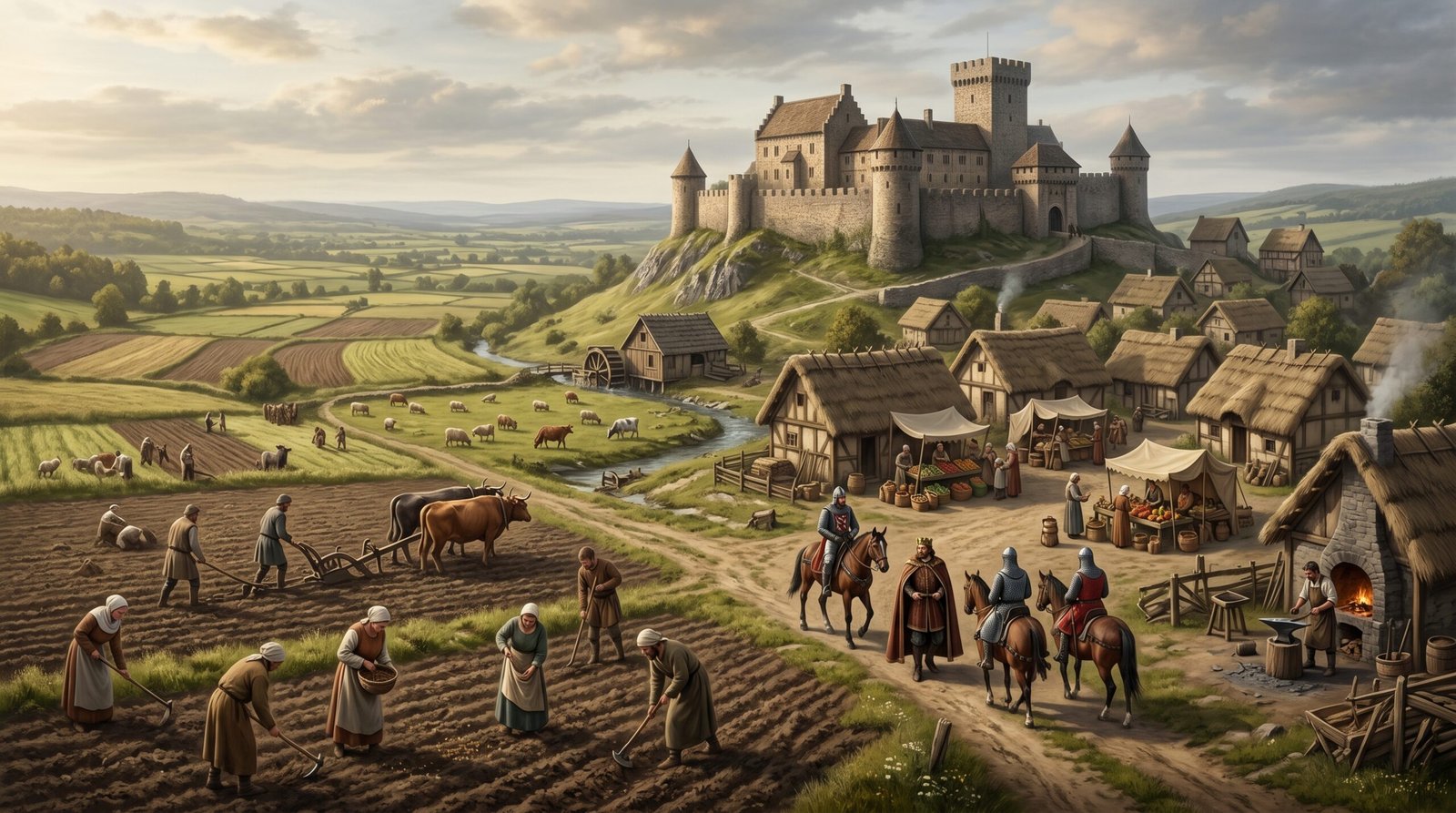
A depiction of medieval manorial estates, showcasing the hierarchy of lords, vassals, and peasants that defined the feudal economy from 500 CE to 1500 CE.
Period: 500 CE – 1500 CE
What Was the Role of Land in Medieval Economies, and How Did It Influence Later Systems?
During one of the key historical eras of economy, medieval Europe’s feudal economy centered on land ownership as the primary economic asset. Land served as the foundation for production, sustenance, and societal organization, with a hierarchical system of lords, vassals, and peasants sustaining agrarian productivity. The self-sufficient manorial estates created a localized economic system with limited external trade. This emphasis on land ownership and agriculture shaped not only medieval systems but also influenced later economies, including the plantation-based agricultural systems of the Southern United States.
Economy Type
Agrarian with Self-Sufficient Manorial Estates: Land ownership underpinned the economy, with estates producing all necessary goods for local consumption.
Impact
The feudal system marked a gradual shift toward urban trade and the beginnings of economic specialization, laying the groundwork for more interconnected markets in later centuries.
Key Developments
Guilds: These associations of craftsmen and merchants regulated quality, pricing, and production, supporting the emergence of local trade systems.
Local Markets: Small-scale trade within towns allowed for some degree of economic exchange beyond manorial estates.
Self-Sufficiency: Manorial estates provided most goods and services internally, reducing reliance on external economies.
Legacy
The feudal economy established a land-based hierarchy, shaping economic structures and societal organization. Its focus on agriculture and localized production influenced the later transition to trade-based economies.
U.S. Connection
The manorial system of medieval Europe shares key parallels with the plantation-based economies of the Southern United States, both of which represent significant phases in the historical eras of economy. In both systems, land ownership and agricultural production served as the economic backbone, supported by hierarchical labor structures. The focus on self-sustaining estates reflects the enduring influence of medieval feudal frameworks on later land-centric economies.
5. Mercantilism and the Commercial Revolution (Early Modern Era).
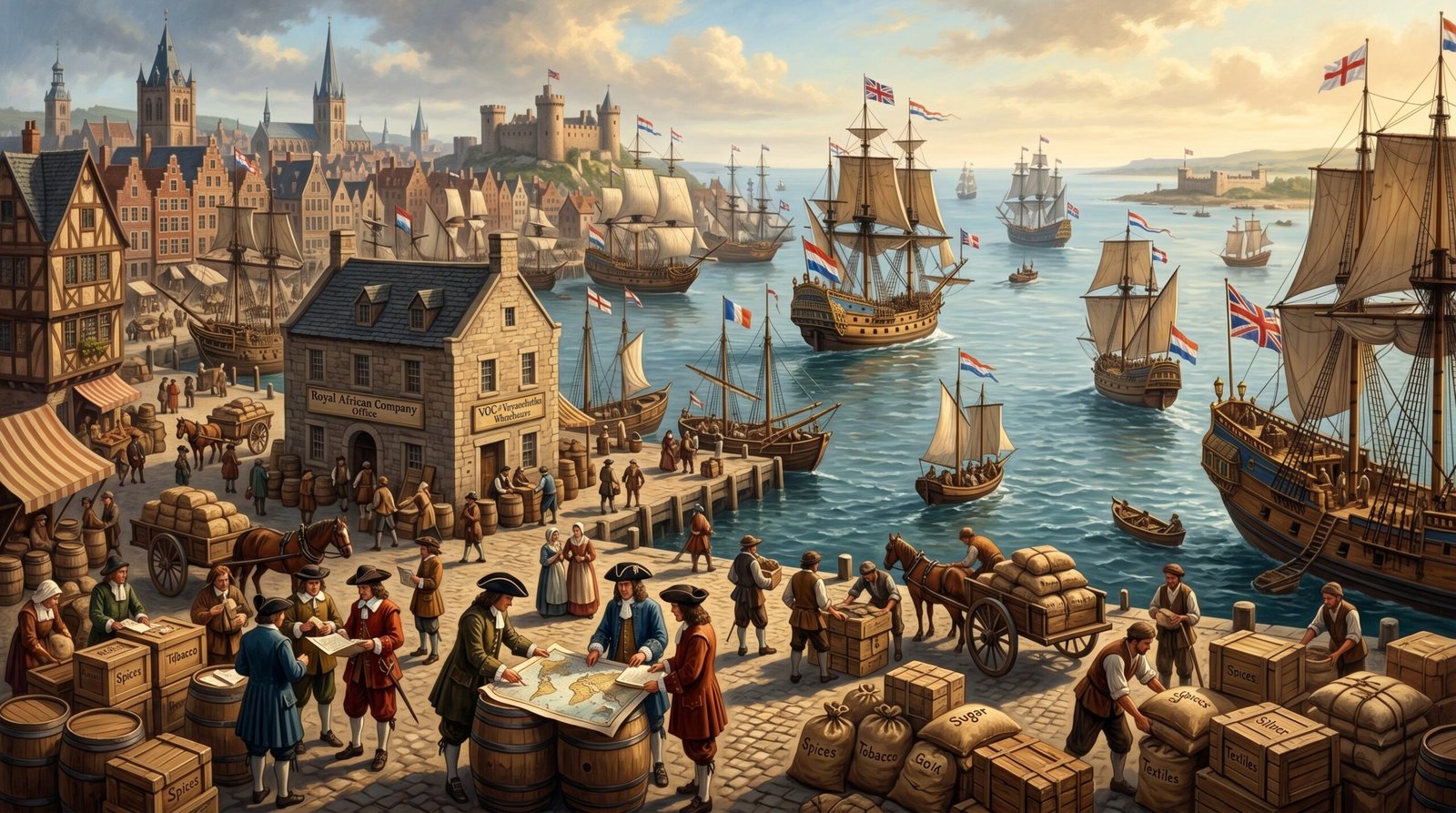
Illustrating the Commercial Revolution’s mercantilist policies, focusing on colonial exploitation, joint-stock companies, and the rise of maritime trade in the early modern era.
Period: 1500 CE – 1750 CE
How Did Mercantilism Shape Colonial Economies in America?
As a defining feature of the historical eras of economy, mercantilism arose alongside European exploration and colonization, emphasizing state control over resources and wealth accumulation through trade. This economic philosophy deeply shaped colonial economies in America, particularly in regions like New England, where maritime trade flourished. European powers prioritized maximizing exports and extracting raw materials from their colonies, enforcing a system that served the interests of the mother countries at the expense of colonial autonomy.
While this mercantilist framework strengthened colonial trade, it also sowed the seeds of economic discontent. The rigid restrictions placed on colonies created tensions that ultimately fueled the American independence movements, as colonies sought to break free from mercantilist control and achieve greater economic self-determination.
Economy Type
State-Controlled and Export-Driven Economies: Mercantilist systems prioritized exports, with colonial economies supplying raw materials to European powers and importing finished goods in return.
Key Developments
Maritime Trade: Colonies like New England became hubs of shipbuilding, fishing, and trade, fostering economic growth.
Joint-Stock Companies: Organizations like the British East India Company facilitated large-scale trade and colonization efforts.
Colonial Exploitation: Colonies provided raw materials like cotton, tobacco, and sugar, which were critical to European economies.
Implications
Mercantilism laid the groundwork for modern global trade systems, introducing practices like state-backed commerce, the establishment of colonial markets, and large-scale shipping routes.
Impact on U.S. Society
The mercantilist policies imposed by European powers shaped the development of early American society. While they encouraged economic growth in regions like New England, they also created economic and political tensions. Colonial resistance to mercantilist restrictions, such as taxation without representation and limits on self-determined trade, became a driving force behind the American Revolution and the eventual establishment of a free-market economy.
6. Industrial Revolution
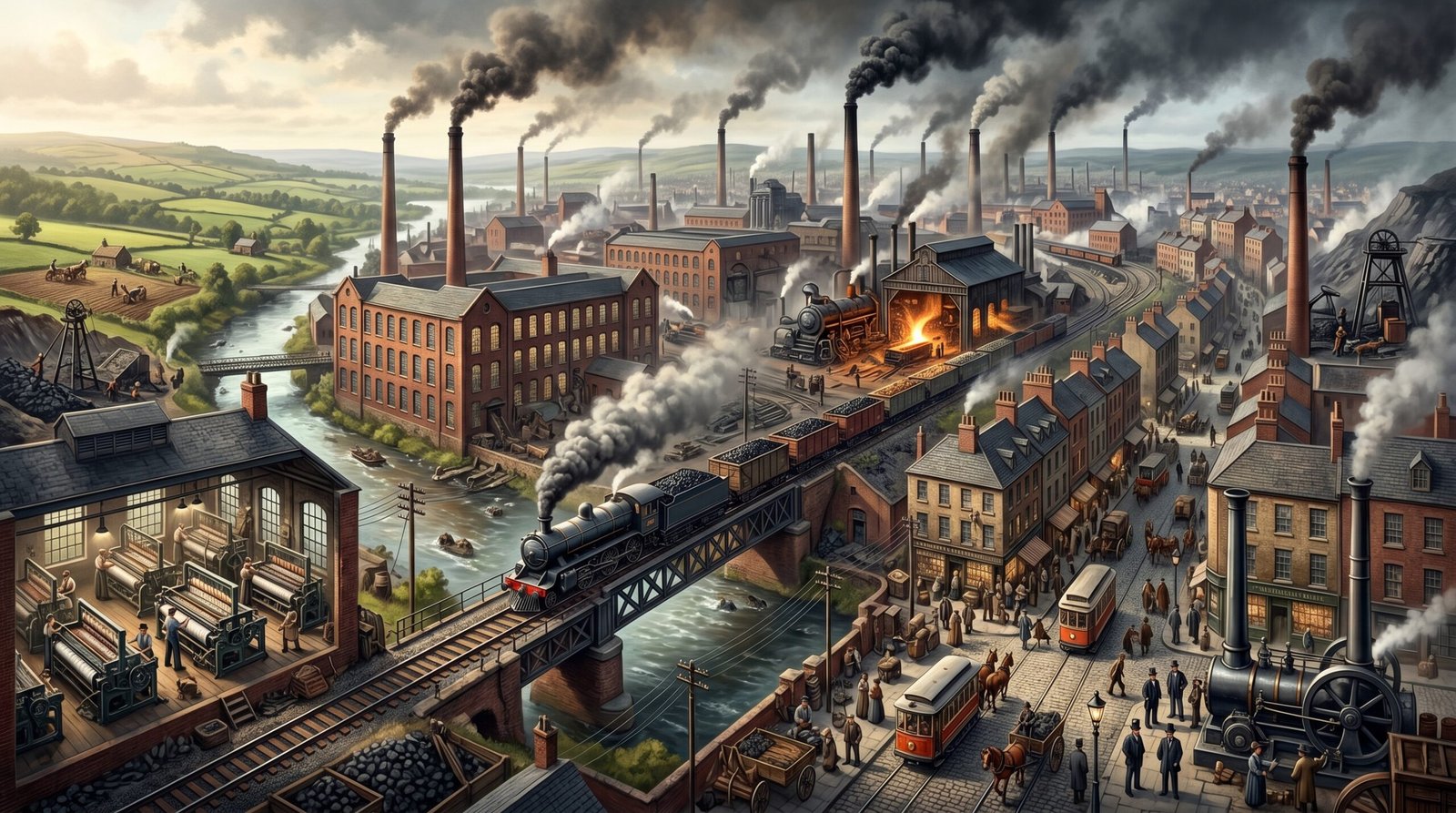
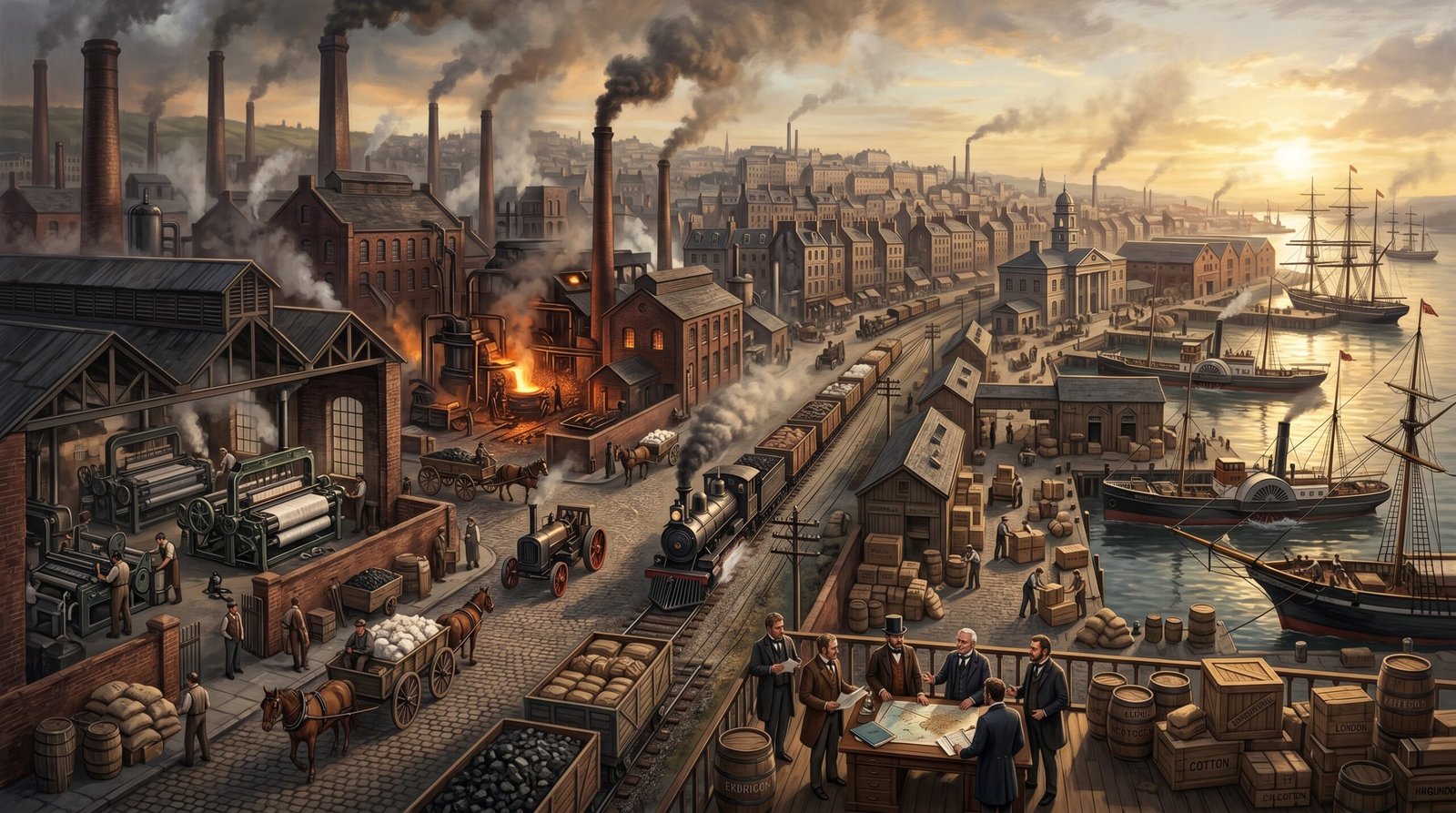
An image showcasing the Industrial Revolution’s impact on economies and societies, featuring factories, steam engines, and urban growth from 1750 CE to 1900 CE.
Period: 1750 CE – 1900 CE
The Industrial Revolution marked the shift to mechanized production, urbanization, and industrial capitalism, beginning in Britain and spreading globally.
Economy Type: Industrial capitalism.
Key Developments: Steam engines, factories, mass production, and global trade expansion.
Transformations: Modern financial systems and industrial urban societies.
How did the U.S. economy change during the Industrial Revolution?
The Industrial Revolution marked a key turning point in the historical eras of economy, transforming the United States from a primarily agricultural to becoming an industrial powerhouse. Spanning from the late 18th to mid-19th century, this era was defined by rapid mechanization and urbanization. Breakthroughs like the cotton gin revolutionized agricultural efficiency while driving economic growth and expansion. These innovations not only elevated productivity but also fundamentally restructured the nation’s economic and social dynamics, setting the stage for modern industrial economies.
Economic Changes During the Industrial Revolution
Transition from Agrarian to Industrial Economy: Prior to the Industrial Revolution, the U.S. economy relied heavily on agriculture, with small-scale farms dominating rural landscapes. Mechanization, such as the invention of the cotton gin by Eli Whitney, revolutionized agricultural productivity, particularly in the South. However, the real shift occurred as industries like textiles, iron, and coal began to dominate, driving the rise of factories.
Impact: This transition created a more diversified economy, reducing reliance on agriculture and establishing the U.S. as a burgeoning industrial power.
Urbanization and the Growth of Cities: Industrialization drew workers from rural areas to urban centers. Cities like New York, Pittsburgh, and Chicago experienced rapid growth as factories became hubs of economic activity. Immigration also surged during this time, as people from Europe sought opportunities in the growing industrial sector.
Impact: Urbanization led to increased economic output but also introduced challenges such as overcrowding, poor living conditions, and labor exploitation.
Expansion of Transportation and Trade: The development of railroads and steamships during the Industrial Revolution played a pivotal role in connecting markets. This infrastructure facilitated the efficient movement of goods, enabling the U.S. to expand its domestic and international trade.
Impact: Railroads boosted the coal and steel industries, laying the foundation for the country’s future economic dominance.
Impact on U.S. Society
Changing Labor Dynamics: The shift to factory-based production introduced wage labor, replacing the subsistence-based economy of earlier times. However, workers faced long hours, low wages, and unsafe conditions, leading to the rise of labor unions advocating for workers’ rights.
Social Impact: The labor movement sowed the seeds for future reforms, including the establishment of minimum wage laws and workplace safety standards.
Technological Advancements: The Industrial Revolution fostered innovation, with inventions like the telegraph and mechanical looms revolutionizing communication and manufacturing. These advancements created ripple effects across industries, accelerating economic growth.
Social Impact: Technological progress improved productivity and living standards over time, though its benefits were unevenly distributed.
Economic Inequality: While industrialization created unprecedented wealth, it also widened the gap between the rich and poor. Industrial tycoons like Andrew Carnegie and John D. Rockefeller amassed vast fortunes, while many laborers struggled to make ends meet.
Social Impact: Economic disparity sparked debates about wealth distribution and the role of government in regulating industry, shaping the progressive movements of the late 19th century.
Legacy of the Industrial Revolution
The Industrial Revolution marked a pivotal shift in the historical eras of economy, laying the foundation for the United States to emerge as a global economic leader. It introduced transformative systems such as mass production, technological advancements, and interconnected trade networks, which continue to shape the modern economy.
By exploring the economic and social transformations of this era, we gain insights into the foundations of contemporary U.S. industry and society. Additionally, this examination highlights the ongoing challenges of balancing economic growth with equity and sustainability in a rapidly evolving world.
7. The Gilded Age and Second Industrial Revolution
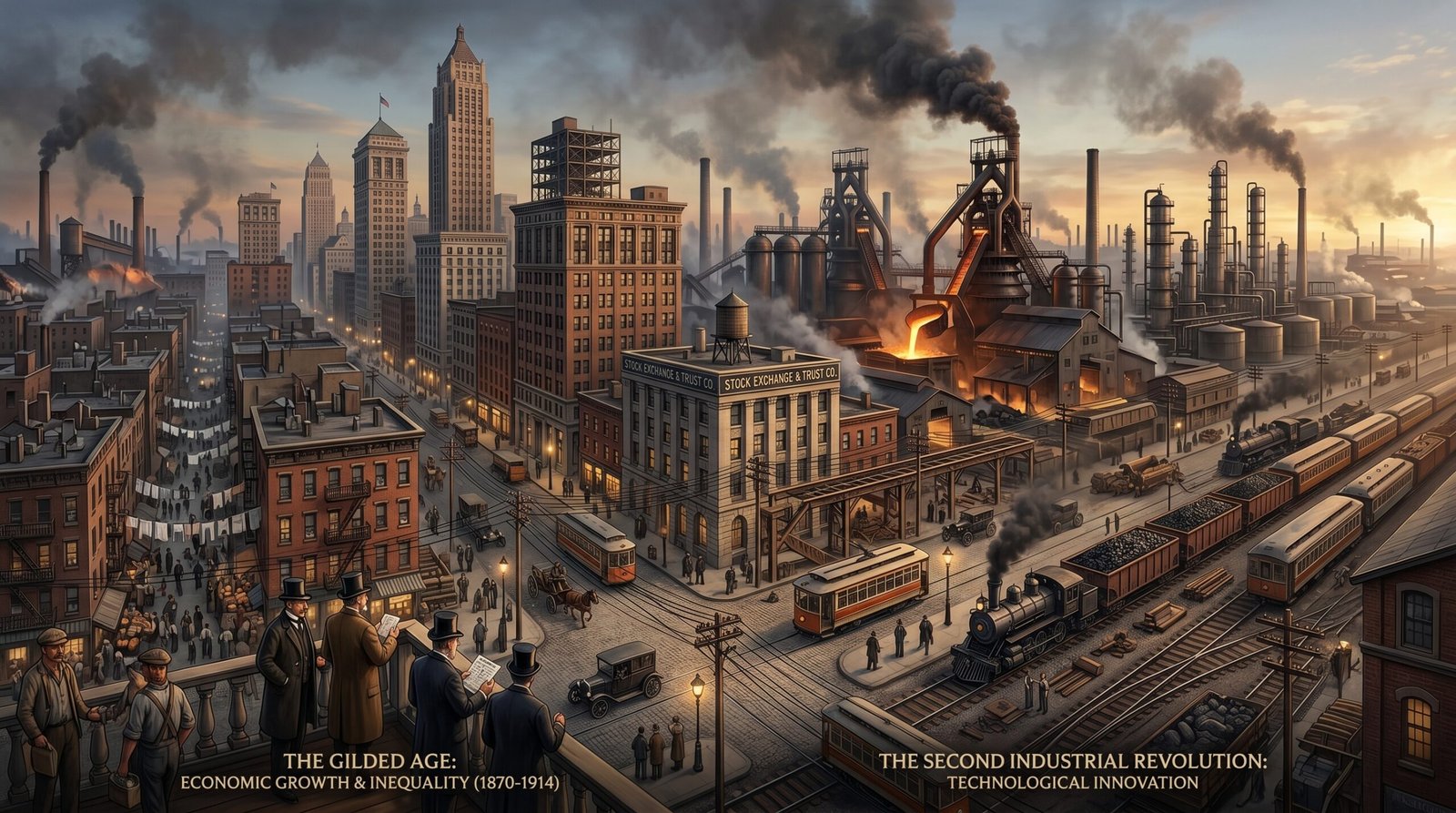
Illustrating the Gilded Age and Second Industrial Revolution’s rapid economic growth, highlighting advancements in steel, oil, and electricity, along with corporate dominance during 1870 CE – 1914 CE.
Period: 1870 CE – 1914 CE
What Industries Defined the U.S. During the Gilded Age?
The Gilded Age and the Second Industrial Revolution marked a transformative period in U.S. history, defined by the rapid expansion of major industries like steel, oil, and electricity. These industries fueled U.S. economic dominance on the global stage while also exacerbating economic inequality. Innovations such as telecommunications, the telephone, and advancements in electricity revolutionized production and connectivity, laying the foundation for the modern consumer economy.
Economy Type
Advanced Industrial Capitalism: Dominated by large-scale industries and corporate monopolies, the economy became increasingly reliant on mass production and technological innovation.
Key Developments
Steel, Oil, and Electricity: These industries powered the U.S. economy, driving infrastructure development and technological progress.
Telecommunications and the Telephone: Innovations in communication revolutionized business operations and personal connectivity.
Corporate Monopolies: Tycoons like John D. Rockefeller (oil) and Andrew Carnegie (steel) created massive corporate empires, consolidating wealth and power.
Outcome
The Gilded Age represented a transformative chapter in the historical eras of economy, laying the groundwork for modern consumer economies. Mass production and technological innovation spurred significant economic growth during this period. However, it also underscored the stark disparities between industrial prosperity and rising economic inequality, offering a dual legacy of progress and societal challenges.
Impact on U.S. Society
The economic boom of the Gilded Age significantly shaped U.S. society. The concentration of wealth in the hands of industrial tycoons like Rockefeller and Carnegie symbolized the opportunities and inequalities of the era. While millions found work in factories and urban centers, many faced low wages, poor working conditions, and minimal protections, sparking the rise of the labor movement.
8. The Great Depression and Keynesian Economics
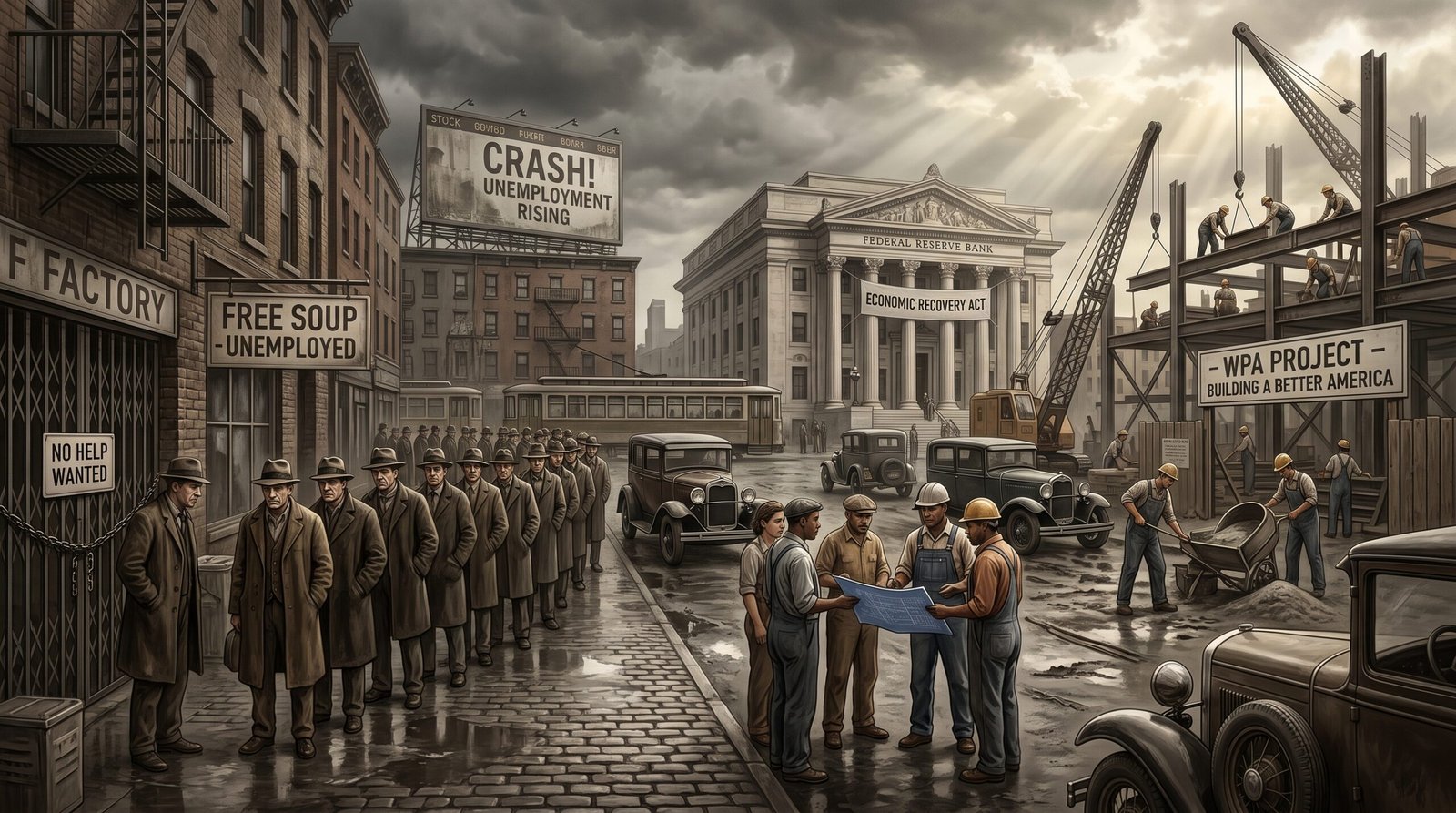
An image representing the Great Depression and the rise of Keynesian economics, showcasing New Deal programs and government intervention during 1929 CE – 1945 CE.
Period: 1929 CE – 1945 CE
Economic Milestones: How Did Government Policies Shape the U.S. Economy During the Great Depression?
The Great Depression of the 1930s stands out as one of the most critical economic milestones in the historical eras of economy, triggering a global economic downturn that reshaped perspectives on free-market policies. In response, the United States embraced unprecedented government intervention through transformative initiatives like the New Deal.
This comprehensive program aimed to stabilize the economy by implementing large-scale infrastructure projects, introducing social welfare programs, and enforcing financial reforms. Influenced by John Maynard Keynes‘ economic theories, these policies underscored the significance of government spending during economic downturns to stimulate demand, boost employment, and restore stability.
The Great Depression marked a turning point in economic governance, highlighting the interplay between policy innovation and market resilience during periods of crisis.
Economy Type
Mixed Economies: A balance between free-market principles and government intervention emerged during this era, reshaping the role of public policy in economic systems.
Key Developments
New Deal Policies: Initiatives like Social Security, unemployment insurance, and public works programs provided relief and stimulated economic growth.
Keynesian Economics: Introduced the concept of counter-cyclical government spending, emphasizing the importance of fiscal intervention during recessions.
Financial Reforms: Laws such as the Glass-Steagall Act restructured the banking system to prevent future financial crises.
Impact
The Great Depression fundamentally shaped modern economic policies, introducing government intervention as a critical tool for mitigating economic downturns and stabilizing markets during crises.
Impact on U.S. Society
Government intervention during the Great Depression had a profound effect on U.S. society. Programs like the New Deal introduced modern welfare systems, providing essential safety nets for millions. These policies also bolstered the labor rights movement, ensuring better protections for workers and creating lasting economic reforms that redefined the relationship between the government and the economy.
9. Post-World War II Economic Boom (Golden Age of Capitalism)
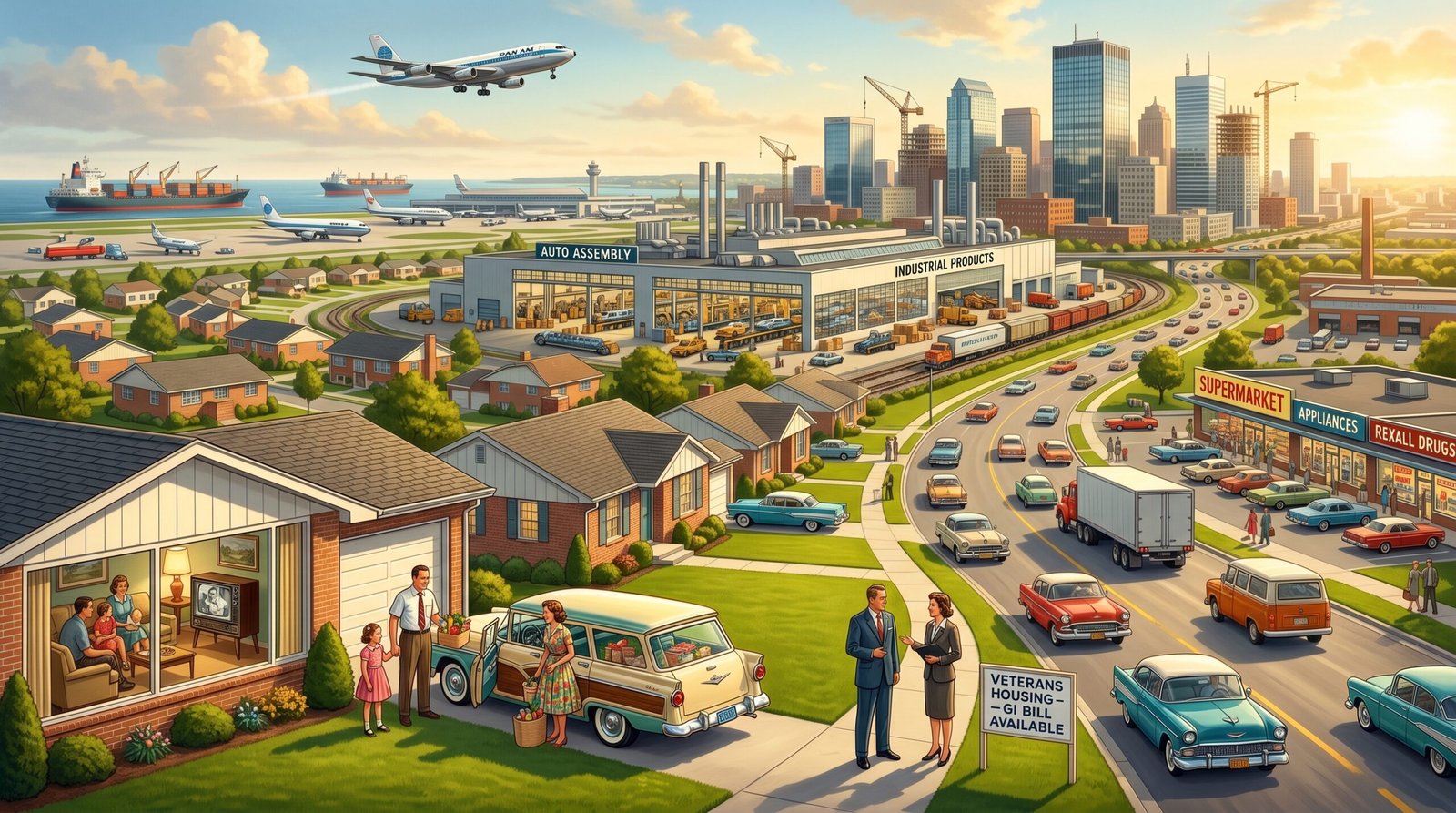
An image showcasing the Post-World War II economic boom, with suburban expansion, middle-class prosperity, and consumer-driven growth defining the Golden Age of Capitalism.
Period: 1945 CE – 1970s CE
Rise of Capitalism: What Factors Drove the U.S. Economy’s Post-War Growth?
The Post-World War II Economic Boom, often called the Golden Age of Capitalism, represents a defining moment in the historical eras of economy. This period of unprecedented growth was propelled by a synergy of technological innovation, surging consumer demand, and large-scale reconstruction efforts.
In the United States, critical drivers included the GI Bill, which significantly expanded educational and housing opportunities for returning veterans, and the rapid suburban expansion fueled by affordable housing and robust infrastructure development. These factors fostered a flourishing consumer culture that became the cornerstone of post-war economic prosperity, cementing the rise of capitalism as a dominant economic framework.
Economy Type
Mixed Economies: The era balanced free-market principles with government intervention, enabling economic stability and growth.
Key Developments
Bretton Woods System: Established a global financial framework, including the creation of the IMF and the World Bank, to support international trade and economic cooperation.
Consumer Culture: Rising incomes and mass production fueled demand for goods, transforming the U.S. into a consumer-driven economy.
GI Bill: Provided veterans with access to higher education, home ownership, and small business opportunities, laying the groundwork for widespread prosperity.
Technological Innovation: Advancements in sectors like automotive, aviation, and electronics drove productivity and growth.
Legacy
The post-war boom defined the prosperity of Western economies and established the United States as a global economic leader. The framework created during this era, including international financial institutions and a consumer-driven culture, continues to shape modern economies.
Impact on U.S. Society
The economic boom led to the rise of the middle class, with millions of Americans achieving financial security through better-paying jobs and affordable housing. Economic disparity narrowed, fostering social mobility and setting the stage for civil rights advancements and broader participation in the workforce. Suburbanization also redefined lifestyles, contributing to shifts in cultural and social dynamics.
10. Neoliberalism and Globalization.
An image depicting the era of neoliberalism and globalization, highlighting the rise of free trade agreements, multinational corporations, and financial liberalization from 1980s CE to 2008 CE.
Period: 1980s CE – 2008 CE
How Did Globalization Transform the U.S. Economy?
In one of the most recent historical eras of economy, globalization and neoliberalism brought profound changes to the U.S. economy. The removal of trade barriers, along with a focus on deregulation and privatization, paved the way for greater international economic integration. The rise of multinational corporations and the expansion of outsourcing reshaped production and trade, fostering unprecedented global interconnectivity. Landmark agreements like NAFTA (North American Free Trade Agreement) facilitated free trade, while the advent of the digital economy revolutionized industries, commerce, and global markets.
Economy Type
Market-Oriented Economies: A focus on minimal government intervention, open markets, and privatization characterized this period, enabling the rise of global trade networks.
Key Developments
Multinational Corporations: Large corporations expanded their operations globally, leveraging cost advantages and increasing market access.
Free Trade Agreements: Treaties like NAFTA removed barriers to trade and encouraged cross-border economic collaboration.
Digital Economy: The rise of the internet and digital technologies transformed communication, commerce, and the flow of information.
Challenges
Rising Inequality: The benefits of globalization were unevenly distributed, with wealth concentrated in certain sectors and regions.
Market Volatility: Increased interconnectivity made economies more susceptible to global financial fluctuations.
Impact on U.S. Society
During this phase of the historical eras of economy, globalization reshaped U.S. society, particularly its workforce. The expansion of multinational corporations created new opportunities, but the outsourcing of manufacturing jobs and the rise of automation displaced many workers. Economic disparity widened as high-skilled workers in technology and finance experienced rapid gains, while workers in traditional industries faced stagnating wages and fewer prospects.
11. The Great Recession and Era of Recovery.
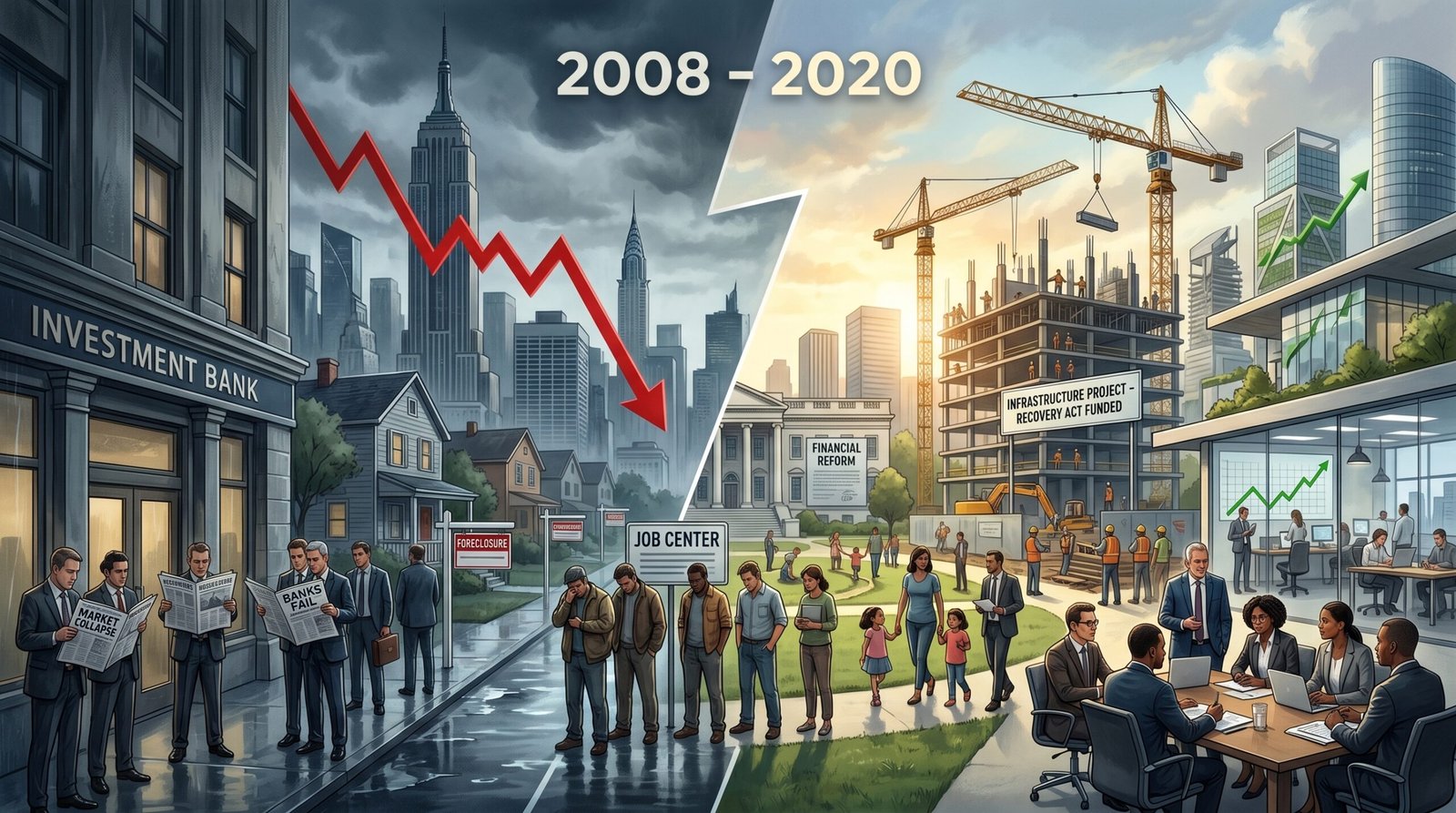
An image showcasing the financial crisis of 2008 and the Era of Recovery, highlighting stimulus packages, government bailouts, and regulatory reforms between 2008 CE and 2020 CE.
Period: 2008 CE – 2020 CE
Economic Globalization Roots: What Lessons Did the U.S. Learn from the Great Recession?
The Great Recession of 2008, rooted in the interconnectedness of the global financial system, exposed critical vulnerabilities and highlighted the far-reaching implications of economic globalization. This pivotal moment in the historical eras of economy emphasized the importance of robust financial regulation and proactive government intervention.
In response, the United States introduced substantial stimulus packages and implemented financial reforms aimed at stabilizing markets and restoring public confidence. These measures underscored the necessity of fostering economic resilience while adopting a more inclusive and equitable approach to growth, ensuring the lessons of this crisis shape future global economic policies.
Economy Type
Mixed Economy with Stronger Regulation: A blend of market principles and increased government oversight emerged to prevent future economic crises and ensure stability.
Key Developments
Stimulus Packages: Programs such as the American Recovery and Reinvestment Act injected funds into the economy to create jobs and restore growth.
Financial Reforms: Policies like the Dodd-Frank Act were introduced to increase accountability in financial institutions and reduce systemic risks.
Focus on Inclusive Growth: Efforts were made to address income inequality and provide opportunities for marginalized communities.
Significance
The Great Recession emphasized the need for economic resilience, revealing the risks of inadequate oversight in financial markets. It led to a rethinking of economic priorities, including greater attention to long-term stability and the social impacts of economic policies.
The Recession’s Impact on U.S. Society
As a defining moment in the historical eras of economy, the recession significantly influenced U.S. society, bringing wealth disparities and economic inequality into sharp focus. Government intervention played a crucial role in stabilizing financial markets, but it also sparked renewed debates on income inequality and the urgency of structural reforms. Initiatives targeting job creation and community support offered relief to many, while highlighting the challenges of achieving a comprehensive and inclusive economic recovery.
12. The Digital and Green Economy (Present and Future).
An image highlighting the Digital and Green Economy of the 2020s, emphasizing artificial intelligence, renewable energy, and climate-conscious policies shaping future industries.Period: 2020s CE – Present
How Are Technology and Sustainability Shaping the Future U.S. Economy?
The Digital and Green Economy represents a transformative period where technology and sustainability are reshaping industries and societal priorities. Innovations such as artificial intelligence (AI), renewable energy, and cryptocurrencies are driving a knowledge-based economy that emphasizes digitalization and environmental consciousness. This era highlights the U.S.’s efforts to balance technological advancements with sustainable growth, focusing on climate-conscious policies and eco-friendly practices.
Economy Type
Knowledge-Based and Green Economy: The integration of advanced technologies and environmentally sustainable practices defines the current economic framework.
Key Developments
Artificial Intelligence and Digitalization: AI advancements and digital tools are revolutionizing industries, improving efficiency, and enhancing decision-making processes.
Renewable Energy and Green Technologies: Investments in solar, wind, and other sustainable energy sources are reducing carbon footprints and supporting climate goals.
Cryptocurrency and Blockchain: These innovations are redefining financial systems, promoting decentralized transactions, and enabling new economic opportunities.
Remote Work and Work Pattern Shifts: The adoption of remote and hybrid work models, accelerated by the COVID-19 pandemic, is changing the structure of workplaces.
Future Direction
The future of the U.S. economy lies in striking a balance between technological growth and environmental sustainability. Emerging policies and investments aim to align economic progress with global climate goals, ensuring long-term stability and resilience.
Significance
This era is significant for setting the groundwork for a sustainable and equitable economy. The integration of green technologies and digital tools positions the U.S. as a leader in combating climate change while fostering innovation-driven growth.
Impact on U.S. Society
In the current phase of the historical eras of economy, technology and sustainability are driving profound changes in societal norms, especially in work and consumption patterns. Remote work has redefined traditional employment structures, while climate action initiatives have heightened public awareness of environmental issues. These shifts are encouraging individuals and communities to adopt more sustainable lifestyles and support eco-friendly innovations.
Conclusion
From the subsistence economies of prehistoric times to today’s digital and green economies, each era of historical eras of economy reflects humanity’s capacity to adapt and innovate. For the United States, this evolution highlights the nation’s remarkable adaptability and innovation, solidifying its role as a global leader. Understanding these historical economic transformations provides valuable insights for navigating future challenges and opportunities. As we move forward, sustainability, equity, and technological integration will define the next phase of economic progress, both globally and for the U.S.
B:-
Historical eras of economy: Transforming Global Humanity and the Global Economy.
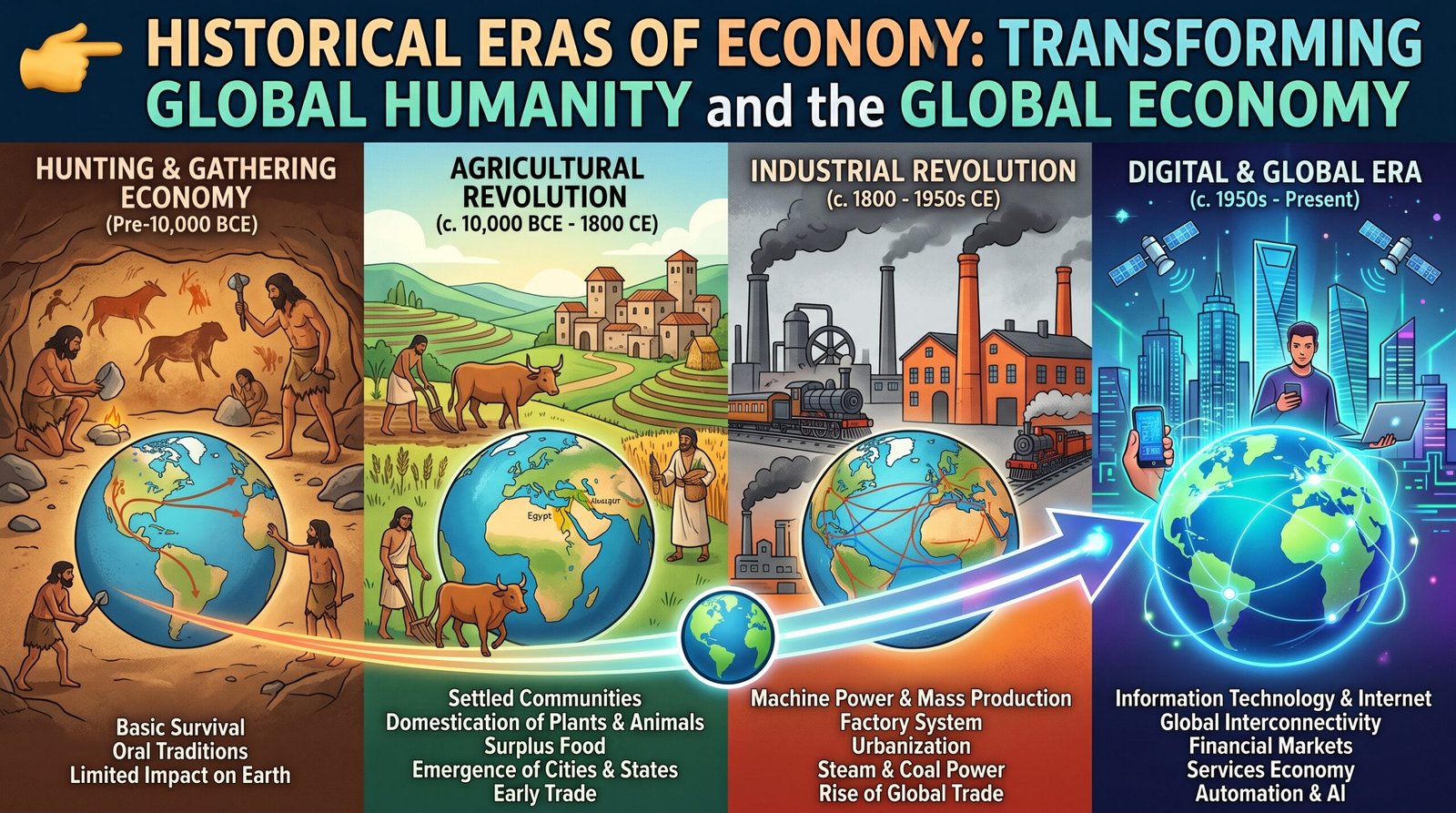
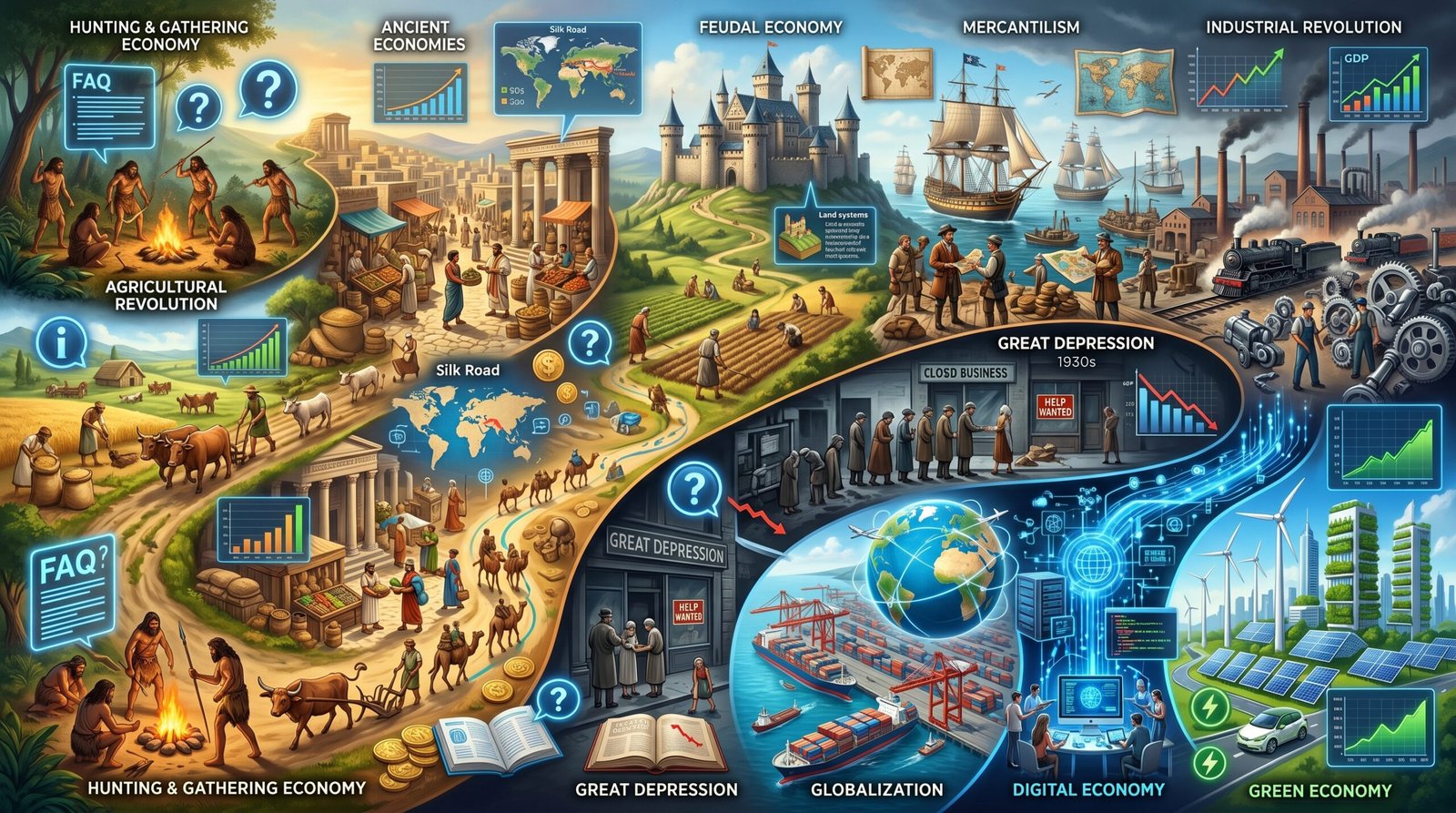
An image depicting key historical eras of the economy, highlighting the evolution of trade, technological advancements, and their transformative impact on global humanity and the global economy.The evolution of economic systems has not only reshaped global economies but also profoundly influenced humanity. Each era brought transformative advancements that altered social structures, lifestyles, and global interactions. By examining these transitions, we gain valuable insights into the interconnectedness of global humanity and the international economy.
1. The Agricultural Revolution: The Birth of Societal Growth.
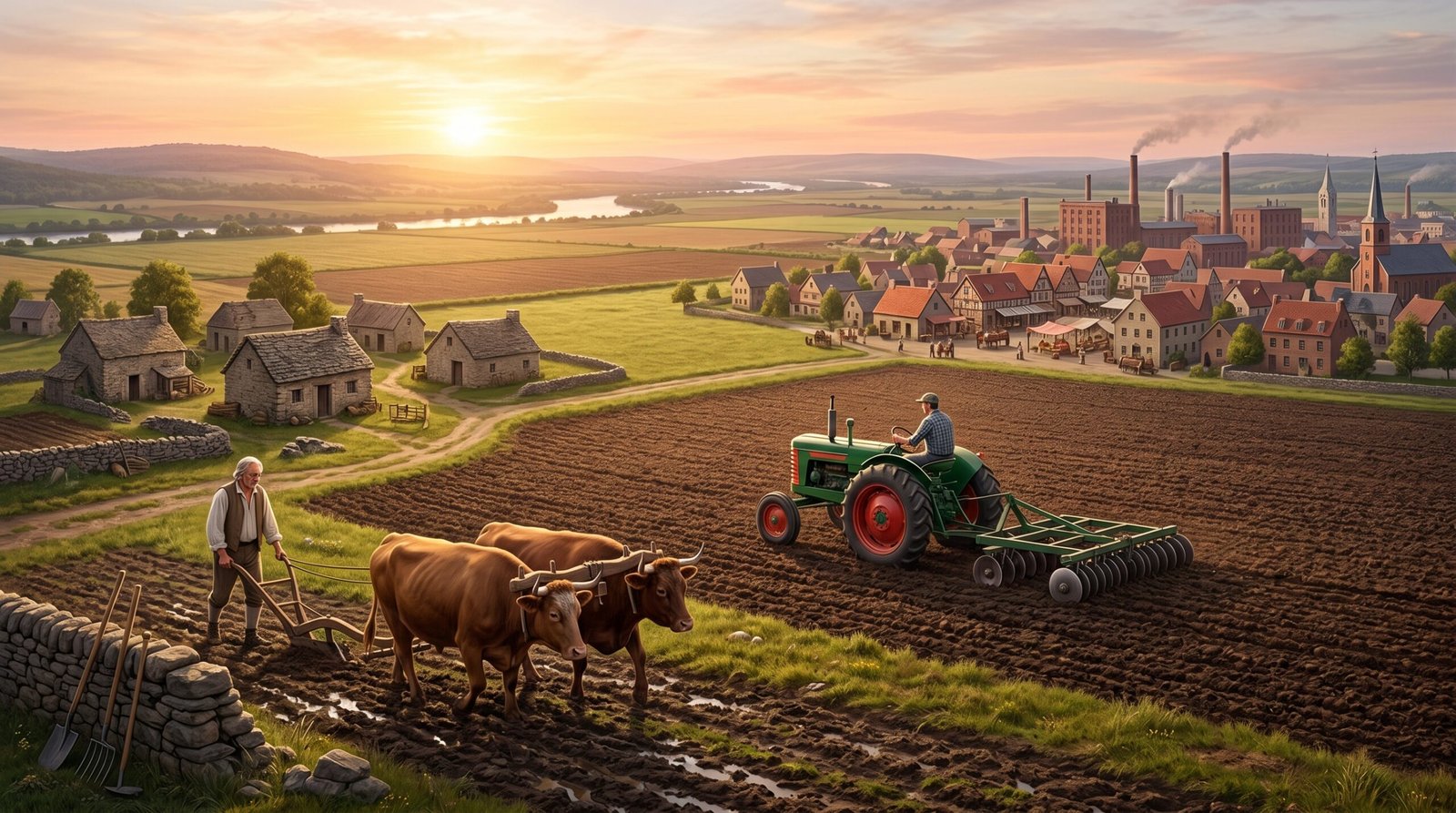
An image showcasing the Agricultural Revolution’s impact on societal growth through innovations in farming, surplus production, and the formation of early trade networks.
The Agricultural Revolution marked humanity’s first major economic transformation. By domesticating plants and animals, early societies transitioned from nomadic hunting and gathering to settled farming communities. This surplus production enabled population growth, specialization of labor, and the rise of trade networks. Regions like Mesopotamia and the Nile Valley became early economic powerhouses, establishing the backbone of future economies.
Effect on Humanity:
Enabled population booms and the formation of cities.
Allowed for complex societies and early economic systems.
Impact on the Global Economy:
Introduced trade networks that connected regions.
Laid the foundation for modern agricultural economies.
2. The Industrial Revolution: Mechanization and Globalization.
An image showcasing the Industrial Revolution’s transformative impact, with mechanized production, factory systems, and globalization driving economic and societal change.The Industrial Revolution was a transformative era that revolutionized production, enabling mass manufacturing and global trade. Mechanized systems like the steam engine and factory production led to urbanization and unprecedented economic growth. However, it also brought challenges, including inequality and environmental degradation.
Effect on Humanity:
Revolutionized work with factory systems and created vast wealth disparities.
Fostered technological innovations that reshaped daily life.
Impact on the Global Economy:
Boosted international trade through advancements in transportation.
Set the stage for industrial economies worldwide, with Britain and the U.S. leading the charge.
3. The Digital Economy: Shaping a Connected World.
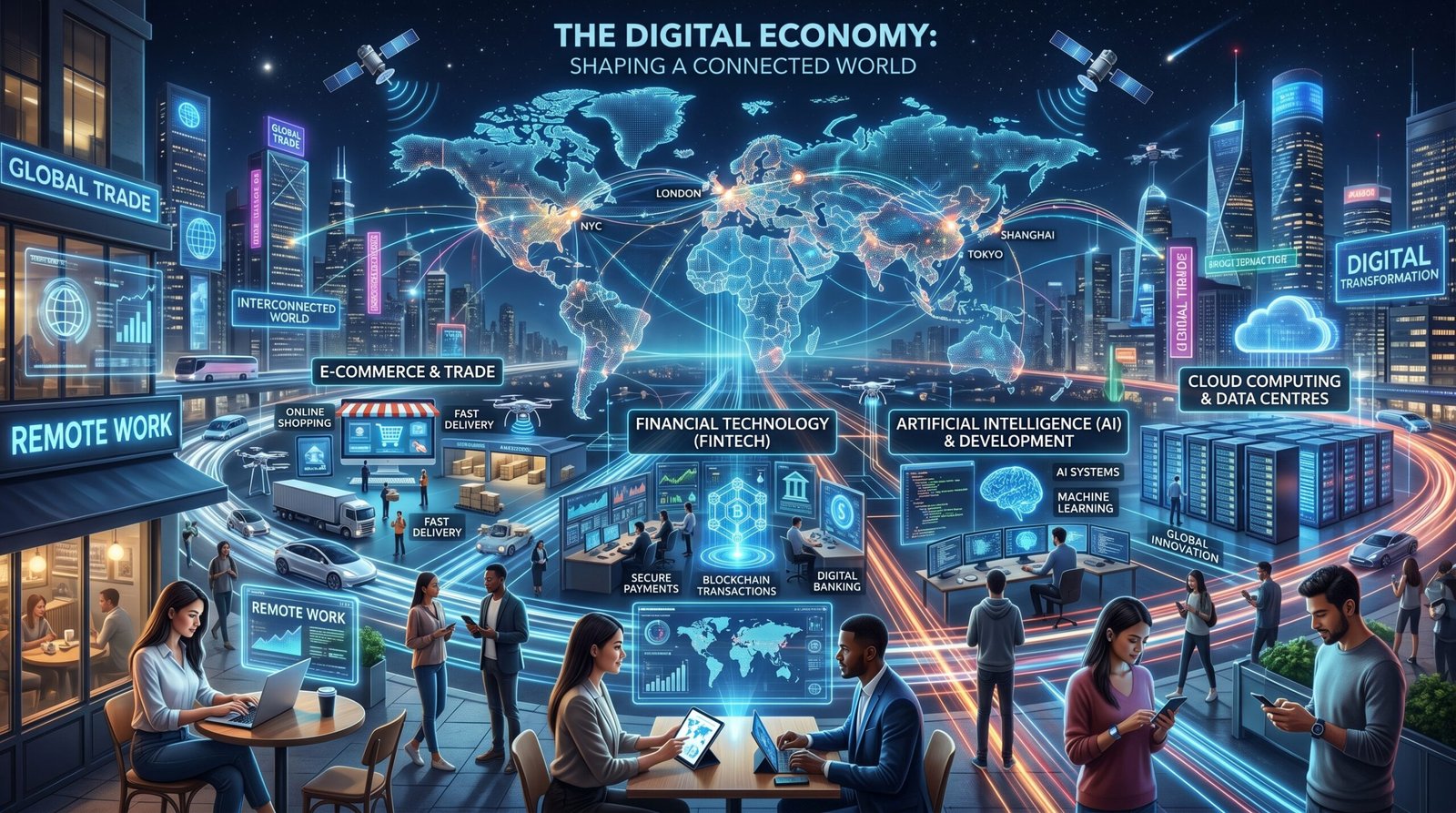
An image representing the Digital Economy’s impact, focusing on online marketplaces, AI advancements, and the globalization of knowledge-based economies.The Digital Economy is the latest major shift, driven by technological innovation. Tools like the internet, artificial intelligence, and e-commerce platforms have eliminated geographical barriers and fostered globalization. While offering opportunities for economic growth and connectivity, it has also highlighted disparities in technological access.
Effect on Humanity:
Increased connectivity and economic opportunities.
Exacerbated disparities between regions with and without access to technology.
Impact on the Global Economy:
Enabled the creation of global marketplaces, boosting trade and innovation.
Catalyzed the rise of knowledge-based economies and digital currencies.
Global Perspective
From the subsistence economies of the Agricultural Revolution to the knowledge-driven Digital Economy, these eras illustrate humanity’s adaptability and resilience. Each period introduced challenges like inequality and environmental concerns but also unlocked opportunities for innovation and global collaboration.
U.S. Perspective
The United States has played a pivotal role in these economic transformations:
Agricultural Revolution: The U.S.’s fertile lands later mirrored the early innovations of Mesopotamia, becoming a global leader in food production.
Industrial Revolution: American cities like Pittsburgh and Chicago became industrial hubs, driving economic growth and technological advancements.
Digital Economy: Silicon Valley now leads the world in technological innovation, shaping the global marketplace and setting trends in artificial intelligence and e-commerce.
FAQ: Understanding the Evolution Of Historical Eras Of Economy
An image representing FAQs on historical economic eras, covering topics like the U.S. economy, Industrial Revolution, Agricultural Revolution, and global trade systems
1. What were the key features of the Hunting and Gathering Economy?
The Hunting and Gathering Economy relied on subsistence practices like hunting, fishing, and gathering wild plants. Communities were small and nomadic, operating on shared resources without formal trade or currency. This system ensured sustainability and equitable distribution of necessities, a model echoed in early Native American societies.
2. How did the Agricultural Revolution impact global economies?
The Agricultural Revolution introduced farming and domestication of animals, leading to food surpluses, early trade systems, and permanent settlements. Regions like Mesopotamia and the U.S. Midwest later adapted similar agricultural innovations, becoming hubs for global food production.
3. How did the Industrial Revolution transform the U.S. economy?
The Industrial Revolution marked the U.S.’s transition from an agrarian to an industrial economy. Innovations like the cotton gin, steam engines, and factory systems drove mass production, urbanization, and expanded global trade networks, laying the foundation for modern economic systems.
4. What role did mercantilism play in shaping colonial economies in America?
Mercantilism, the dominant economic theory during the Early Modern Era, emphasized state control over trade. American colonies like New England thrived on maritime trade, but mercantilist policies, such as taxation and trade restrictions, sparked tensions that fueled the American independence movement.
5. How did the Great Depression reshape economic policies?
The Great Depression of the 1930s led to significant economic reforms. Programs like the New Deal introduced Keynesian economics, emphasizing government intervention to stabilize markets and promote recovery through infrastructure projects and financial regulations.
6. What factors drove the U.S. post-World War II economic boom?
The Post-World War II Economic Boom, often called the Golden Age of Capitalism, was driven by the GI Bill, technological innovations, and suburban expansion. This era saw the rise of the middle class, economic stability, and the creation of global financial systems like the IMF.
7. How did globalization transform the U.S. economy?
The rise of globalization during the late 20th century expanded international trade, reduced barriers, and introduced free trade agreements like NAFTA. While multinational corporations flourished, outsourcing and job migration impacted manufacturing sectors in the U.S.
8. What challenges did the U.S. face during the Great Recession?
The Great Recession of 2008, triggered by the housing market collapse, highlighted economic vulnerabilities. Recovery efforts, including stimulus packages, government bailouts, and financial reforms, helped stabilize the economy and reshape regulatory policies.
9. How is the Digital Economy shaping global trade?
The Digital Economy fosters global trade by leveraging technologies like e-commerce, artificial intelligence, and blockchain. The U.S., led by hubs like Silicon Valley, plays a pivotal role in advancing digital transformation and knowledge-based economies.
10. What role does sustainability play in the modern U.S. economy?
The Digital and Green Economy emphasizes balancing technological growth with sustainability. Innovations in renewable energy, AI, and climate-conscious policies are shaping the U.S. economy’s future, aligning with global goals for sustainable development.
11. How did early trade routes shape global economies?
Ancient trade routes like the Silk Road connected diverse regions, fostering the exchange of goods, cultures, and ideas. These routes laid the foundation for modern global trade systems and contributed to the economic development of civilizations like Mesopotamia and Rome.
12. What industries defined the U.S. during the Gilded Age?
The Gilded Age saw the rise of industries like steel, oil, and electricity, driven by technological innovation and industrial tycoons like Rockefeller and Carnegie. This period marked the growth of corporate monopolies and significant economic inequality.
13. How did the Agricultural Revolution influence early societies?
The Agricultural Revolution enabled the establishment of permanent settlements, food surpluses, and trade systems. It also led to the creation of social hierarchies and the specialization of labor, which became the foundation of complex societies.
14. What role did Keynesian economics play in modern recovery policies?
Keynesian economics, introduced during the Great Depression, emphasized government intervention to stimulate demand and stabilize markets. These principles continue to influence modern recovery policies, such as those implemented during the 2008 financial crisis.
15. How does technology shape the modern global economy?
Technological innovations like AI, blockchain, and e-commerce drive the Digital Economy, enabling global connectivity and knowledge-based growth. The U.S., as a leader in technological advancements, shapes global economic trends through innovation.
16. What are the environmental challenges of industrialization?
While industrialization accelerated economic growth, it also caused environmental degradation through resource exploitation and pollution. Modern economies address these challenges by incorporating green technologies and adopting climate-conscious policies.
17. How has the U.S. contributed to global trade systems?
The U.S. has played a pivotal role in shaping global trade systems through innovations during the Industrial Revolution, leadership in free trade agreements like NAFTA, and advancements in the Digital Economy.
18. Why is the Green Economy essential for future growth?
The Green Economy emphasizes sustainable growth by focusing on renewable energy, eco-friendly practices, and climate-conscious policies. This approach ensures long-term economic resilience while addressing global environmental challenges.
19. What were the main drivers of economic change during the Agricultural Revolution?
The Agricultural Revolution was driven by the domestication of plants and animals, which enabled the shift from nomadic lifestyles to settled farming communities. This transformation led to surplus food production, the rise of trade, and the development of early economic systems. Globally, regions like Mesopotamia became economic hubs, while the U.S.’s fertile lands later mirrored this agricultural significance.
20. How did the Industrial Revolution affect global trade?
The Industrial Revolution revolutionized production with mechanized systems and innovations like the steam engine. These advancements enabled faster, more efficient global trade networks. In the U.S., cities like Pittsburgh and Chicago became industrial powerhouses, contributing to worldwide economic integration.
21. What role did the U.S. play in the development of the digital economy?
The digital economy emerged as a global phenomenon, with the U.S. leading through technological innovation. Silicon Valley became a hub for digital transformation, fostering advancements in artificial intelligence, e-commerce, and cryptocurrencies. This era connected global markets and highlighted technological disparities.
22. How has globalization impacted economic disparities?
Globalization has fostered interconnected markets and expanded trade opportunities. However, it has also widened the gap between developed and developing nations. In the U.S., globalization contributed to the decline of manufacturing jobs, while boosting sectors like technology and finance.
23. How does the current green economy address global challenges?
The green economy focuses on sustainability and combating climate change through renewable energy and eco-friendly technologies. Globally, countries are adopting green initiatives, with the U.S. investing heavily in solar and wind energy to lead this transformation.
24. Why is understanding economic history important for modern societies?
Studying economic history reveals patterns of innovation, resilience, and adaptation. It helps nations, including the U.S., learn from past economic systems—like the Industrial Revolution or the Great Depression—to shape future policies that promote sustainable and inclusive growth.