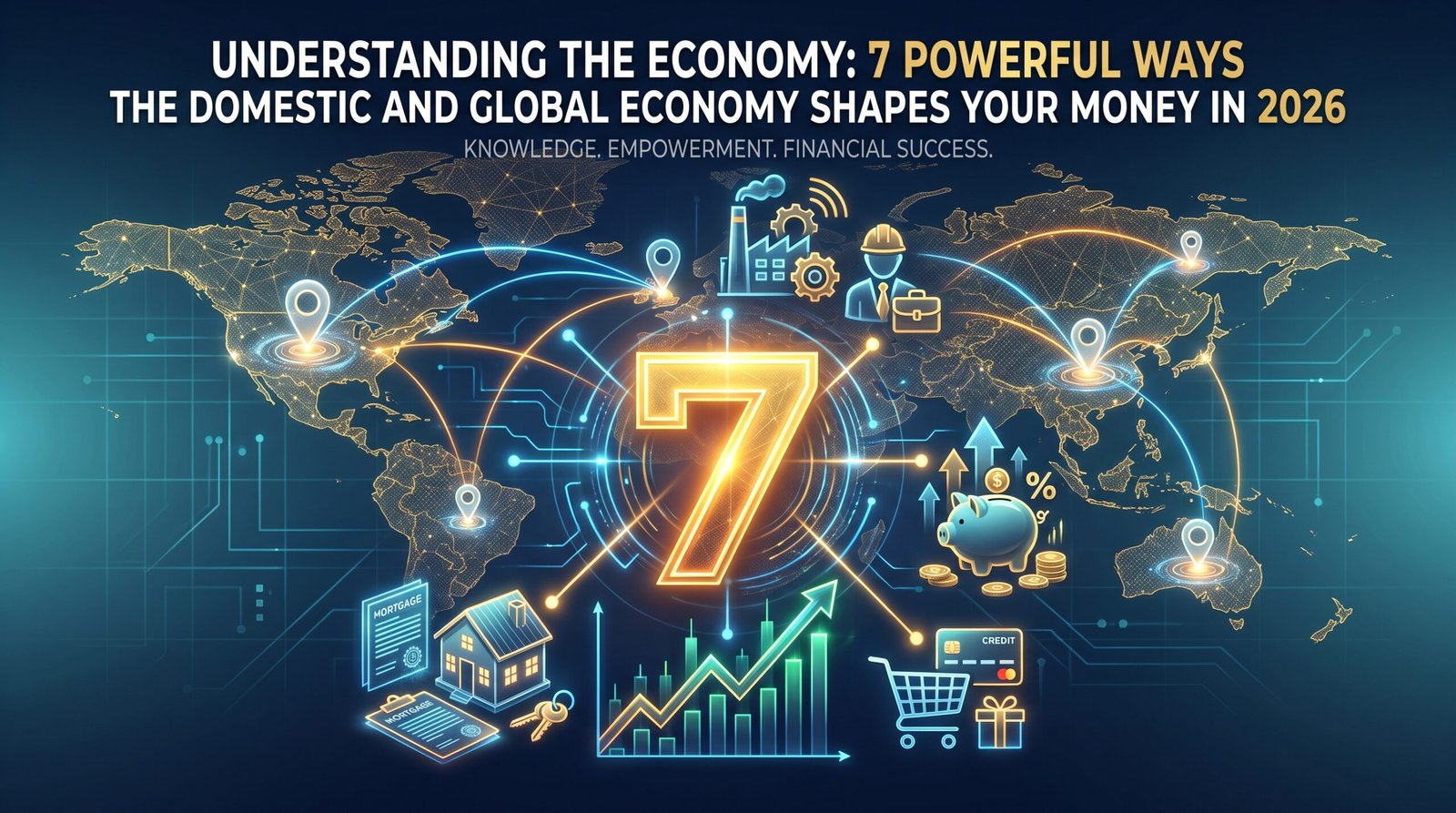
Understanding the Economy: 7 Powerful Ways the Domestic and Global Economy Shapes Your Money in 2026

Fabrics of Economy – The Interconnected Threads That Weave the Domestic and Global Economy 🧵🌍🔗

Metaphorical Framework for Understanding How Economic Systems Work Together

Threads. Weave. Connect. 🧶

When understanding the economy, it helps to think of it not as a collection of isolated parts, but as a woven fabric—where each thread represents a different system, sector, or process, and together they form a cohesive, functioning whole. Just as a garment is strong and flexible because countless threads are woven together, an economy is resilient and dynamic because its various components are interconnected.

Whether you are in the United States 🇺🇸, United Kingdom 🇬🇧, Europe 🇪🇺, Asia 🌏, Australia 🇦🇺, or anywhere else globally 🌐, these ten metaphorical threads—production, labor, finance, trade, governance, innovation, consumer behavior, natural resources, social infrastructure, and income distribution—work together to create the domestic and global economy.

This Segment provides a conceptual, big-picture overview. For detailed measurement of each thread (data, formulas, percentages, historical trends), please see Segment: Metrics of Economy.

👉 Affiliate CCTA: Visualize the economy as a whole. [Get economic visualization and data tools here] 📊

The “Fabrics of Economy” Metaphor Explained

What Does the Metaphor Mean?

The term “fabrics of economy” is a powerful metaphor that represents the interconnected systems, processes, and structures that make up the economic landscape of a society. Just as fabric is woven from various threads to form a cohesive material, an economy is woven from different sectors, policies, institutions, and interactions to create a functioning whole.

Simple Definition: The economy is like a tapestry—each thread is important, and they all work together. 🪢

Why the Metaphor Works

Fabric ElementEconomic EquivalentWhy It Matters
Warp threads (vertical)Core economic structures (production, labor, finance)The foundation that holds everything together
Weft threads (horizontal)Flows of goods, services, and moneyConnect different parts of the economy
Weave patternEconomic policies and institutionsDetermine how threads interact
TensionSupply and demand forcesKeep the fabric taut and functional
Fraying edgesMarket failures or economic distressSignal where the fabric is weakening
PatchingGovernment intervention or policy changesRepair damaged areas

Examples:

📍 Domestic Economy Example: In the United States, the 2008 financial crisis caused one thread (financial systems) to fray. The government (governance thread) stepped in with bailouts and stimulus (patching), and the economy (the fabric) eventually healed.

📍 Global Example: In Europe (Germany, France, UK) , the COVID-19 pandemic stressed multiple threads simultaneously: production (factories closed), labor (unemployment rose), trade (supply chains disrupted), and consumer behavior (spending crashed). Coordinated policy responses (fiscal stimulus, monetary easing) helped repair the fabric.

👉 Affiliate CCTA: Understand how economic threads interact. [Get economic analysis and policy tracking tools here] 🔍

The Ten Threads of the Economic Fabric (Conceptual Overview)

Thread #1: Production and Industry 🏭

AspectDescription
What It Is (Conceptual)The core capacity of an economy to create goods and services. Industries—agricultural, manufacturing, and service-based—form the backbone of economic activity.
Key ConceptsSupply chains, productivity, labor, capital, technology, innovation.
Why It’s a ThreadWithout production, there would be nothing to consume, trade, or distribute. It is the foundation thread.
How It InteractsProduction feeds into trade (exports), labor (jobs), and consumption (goods available).
For Detailed Measurement👉 See Section 3.2 (GDP), Section 3.3 (Growth Indicators), Section 3.12 (Labor Productivity)

📍 Conceptual Example: A factory produces cars (production). This creates jobs (labor thread), generates revenue for trade (trade thread), and provides goods for consumers (consumer behavior thread).

Thread #2: Labor Market 👥

AspectDescription
What It Is (Conceptual)The workforce (employed, unemployed, and underemployed) and the dynamics between employers and workers. It includes wages, working conditions, and policies affecting labor mobility.
Key ConceptsUnemployment, wage rates, education, skill levels, labor mobility.
Why It’s a ThreadWorkers are the engine of the economy. Without labor, production stops, and consumption falters.
How It InteractsLabor feeds into production (workers create goods), consumption (workers spend wages), and income distribution (wages determine living standards).
For Detailed Measurement👉 See Section 3.4 (Unemployment Rate), Section 3.12 (Labor Productivity)

📍 Conceptual Example: When the labor market is strong (low unemployment, rising wages), workers spend more, driving consumption and growth. When it is weak, the entire economy suffers.

Thread #3: Financial Systems 🏦

AspectDescription
What It Is (Conceptual)The institutions that manage the flow of capital—banks, stock markets, insurance companies, and central banks. They facilitate investments and loans, ensure liquidity, and enable businesses to grow and individuals to save.
Key ConceptsInterest rates, credit, investments, financial regulation, banking.
Why It’s a ThreadFinance is the circulatory system of the economy. It moves money from savers to borrowers, funds investment, and enables transactions.
How It InteractsFinance enables production (loans for factories), consumption (credit cards, mortgages), and investment (stock markets).
For Detailed Measurement👉 See Section 3.6 (Interest Rates), Section 3.9 (Public Debt), Section 3.13 (Foreign Direct Investment)

📍 Conceptual Example: A business borrows from a bank (financial system) to build a factory (production). The factory hires workers (labor), who deposit wages in banks (financial system), which then lend to other businesses—a continuous cycle.

Thread #4: Trade and Globalization 📦

AspectDescription
What It Is (Conceptual)The exchange of goods, services, and capital across borders (domestic and international). Globalization has intensified this connection, making economies interdependent on imports, exports, and foreign direct investment.
Key ConceptsFree trade, tariffs, international trade agreements, globalization, supply chains.
Why It’s a ThreadNo economy is an island. Trade connects economies, allowing specialization and efficiency.
How It InteractsTrade connects production (exports), consumption (imports), and finance (capital flows).
For Detailed Measurement👉 See Section 3.7 (Balance of Trade), Section 3.8 (Exchange Rates)

📍 Conceptual Example: A German automaker exports cars to the US (trade). The revenue flows back to Germany (finance). American consumers get vehicles (consumption). Both economies benefit—but trade tensions can fray this thread.

Thread #5: Governance and Institutions 🏛️

AspectDescription
What It Is (Conceptual)The regulatory framework that guides how economies function. This includes fiscal policies (taxation and spending), monetary policies (control of the money supply), and laws governing trade, labor, and industry.
Key ConceptsGovernment regulation, fiscal policy, monetary policy, central banks, taxation.
Why It’s a ThreadRules prevent chaos. Governance provides stability, enforces contracts, and corrects market failures.
How It InteractsGovernance shapes all other threads: labor laws (labor), financial regulation (finance), trade policy (trade), environmental rules (natural resources).
For Detailed Measurement👉 See Section 3.14 (Budget Deficit/Surplus), Section 3.11 (Income Inequality) for policy impacts

📍 Conceptual Example: When a central bank raises interest rates (governance thread), borrowing becomes more expensive (financial thread), slowing spending (consumer behavior thread) and reducing inflation.

Thread #6: Innovation and Technology 💡

AspectDescription
What It Is (Conceptual)Technology acts as both a fabric and a driver of change. Technological innovation enhances productivity, creates new industries, and disrupts existing markets.
Key ConceptsDigital economy, automation, artificial intelligence, innovation ecosystems, research & development (R&D).
Why It’s a ThreadInnovation is the engine of long-term growth. It raises productivity, creates new jobs, and makes old ones obsolete.
How It InteractsInnovation transforms production (automation), labor (new skills), and consumer behavior (e-commerce, streaming).
For Detailed Measurement👉 See Section 3.12 (Labor Productivity), Section 3.16 (Stock Market Performance for tech stocks)

📍 Conceptual Example: The internet (innovation thread) created e-commerce (trade thread), disrupted retail jobs (labor thread), and changed how consumers shop (consumer behavior thread).

Thread #7: Consumer Behavior 🛒

AspectDescription
What It Is (Conceptual)The spending patterns and preferences of consumers shape demand in an economy. Businesses respond to consumer needs, and the flow of money from consumers to businesses drives much of the economic activity.
Key ConceptsConsumption, demand, savings, consumer confidence.
Why It’s a ThreadConsumer spending drives 60-70% of GDP in most developed economies. What consumers do determines whether the economy grows or contracts.
How It InteractsConsumer spending drives production (factories produce what consumers buy), labor (hiring responds to demand), and trade (imports satisfy consumer preferences).
For Detailed Measurement👉 See Section 3.17 (Savings Rate), Section 3.2 (Consumption component of GDP)

📍 Conceptual Example: When consumer confidence is high, people spend more. This increases production, which requires more labor, which puts more money in workers’ pockets, which leads to more spending—a virtuous cycle.

Thread #8: Natural Resources and Environment 🌿

AspectDescription
What It Is (Conceptual)Natural resources (renewable and non-renewable) form an essential component of many economies. How these resources are managed, extracted, and utilized has a direct impact on economic growth and environmental sustainability.
Key ConceptsResource extraction, environmental regulation, sustainability, green economy, renewable vs. non-renewable.
Why It’s a ThreadEverything ultimately comes from nature. Resources fuel production; the environment sustains life.
How It InteractsResources feed into production (raw materials), trade (commodity exports), and governance (environmental policy).
For Detailed Measurement👉 See Section 3.5 (Inflation, especially energy prices), Section 3.7 (Trade Balance for commodities)

📍 Conceptual Example: Oil (natural resource) is extracted, refined into gasoline, and sold to consumers. High oil prices affect inflation (price thread), trade balances (oil-exporting vs. importing countries), and consumer behavior (less driving).

Thread #9: Social Infrastructure 🏥

AspectDescription
What It Is (Conceptual)Education, healthcare, housing, and transportation are crucial societal elements that enable an economy to function efficiently. The quality of social infrastructure determines the productivity and well-being of the workforce.
Key ConceptsPublic services, human capital development, social welfare, infrastructure.
Why It’s a ThreadHealthy, educated, well-housed workers are more productive. Infrastructure connects markets.
How It InteractsSocial infrastructure supports labor (healthy, educated workers), production (transportation moves goods), and governance (public services).
For Detailed Measurement👉 See Section 3.15 (Human Development Index), Section 3.10 (Poverty Rate)

📍 Conceptual Example: A country with excellent public education (social infrastructure) produces skilled workers (labor thread), who innovate (innovation thread), driving productivity (production thread) and growth.

Thread #10: Income Distribution and Inequality ⚖️

AspectDescription
What It Is (Conceptual)How wealth and income are distributed across different sections of society. Economic inequality can influence social stability, political decisions, and overall economic growth.
Key ConceptsIncome inequality, wealth distribution, poverty, social mobility.
Why It’s a ThreadHow the pie is shared affects social cohesion, political stability, and even growth itself.
How It InteractsInequality affects consumer behavior (poor spend more of their income; rich save more), governance (policy responds to inequality), and social infrastructure (unequal access to education, healthcare).
For Detailed Measurement👉 See Section 3.10 (Poverty Rate), Section 3.11 (Gini Coefficient / Income Inequality)

📍 Conceptual Example: When income inequality is high, the rich save (reducing consumption), while the poor struggle to afford basics. This can reduce aggregate demand, slow growth, and fuel political instability.

👉 Affiliate CCTA: Explore how these threads affect your finances. [Get personal finance and economic analysis tools here] 📊

How the Ten Threads Interact (The Dynamic Fabric):

The Interconnected Web

ThreadConnects ToHow They Interact
ProductionLabor, Finance, Trade, Natural Resources, InnovationProduction requires workers (labor), capital (finance), raw materials (resources), and technology (innovation), and produces goods for trade.
Labor MarketProduction, Consumer Behavior, Income Distribution, Social InfrastructureWorkers produce goods (production), earn wages (income distribution), spend (consumer behavior), and benefit from education/healthcare (social infrastructure).
Financial SystemsProduction, Trade, Governance, InnovationFinance funds production, enables trade, is regulated by governance, and finances innovation.
Trade & GlobalizationProduction, Consumer Behavior, Financial Systems, Exchange RatesTrade moves goods (production), satisfies consumers (behavior), involves currency (exchange rates), and requires financing.
GovernanceAll threadsLaws, regulations, taxes, and spending shape every other thread.
InnovationProduction, Labor, Consumer BehaviorTechnology changes how we produce, what skills workers need, and how consumers behave.
Consumer BehaviorProduction, Labor, TradeConsumer demand drives production, which drives labor demand, which drives imports (trade).
Natural ResourcesProduction, Trade, EnvironmentResources fuel production, are traded globally, and affect the environment.
Social InfrastructureLabor, Income Distribution, GovernanceEducation/healthcare improve labor productivity, reduce inequality, and are provided by governance.
Income DistributionConsumer Behavior, Governance, Social InfrastructureHow income is shared affects spending (behavior), policy (governance), and access to services (infrastructure).

The Ripple Effect: When One Thread Frays

DisruptionAffected ThreadsRipple Effect
Financial crisis (2008)Financial Systems, Labor, Consumer Behavior, Trade, GovernanceBanks fail → credit freezes → businesses close → unemployment rises → spending crashes → trade collapses → governments bail out banks.
Pandemic (2020)Labor, Production, Trade, Consumer Behavior, GovernanceLockdowns → factories close → supply chains break → unemployment spikes → spending shifts → governments stimulate.
War (Ukraine 2022)Natural Resources, Trade, Inflation, Governance, Consumer BehaviorEnergy prices spike → inflation rises → trade routes disrupted → sanctions imposed → consumers cut spending.

Examples:

📍 Domestic Economy Example: In the United States, the 2008 financial crisis started with one thread (financial systems: subprime mortgages). It quickly spread to labor (unemployment rose to 10%), consumer behavior (spending crashed), and governance (TARP bailouts, stimulus). The fabric frayed, but policy responses helped repair it.

📍 Global Example: The COVID-19 pandemic frayed multiple threads simultaneously across the global economy. Production (factories closed in China), labor (unemployment spiked worldwide), trade (supply chains snapped), and consumer behavior (spending shifted from services to goods). The fabric stretched but did not tear, thanks to coordinated fiscal and monetary policy.

👉 Affiliate CCTA: Understand how global events affect the economic fabric. [Get global economic news and analysis tools here] 🌍

📊 Segment Summary: Fabrics of Economy (Metaphorical Framework)


Thread #Thread NameConceptual FocusFor Detailed Measurement
1Production and IndustryCreating goods and servicessegment 3.2 (GDP), 3.3 (Growth), 3.12 (Productivity)
2Labor MarketWorkforce, wages, employmentsegment 3.4 (Unemployment), 3.12 (Productivity)
3Financial SystemsBanks, markets, capital flowsegment 3.6 (Interest Rates), 3.9 (Debt), 3.13 (FDI)
4Trade and GlobalizationCross-border exchangesegment 3.7 (Trade Balance), 3.8 (Exchange Rates)
5Governance and InstitutionsRules, policies, regulationsegment 3.14 (Budget), 3.11 (Inequality impacts)
6Innovation and TechnologyNew ideas, productivity driverssegment 3.12 (Productivity), 3.16 (Stock Market)
7Consumer BehaviorSpending, saving, confidencesegment 3.17 (Savings Rate), 3.2 (Consumption)
8Natural ResourcesRaw materials, environmentsegment 3.5 (Inflation), 3.7 (Trade)
9Social InfrastructureEducation, healthcare, housingsegment 3.15 (HDI), 3.10 (Poverty)
10Income DistributionHow wealth is sharedsegment 3.10 (Poverty), 3.11 (Gini Coefficient)

🌟 Final Thoughts on the Fabrics of Economy

Understanding the economy means seeing the whole fabric, not just individual threads. The domestic and global economy is a complex, adaptive system where production, labor, finance, trade, governance, technology, consumer behavior, natural resources, social infrastructure, and income distribution all interact.

Do ThisDon’t Do This
✅ Recognize that all ten threads are interconnected (a change in one affects others).❌ Assume that the economy is just one thread (e.g., just the stock market).
✅ Use the metaphor to understand how crises spread (ripple effects).❌ Forget that different countries have different thread strengths (some have stronger labor, others stronger natural resources).
✅ Appreciate that a healthy economy requires all threads to be strong and balanced.❌ Ignore the role of governance (the thread that shapes all others).
✅ Refer to Section 3 for detailed measurement of each thread.❌ Expect conceptual threads to provide data (they provide the big picture, not the numbers).

The “fabrics of economy” metaphor is not just a poetic device—it is a powerful way to visualize how economies work. When all threads are woven together tightly and balanced, the result is a strong, resilient, prosperous economy. When threads fray or break, the entire fabric is at risk.

For detailed measurement of each thread (data, formulas, percentages, historical trends), please see segment 3: Metrics of Economy.

👉 Affiliate CCTA: Master the entire economic fabric. [Get comprehensive economics courses, data tools, and analysis resources here] 🚀
Introduction to Economy – What Is an Economy? 🌍📦💰

Understanding the System That Governs Production, Distribution, and Consumption

Produce. Distribute. Consume. 🔄

When understanding the economy, you must start with the most fundamental question: What exactly is an economy? Whether you are in the United States 🇺🇸, United Kingdom 🇬🇧, Europe 🇪🇺, Asia 🌏, Australia 🇦🇺, or anywhere else globally 🌐, the economy is the system that shapes every aspect of your financial life—from the price of groceries to the availability of jobs, from your mortgage rate to your retirement security.

In this comprehensive section, we focus exclusively on the economy as a system—not to be confused with economics (the study), which is covered in Section 8. Here, we explore:

  • What is an economy? (Simple definition)
  • The core problem: Scarcity (Why economies exist)
  • Levels of the economy (Local, national, global)
  • Key characteristics (Production, distribution, consumption)
  • Why the economy matters (For individuals, businesses, and governments)

👉 Affiliate CCTA: Understand the economy to manage your finances better. [Get personal finance and budgeting tools here] 📊

What Is an Economy? (Simple Definition)

The Core Definition

An economy is the system through which a society produces, distributes, and consumes goods and services. It is the real-world machinery that turns raw materials into products, moves those products to people who need them, and enables individuals, businesses, and governments to obtain what they require to live, work, and thrive.

Simple Definition: The economy is the system that answers: What gets made? How does it reach you? Who gets it? 🏭

The Economy in Everyday Life

Everyday ActivityEconomic Function
You buy groceriesConsumption – You are using goods.
A factory assembles carsProduction – Goods are being created.
A truck delivers packagesDistribution – Goods are moving to consumers.
You deposit money in a bankFinancial system – Money is being managed.
The government builds a roadPublic investment – Infrastructure is being created.


Examples:

📍 Domestic Economy Example: In the United States, the economy produces over $25 trillion worth of goods and services annually. This includes everything from iPhones assembled in China (imports count in consumption) to corn grown in Iowa to software written in Silicon Valley.

📍 Global Example: In Germany, the economy is driven by manufacturing exports (cars, machinery, chemicals). In India, the economy has a large agricultural sector plus a booming technology services sector. In Japan, the economy faces challenges from an aging population (shrinking workforce) but maintains high productivity through automation.

👉 Affiliate CCTA: Learn how the economy affects your wallet. [Get economic data and analysis tools here] 📈

The Core Problem: Scarcity (Why Economies Exist)

What Is Scarcity?

Scarcity is the fundamental economic problem: human wants and needs are unlimited, but the resources available to satisfy those wants and needs are limited. Because of scarcity, every society—rich or poor—must make choices about how to allocate its resources.

Simple Definition: You can’t have everything you want because there isn’t enough of everything to go around. 😔

ResourceDefinitionExamplesWhy It’s Scarce
LandNatural resources used in productionOil, coal, timber, water, minerals, agricultural land, fishing groundsFinite; cannot be created
LaborHuman effort (physical and mental)Factory workers, software engineers, doctors, teachers, artistsLimited supply; requires time and training
CapitalMan-made goods used to produce other goodsFactories, computers, trucks, robots, software, office buildingsRequires investment to create; depreciates over time
EntrepreneurshipThe ability to organize resources, take risks, and innovateSteve Jobs, Elon Musk, Sara BlakelyRare talent; cannot be mass-produced

The Three Fundamental Economic Questions

Because of scarcity, every economy must answer three questions:

QuestionWhat It MeansHow Different Economies Answer
What to produce?Which goods and services get produced, and in what quantities?Market economies: consumers vote with wallets. Command economies: government planners decide.
How to produce?What methods, technology, and combination of resources to use?Market economies: firms choose least-cost methods. Command economies: government dictates methods.
For whom to produce?Who gets the finished goods and services?Market economies: those with purchasing power. Command economies: government allocation.

Examples:

📍Domestic Economy Example: In the United States, scarcity means the government cannot simultaneously fund every desired program. If Congress spends more on defense, it has less for education, healthcare, or infrastructure. If you buy a new car, you cannot also take an expensive vacation with the same money.

📍 Global Example: In Europe (Germany, France, UK) , scarcity forces trade-offs in government budgets. During the energy crisis (2022-2024), European governments had to choose between subsidizing energy bills (protecting households) and investing in renewable energy (long-term solution). They chose both, but at the cost of higher debt.

👉 Affiliate CCTA: Make better choices by understanding scarcity. [Get decision-making and resource management tools here] 🎯

The Three Pillars of Any Economy

Every economy, regardless of size or system, is built on three fundamental activities.

Pillar #1: Production 🏭

AspectDescription
DefinitionThe process of creating goods and services using resources (land, labor, capital, entrepreneurship).
ExamplesA factory assembling cars; a farm growing wheat; a doctor providing healthcare; a software company writing code.
Why It MattersWithout production, there would be nothing to consume. Production creates jobs, generates income, and determines a country’s productive capacity.

Pillar #2: Distribution 🚚

AspectDescription
DefinitionThe process of moving produced goods and services from producers to consumers (supply chains, logistics, retail).
ExamplesShipping containers bringing iPhones from China to the US; trucks delivering groceries to supermarkets; pipelines moving natural gas; broadband delivering streaming video.
Why It MattersEven the best-produced goods are worthless if they cannot reach consumers. Efficient distribution lowers prices and increases availability.

Pillar #3: Consumption 🛒

AspectDescription
DefinitionThe final use of goods and services by individuals, businesses, and governments.
ExamplesYou buying groceries; a company purchasing computers; the military buying fighter jets; the government buying office supplies.
Why It MattersConsumption drives demand, which drives production. Consumer spending accounts for 60-70% of GDP in most developed economies.


The Economic Cycle (How the Three Pillars Interact)

┌─────────────────────────────────────────────────────────────────────────────┐
│ THE ECONOMIC CYCLE │
│ │
│ ┌─────────────────────────────────────────────────────────────────────┐ │
│ │ │ │
│ │ PRODUCTION ──────────────────────────────────────────────────┐ │ │
│ │ (Firms create goods/services) │ │ │
│ │ │ │ │ │
│ │ │ (Goods produced) │ │ │
│ │ ▼ │ │ │
│ │ DISTRIBUTION │ │ │
│ │ (Supply chains, logistics, retail) │ │ │
│ │ │ │ │ │
│ │ │ (Goods delivered) │ │ │
│ │ ▼ │ │ │
│ │ CONSUMPTION ────────────────────────────────────────────────┘ │ │
│ │ (Households, businesses, governments buy and use) │ │
│ │ │ │ │
│ │ │ (Spending creates revenue) │ │
│ │ ▼ │ │
│ │ PRODUCTION (Again) ─── (Firms hire, invest, produce more) │ │
│ │ │ │
│ └─────────────────────────────────────────────────────────────────────┘ │
│ │
└─────────────────────────────────────────────────────────────────────────────┘

Examples:

📍Domestic Economy Example: In the United States, a typical economic cycle: A factory produces cars (production). Trucks deliver them to dealerships (distribution). You buy a car (consumption). The dealership pays the factory, which pays workers, who spend their wages on other goods—and the cycle continues.

📍 Global Example: In Europe (Germany, France, UK) , the cycle is similar but with more international trade. A German factory produces cars (production). Ships transport them to China (international distribution). Chinese consumers buy the cars (consumption). German workers are paid, and they spend on French wine, Italian vacations, and Spanish produce.

👉 Affiliate CCTA: Track economic cycles to time your purchases. [Get price tracking and economic calendar tools here] 📅

Levels of the Economy

The economy exists at multiple levels, from your neighborhood to the entire world.

Level #1: Local Economy 🏘️

AspectDescription
DefinitionEconomic activity within a small geographic area (city, town, neighborhood).
ExamplesYour local grocery store, the coffee shop on the corner, the plumber who fixes your sink, the school where your children learn.
Why It MattersLocal economies provide jobs, services, and community. They are affected by national policies but also have unique characteristics.

Level #2: National Economy 🇺🇸

AspectDescription
DefinitionEconomic activity within a country’s borders, governed by national policies and institutions.
ExamplesThe US economy, the German economy, the Japanese economy, the Indian economy.
Why It MattersNational governments control fiscal policy (taxes, spending) and influence monetary policy (through central banks). Most economic data (GDP, inflation, unemployment) is reported at the national level.

Level #3: Global Economy 🌐

AspectDescription
DefinitionEconomic activity that crosses international borders—trade, investment, capital flows, migration.
ExamplesAn iPhone designed in California, chips from Taiwan, screen from South Korea, assembled in China, sold worldwide.
Why It MattersNo economy is an island. A recession in the US affects Europe and Asia. A war in Ukraine raises energy prices globally. A pandemic anywhere disrupts supply chains everywhere.

How the Levels Interact

EventLocal ImpactNational ImpactGlobal Impact
Factory closes in DetroitJob losses in Detroit; local businesses sufferAuto sector decline; trade deficit with Japan/Germany changesGlobal auto supply chains adjust
Federal Reserve raises ratesMortgage payments rise for local homeownersNational borrowing costs increase; housing market coolsGlobal capital flows shift toward US (higher rates attract investment)
China locks down a port cityLocal shortages of electronics, clothing, auto partsUS trade deficit with China falls temporarily; inflation risesGlobal shipping rates spike; supply chains reroute

Examples:

📍Domestic Economy Example: In the United States, a local bakery (local economy) buys flour from a national distributor (national economy) that imports wheat from Canada (global economy). If the Canadian wheat harvest fails (global shock), the national distributor raises prices (national response), and the local bakery either raises bread prices or reduces profits (local impact).

📍 Global Example: In Europe (Germany, France, UK) , the global economy is highly integrated. A German auto parts supplier sells to a French car factory (EU single market), which exports finished cars to China (global trade). A slowdown in China (global) reduces German exports (national), which affects local employment in Bavarian towns (local).

👉 Affiliate CCTA: Understand all levels of the economy. [Get economic data and analysis tools for local, national, and global markets here] 🌍

Key Characteristics of an Economy

Characteristic #1: Production

AspectDescription
DefinitionCreation of goods and services using natural and human-made resources.
SectorsPrimary (agriculture, mining, fishing), Secondary (manufacturing, construction), Tertiary (services, retail, healthcare), Quaternary (technology, R&D, information).
Measured ByGDP (Gross Domestic Product), industrial production index, manufacturing PMI.

Characteristic #2: Distribution

AspectDescription
DefinitionAllocation and delivery of produced goods to consumers or markets.
ChannelsSupply chains, logistics networks, retail stores, e-commerce platforms, wholesale markets.
Measured ByRetail sales, inventory levels, logistics performance index, shipping rates.

Characteristic #3: Consumption

AspectDescription
DefinitionUtilization of goods and services by individuals or entities.
TypesPrivate consumption (households), public consumption (government), intermediate consumption (businesses using inputs).
Measured ByPersonal consumption expenditures (PCE), retail sales, consumer confidence index.

Characteristic #4: Exchange and Trade

AspectDescription
DefinitionDomestic and international transactions (buying and selling).
FormsBarter (direct exchange), monetary exchange (using money), domestic trade (within a country), international trade (across borders).
Measured ByTrade balance (exports minus imports), retail sales, wholesale trade.

Characteristic #5: Government Policies

AspectDescription
DefinitionTaxation, regulations, spending, and economic incentives that shape economic activity.
ExamplesIncome tax, corporate tax, sales tax, tariffs, subsidies, minimum wage, environmental regulations, antitrust laws.
Measured ByBudget deficit/surplus, government spending as % of GDP, tax revenue as % of GDP.

Examples:

📍 Domestic Economy Example: In the United States, the economy is characterized by high consumption (households spend 60-70% of GDP), advanced distribution networks (Amazon, FedEx, UPS, Walmart), and significant government intervention (Social Security, Medicare, defense, infrastructure, regulation).

📍 Global Example: In China, the economy is characterized by high production (manufacturing dominates), state-controlled distribution (government influences logistics and retail), and rising consumption (growing middle class). Government policies (five-year plans, industrial policy) play a larger role than in the US.

👉 Affiliate CCTA: Track economic characteristics. [Get economic indicator tracking tools here] 📊

Why the Economy Matters

For Individuals

ReasonExplanation
Jobs and incomeThe economy determines whether jobs are available and how much they pay.
Prices and purchasing powerInflation affects what you can buy with your paycheck.
Savings and investmentsInterest rates, stock market, and real estate values depend on economic conditions.
Financial securityA strong economy provides opportunities; a weak economy creates stress and hardship.

For Businesses

ReasonExplanation
Demand for productsEconomic growth means more customers with more money to spend.
Cost of borrowingInterest rates affect loans for expansion, equipment, and inventory.
Wages and hiringLabor market conditions determine whether workers are available and at what cost.
ProfitabilityEconomic conditions affect revenues, costs, and ultimately profits.

For Governments

ReasonExplanation
Tax revenueEconomic growth increases tax revenue (more workers, higher profits, more spending).
Spending demandsRecessions increase demand for unemployment benefits, food assistance, and other safety net programs.
Debt sustainabilityEconomic growth makes debt more manageable (debt-to-GDP ratio falls as GDP rises).
Political stabilityEconomic distress (high unemployment, high inflation, falling living standards) leads to political unrest.

Examples:

📍Domestic Economy Example: In the United States, when the economy is strong (low unemployment, moderate inflation, GDP growth), individuals find jobs easily, businesses expand, and government tax revenues rise. When the economy is weak (recession), individuals face layoffs, businesses cut back, and government deficits rise.

📍 Global Example: In Europe (Germany, France, UK) , the economy affects everything from whether a Spanish college graduate can find a job (youth unemployment in Spain has exceeded 30% in some years) to whether a German automaker can sell cars globally to whether the Greek government can afford to pay pensions.

👉 Affiliate CCTA: Protect yourself from economic downturns. [Get emergency fund, budgeting, and career planning tools here] 🛡️

Segment Summary: Introduction to Economy (What Is an Economy?)

Sub-SegmentKey Takeaway
2.1 What Is an Economy?The system that produces, distributes, and consumes goods and services.
2.2 ScarcityThe fundamental problem: unlimited wants, limited resources. Forces choice and trade-offs.
2.3 Three PillarsProduction (creating goods), Distribution (moving goods), Consumption (using goods).
2.4 Levels of the EconomyLocal (neighborhood), National (country), Global (world). All are interconnected.
2.5 Key CharacteristicsProduction, distribution, consumption, exchange/trade, government policies.
2.6 Why It MattersAffects jobs, prices, savings, business profitability, government revenue, and political stability.

🌟 Final Thoughts on What Is an Economy?

Understanding the economy starts with understanding what an economy actually is—a system that turns resources into goods and services, moves them to people who need them, and enables consumption that drives further production.

Do ThisDon’t Do This
✅ Recognize that the economy is a real system (not a theory or abstraction).❌ Confuse the economy (the system) with economics (the study of the system).
✅ Understand that scarcity forces trade-offs (you cannot have everything).❌ Forget that the economy operates at multiple levels (local, national, global).
✅ Appreciate how production, distribution, and consumption interact.❌ Ignore the role of government policies in shaping economic outcomes.
✅ Use economic knowledge to make better financial decisions (budgeting, saving, investing, career).❌ Assume that the economy is too complex to understand (it’s not—scarcity + production + distribution + consumption is the core).

The economy is not a mysterious force controlled by unseen hands. It is the sum of billions of daily decisions made by people like you. By understanding what the economy is—its components, levels, and characteristics—you take the first step toward mastering your financial future.

In segment 8 (Economics vs. Economy), we will explore how the study of economics differs from the economy itself. In Section 14 (Expanded FAQs), we will answer common questions about the economy in a quick-reference format.

👉 Affiliate CCTA: Start your journey to financial mastery. [Get comprehensive financial education and economic analysis tools here] 🚀

❓ Frequently Asked Questions (FAQs) – What Is an Economy? 🤔

Q1. What is the simplest definition of an economy?

An economy is the system through which a society produces, distributes, and consumes goods and services.

Scarcity means resources are limited while wants are unlimited. It matters because it forces every society to make choices about what to produce, how to produce it, and who gets it.

Production (creating goods), Distribution (moving goods to consumers), and Consumption (using goods).

Local economy = your neighborhood, city, or town. National economy = economic activity within a country’s borders. Global economy = economic activity that crosses international borders (trade, investment, capital flows). All are interconnected.

The economy determines job availability, wages, prices (inflation), interest rates (mortgages, loans, savings), and investment returns (stocks, bonds, real estate).

The most common measures are GDP (total output), inflation (price changes), unemployment rate (job market health), and interest rates (cost of borrowing). See segment 3 for detailed metrics.

No. The stock market is a small part of the economy (corporate equity value). The economy includes all production, distribution, and consumption—most of which is not publicly traded (housing, healthcare, education, government services, etc.).

👉 Affiliate CCTA: Get answers to all your economy questions. [Explore our comprehensive economics FAQ and learning resources here] 📚

Read More

Affiliate Disclosure: This is a referral link. I may earn a small commission at no cost to you 👇🌺

🛠️ Try the Logo Maker 👇🥂

Try Hostinger Now — Plans Starting at $2.99 / month!

Affiliate Disclosure: This is a referral link. I may earn a small commission at no cost to you 👇🌺

Try Hostinger Now — Plans Starting at $2.99 / month!

Affiliate Disclosure: This is a referral link. I may earn a small commission at no cost to you 👇 🌺

Affiliate Disclosure: This is a referral link. I may earn a small commission at no cost to you 👇🌺

🛠️ Try the Logo Maker 👇🥂

Never Crash. Always ScaleOrder Now

Affiliate Disclosure: This is a referral link. I may earn a small commission at no cost to you 👇🌺

Start with Hostinger today in 2026 — your all-in-one smart website Hosting for Smart Seasons.

Affiliate Disclosure: This is a referral link. I may earn a small commission at no cost to you 👇 🌺

Hostinger 2026 — Fast. Global. Reliable. Starts Here

Read More

Affiliate Disclosure: This is a referral link. I may earn a small commission at no cost to you 👇🌺

🛠️ Try the Logo Maker 👇🥂

Try Hostinger Now — Plans Starting at $2.99 / month!

Affiliate Disclosure: This is a referral link. I may earn a small commission at no cost to you 👇🌺

Try Hostinger Now — Plans Starting at $2.99 / month!

Affiliate Disclosure: This is a referral link. I may earn a small commission at no cost to you 👇 🌺

Affiliate Disclosure: This is a referral link. I may earn a small commission at no cost to you 👇🌺

🛠️ Try the Logo Maker 👇🥂

Affiliate Disclosure: This is a referral link. I may earn a small commission at no cost to you 👇🌺

🛠️ Try the Logo Maker 👇🥂

Never Crash. Always ScaleOrder Now

Affiliate Disclosure: This is a referral link. I may earn a small commission at no cost to you 👇🌺

Start with Hostinger today in 2026 — your all-in-one smart website Hosting for Smart Seasons.

Affiliate Disclosure: This is a referral link. I may earn a small commission at no cost to you 👇 🌺

Hostinger 2026 — Fast. Global. Reliable. Starts Here