
Resource and Economy Tools Posts Menu
Understanding the Economy: 7 Powerful Ways the Domestic and Global Economy Shapes Your Money in 2026
yelli
June 3, 2026
4:24 am
Balance of Trade – Exports vs. Imports 📦🌍📊
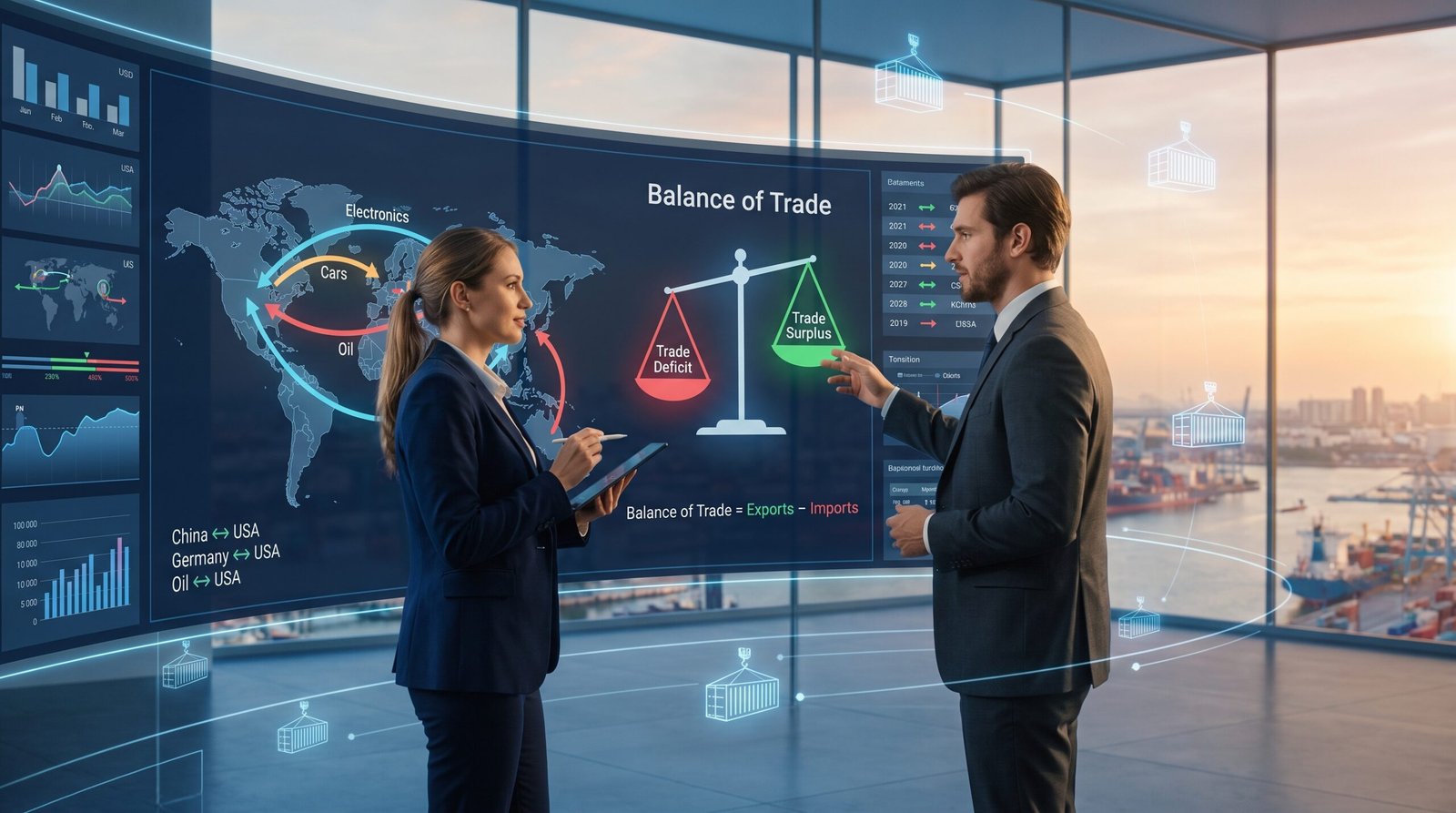
How Trade Flows Shape the Domestic and Global Economy
Export. Import. Balance. ⚖️
When understanding the economy, the balance of trade reveals whether a country sells more to the world than it buys—or vice versa. Whether you are in the United States 🇺🇸, United Kingdom 🇬🇧, Europe 🇪🇺, Asia 🌏, Australia 🇦🇺, or anywhere else globally 🌐, trade balances affect your job security (export industries vs. import-competing industries), the prices you pay for goods, and even the value of your currency.
In this Segment, we dive deep into the balance of trade—what it measures, trade surpluses vs. deficits, what the numbers mean for the domestic and global economy, and why they matter for your money.
👉 Understand global trade flows. [Get real-time trade data and analysis tools here] 📊
What Is the Balance of Trade? (Definition)
The Simple Definition
The balance of trade measures the difference between a country’s exports (goods and services sold to other countries) and its imports (goods and services bought from other countries) over a specific period (usually monthly, quarterly, or annually).
Simple Definition: Does the country sell more to the world than it buys? 📦
The Basic Formula
Balance of Trade = Total Exports – Total Imports
Trade Surplus vs. Trade Deficit
| Condition | Definition | Formula Result | Common Phrase |
|---|---|---|---|
| Trade Surplus | Exports > Imports (positive balance) | Positive number (+) | “Favorable” balance of trade |
| Trade Deficit | Imports > Exports (negative balance) | Negative number (-) | “Unfavorable” balance of trade |
| Trade Balance | Exports = Imports (zero balance) | Zero (0) | Balanced trade |
Goods vs. Services (Important Distinction)
| Type | Definition | Examples | Typical Pattern |
|---|---|---|---|
| Goods (Merchandise) | Physical, tangible products | Cars, electronics, clothing, machinery, oil, food | Many developed countries run deficits (manufacturing moved overseas). |
| Services (Intangible) | Non-physical products | Tourism, banking, insurance, consulting, software, royalties | Many developed countries run surpluses (export expertise). |
Examples:
📍 Domestic Economy Example: The United States typically runs a large trade deficit in goods (importing far more cars, electronics, clothing, and oil than it exports) but a trade surplus in services (exporting financial services, software, entertainment, and tourism). The overall balance of trade (goods + services) is usually negative (deficit).
📍 Global Example: Germany runs a large trade surplus—exporting far more cars, machinery, and chemicals than it imports. This surplus reflects Germany’s manufacturing strength and has made it a target of criticism from the US and other trading partners.
👉 Track trade balances by country. [Discover international trade data platforms here] 🌍
How the Balance of Trade Is Calculated
Components of Trade
| Component | Definition | Examples |
|---|---|---|
| Exports (X) | Goods and services produced domestically and sold to foreign buyers. | US selling Boeing aircraft to Europe; Germany selling BMWs to China; Australia selling iron ore to Japan. |
| Imports (M) | Goods and services produced abroad and purchased by domestic buyers. | US buying iPhones from China; UK buying wine from France; Japan buying oil from Saudi Arabia. |
| Net Exports (X – M) | Exports minus imports (contributes to GDP). | Positive = adds to GDP; negative = subtracts from GDP. |
The Balance of Trade Formula in GDP
Recall from GDP (Section 3.3) that:
GDP = C + I + G + (X – M)
Where (X – M) is Net Exports (balance of trade).
| If Net Exports Is… | Then… | Effect on GDP |
|---|---|---|
| Positive (Surplus) | Country exports more than it imports. | Adds to GDP (increases economic growth). |
| Negative (Deficit) | Country imports more than it exports. | Subtracts from GDP (reduces economic growth). |
Example Calculation
| Scenario | Exports (X) | Imports (M) | Net Exports (X – M) | Trade Status |
|---|---|---|---|---|
| Country A | $500 billion | $400 billion | +$100 billion | Trade Surplus |
| Country B | $400 billion | $500 billion | -$100 billion | Trade Deficit |
| Country C | $450 billion | $450 billion | $0 | Balanced Trade |
Examples:
📍 Domestic Economy Example: In the United States, if exports are $2.5 trillion and imports are $3.5 trillion, net exports are -$1.0 trillion (trade deficit). This subtracts 1 trillion dollars from US GDP, meaning that without the trade deficit, US GDP would be $1 trillion higher.
📍 Global Example: China runs a large trade surplus (exports > imports). This surplus adds to China’s GDP and has helped fuel its rapid economic growth over the past three decades.
👉 See how trade affects GDP. [Get economic data and GDP tracking tools here] 📈
Trade Surplus: What It Means for the Economy
Characteristics of a Trade Surplus
| Aspect | Explanation |
|---|---|
| Definition | Exports > Imports (positive net exports). |
| Common in | Manufacturing powerhouses (Germany, China, Japan, South Korea); resource-rich countries (Australia, Saudi Arabia, Russia—when energy prices high). |
| Effect on GDP | Positive contribution (adds to growth). |
| Effect on Currency | Typically strengthens currency (foreign buyers need your currency to buy your exports). |
| Effect on Jobs | Supports jobs in export industries (manufacturing, agriculture, resources). |
Advantages of a Trade Surplus
| Advantage | Explanation |
|---|---|
| GDP growth | Net exports add directly to economic output. |
| Job creation | Export industries tend to pay higher wages than import-competing industries. |
| Currency strength | Foreign demand for your currency increases its value (benefits travelers and importers). |
| Wealth accumulation | Surplus countries accumulate foreign reserves (treasury bonds, currencies, assets). |
| Bargaining power | Surplus countries have leverage in trade negotiations. |
Potential Disadvantages of a Trade Surplus
| Disadvantage | Explanation |
|---|---|
| Trade tensions | Surplus countries are often accused of unfair trade practices (currency manipulation, subsidies). |
| Over-reliance on exports | If global demand falls, surplus countries suffer disproportionately. |
| Strong currency hurts exporters | A very strong currency makes exports more expensive (can reduce surplus over time). |
| Under-consumption | Persistent surpluses can indicate that a country saves too much and consumes too little (Germany, China). |
Examples:
📍Domestic Economy Example: The United States has not run a consistent trade surplus since the 1970s. However, Germany runs persistent surpluses—exporting BMWs, Mercedes, Siemens machinery, and BASF chemicals worldwide. Germany’s surplus has made it Europe’s economic engine but also a target of criticism from the US and other EU members.
📍 Global Example: China ran massive trade surpluses for decades (exports >> imports), accumulating over $3 trillion in foreign reserves. This surplus fueled China’s rapid industrialization but also led to trade wars with the US (Trump tariffs, Biden tariffs).
👉 Invest in surplus countries. [Explore international equity and ETF platforms here] 🌏
Trade Deficit: What It Means for the Economy
Characteristics of a Trade Deficit
| Aspect | Explanation |
|---|---|
| Definition | Imports > Exports (negative net exports). |
| Common in | High-consumption, high-income countries (United States, United Kingdom); countries with strong currencies; countries that are net importers of oil/energy. |
| Effect on GDP | Negative contribution (subtracts from growth). |
| Effect on Currency | Typically weakens currency (domestic currency flows out to pay for imports). |
| Effect on Jobs | Can pressure import-competing industries (manufacturing, agriculture). |
Advantages of a Trade Deficit
| Advantage | Explanation |
|---|---|
| Higher living standards | Consumers have access to cheaper and more diverse goods from around the world. |
| Lower inflation | Imports from low-cost countries (China, Vietnam, Mexico) keep prices down. |
| Investment inflows | Deficit countries attract foreign investment to finance the deficit (buying bonds, stocks, real estate). |
| Currency benefits travelers | A weaker currency (from persistent deficits) makes the country a cheaper destination for tourists. |
| Global integration | Deficit countries are deeply integrated into global supply chains. |
Potential Disadvantages of a Trade Deficit
| Disadvantage | Explanation |
|---|---|
| Job losses in manufacturing | Import competition can destroy domestic factories and jobs (Rust Belt, deindustrialization). |
| Debt accumulation | Persistent deficits require borrowing from foreign lenders or selling assets to foreigners. |
| Currency vulnerability | Heavy reliance on foreign capital can lead to currency crises if investors lose confidence. |
| Loss of industrial base | Over time, deficit countries may lose the capability to produce certain goods (strategic vulnerability). |
| Trade tensions | Deficit countries often blame surplus countries for unfair trade practices. |
Examples:
📍Domestic Economy Example: The United States has run persistent trade deficits since the 1970s. Consumers benefit from cheap imported goods (electronics, clothing, cars), but manufacturing employment has fallen dramatically. The deficit is financed by foreign investment in US Treasury bonds (China, Japan, other countries hold trillions in US debt).
📍 Global Example: The United Kingdom also runs persistent trade deficits, particularly in goods. The UK imports far more manufactured goods than it exports, but runs a surplus in services (financial services, legal services, consulting). The deficit is financed by foreign investment in UK assets.
👉 Shop smarter with trade deficit insights. [Discover price comparison and shopping tools here] 🛍️
What Causes Trade Surpluses and Deficits?
Major Factors Influencing the Balance of Trade
| Factor | How It Affects Trade | Example |
|---|---|---|
| Exchange Rates | Strong currency → imports cheaper, exports more expensive → deficit widens (or surplus shrinks). Weak currency → opposite effect. | Strong dollar = US deficit widens; weak yen = Japan surplus widens. |
| Comparative Advantage | Countries export what they produce efficiently; import what others produce efficiently. | US exports aircraft (Boeing); imports clothing (Bangladesh, Vietnam). |
| Domestic Savings vs. Investment | Countries that save more than they invest run surpluses; countries that invest more than they save run deficits. | China (high savings) = surplus; US (low savings, high investment) = deficit. |
| Government Policies | Tariffs, subsidies, quotas, trade agreements all affect trade flows. | Trump tariffs on Chinese goods reduced US-China deficit (but shifted to other countries). |
| Natural Resources | Resource-rich countries export oil, gas, minerals, or agricultural products. | Australia (iron ore), Saudi Arabia (oil), Brazil (soybeans). |
| Stage of Development | Developing countries often import capital goods (machinery) and export labor-intensive goods. | Vietnam exports clothing, imports machinery for factories. |
The Savings-Investment Identity
A country’s trade balance is mathematically equal to the difference between its savings and investment:
Trade Balance = Savings – Investment
Examples:
📍 Domestic Economy Example: The United States has very low savings rates (households, businesses, and government all save little) and very high investment (housing, business equipment, technology). To finance this investment, the US borrows from abroad—which shows up as a trade deficit.
📍 Global Example: China has very high savings rates (households save a large share of income; the government saves through state-owned enterprises). China invests less than it saves, so it exports its excess savings—buying US Treasury bonds and running a trade surplus.
👉 Understand the savings-investment connection. [Get personal savings and investment tools here] 💰
Is a Trade Deficit Bad? Is a Trade Surplus Good?
The Truth: Neither Is Inherently Good or Bad
| Misconception | Reality |
|---|---|
| “Trade deficits destroy jobs.” | Trade deficits destroy SOME jobs (import-competing industries) but create others (distribution, retail, services). The net effect depends on the economy. |
| “Trade surpluses mean a strong economy.” | Persistent surpluses can indicate weak domestic demand (people saving too much, spending too little). Japan and Germany have strong economies but also suffer from low growth and aging populations. |
| “Deficit countries are losers.” | Deficit countries like the US enjoy higher living standards, lower prices, and access to global capital. |
| “Surplus countries are winners.” | Surplus countries like China face trade tensions, currency pressure, and over-reliance on foreign demand. |
When a Trade Deficit Is Concerning
| Red Flag | Explanation |
|---|---|
| Financed by short-term borrowing | If a deficit is financed by volatile capital flows (foreign investors can leave quickly), a crisis is possible. |
| Accompanied by deindustrialization | If a country loses its ability to produce strategic goods (defense, medicine, energy), it becomes vulnerable. |
| Caused by currency manipulation | If a deficit is due to an artificially undervalued currency (trading partner cheating), it’s unfair. |
| Persistent and growing | A small, temporary deficit is fine. A large, growing, persistent deficit may be unsustainable. |
When a Trade Surplus Is Concerning
| Red Flag | Explanation |
|---|---|
| Caused by weak domestic demand | If a surplus is due to consumers not spending (fear, poverty, lack of social safety net), it’s a problem. |
| Reliance on a single trading partner | If a surplus is concentrated with one country, that country can exert leverage. |
| Accompanied by currency manipulation | If a surplus is maintained by keeping the currency artificially low, it’s unfair trade. |
Examples:
📍 Domestic Economy Example: The United States trade deficit is concerning to some economists because it is persistent, large, and financed by foreign borrowing. Others argue it’s not a problem because the US borrows in its own currency (dollars) and enjoys higher living standards as a result.
📍 Global Example: Germany’s trade surplus is concerning to some because it reflects weak domestic consumption (Germans save too much, spend too little) and puts pressure on other eurozone countries (Greece, Italy, Spain) that run deficits and cannot devalue their currency (they use the euro).
👉 Make informed trade-related investment decisions. [Get global economic analysis tools here] 🌐
How the Balance of Trade Affects Your Money 💰
Direct Impacts on Your Wallet
| Trade Condition | Impact on You |
|---|---|
| Trade deficit (US, UK) | • Cheaper imported goods (electronics, clothing, cars) • Lower inflation • More product choices • Potential manufacturing job pressure. |
| Trade surplus (Germany, China, Japan) | • Stronger export industries (higher-paying jobs) • Currency tends to strengthen (cheaper travel abroad) • Potential trade tensions with deficit countries. |
Currency Effects
| Trade Balance Effect on Currency | Impact on You |
|---|---|
| Surplus → currency strengthens | Travel abroad cheaper; imported goods cheaper; foreign investments lose value. |
| Deficit → currency weakens | Travel abroad more expensive; imported goods cost more; foreign investments gain value. |
Stock Market Effects
| Sector | Trade Surplus Country | Trade Deficit Country |
|---|---|---|
| Exporters | Benefit (sell more abroad) | Struggle (face competition from imports) |
| Importers/Retailers | May struggle (competition from foreign goods) | Benefit (cheaper supply) |
| Banks | Benefit from currency strength | Mixed (currency weakness can cause inflation) |
| Consumers | Higher prices (if surplus leads to strong currency) | Lower prices (cheap imports) |
Examples:
📍Domestic Economy Example: In the United States (deficit country), consumers benefit from cheap imports—an iPhone costs less than if it were made in the US; clothing from Bangladesh is affordable; cars from Japan and Germany offer competition that keeps prices down.
📍 Global Example: In Germany (surplus country), workers in export industries (automotive, machinery, chemicals) earn high wages. German consumers, however, might pay slightly more for some goods due to the euro’s strength (influenced by Germany’s surplus).
👉 Invest in trade-sensitive sectors. [Discover sector-specific investment tools here] 📈
Global Trade Balances: A Snapshot
Trade Balances by Country/Region (Illustrative)
| Country/Region | Trade Balance | Primary Exports | Primary Imports |
|---|---|---|---|
| United States | DEFICIT (large) | Aircraft, machinery, agricultural products, financial services, software | Electronics (China), cars (Japan/Germany), oil (Canada/Mexico), clothing (Bangladesh/Vietnam) |
| China | SURPLUS (large) | Electronics, machinery, clothing, furniture, toys | Semiconductors, oil, soybeans, aircraft |
| Germany | SURPLUS (large) | Cars, machinery, chemicals, pharmaceuticals | Oil, gas, electronics, agricultural products |
| Japan | SURPLUS (moderate) | Cars, electronics, machinery, chemicals | Oil, gas, food, raw materials |
| United Kingdom | DEFICIT (moderate) | Financial services, pharmaceuticals, machinery, aircraft parts | Cars, electronics, clothing, food |
| Australia | SURPLUS (varies with commodity prices) | Iron ore, coal, natural gas, education services, tourism | Machinery, electronics, cars, refined oil |
| Canada | SURPLUS (often) | Oil, natural gas, timber, machinery, agricultural products | Cars (from US/Mexico), electronics, clothing |
| India | DEFICIT (persistent) | Software services, pharmaceuticals, textiles, gems/jewelry | Oil, electronics, machinery, chemicals |
The Global Imbalance: Who Lends, Who Borrows
         SURPLUS COUNTRIES (Lenders)              DEFICIT COUNTRIES (Borrowers)
         ┌─────────────────────────┐              ┌─────────────────────────┐
         │  China (largest lender) │              │  United States (largest │
         │  Germany                │              │    borrower)             │
         │  Japan                  │              │  United Kingdom          │
         │  Saudi Arabia (oil)     │   ========>  │  India                   │
         │  Russia (energy)        │   (capital   │  Brazil (often)          │
         │  South Korea            │    flows)    │                          │
         └─────────────────────────┘              └─────────────────────────┘
                    │                                         │
                    │                                         │
                    ▼                                         ▼
         Surplus countries buy assets            Deficit countries sell assets
         (Treasury bonds, stocks, real           (bonds, stocks, real estate)
         estate) in deficit countries
Examples:
📍Domestic Economy Example: The United States is the world’s largest deficit country and largest borrower. Surplus countries like China, Japan, and Germany buy US Treasury bonds to recycle their surplus dollars back into the US economy. This keeps US interest rates lower than they would otherwise be.
📍 Global Example: China is the world’s largest surplus country and largest lender. China holds over $1 trillion in US Treasury bonds, making it heavily exposed to the US economy. This interdependence creates both cooperation and tension.
👉 Diversify across surplus and deficit countries. [Explore global asset allocation tools here] 🌍
Summary: Balance of Trade
| Sub-Segment | Key Takeaway |
|---|---|
| 3.7.1 What Is the Balance of Trade? | Exports minus imports; surplus (positive) vs. deficit (negative). |
| 3.7.2 How It’s Calculated | (X – M) is net exports; contributes to GDP (positively if surplus, negatively if deficit). |
| 3.7.3 Trade Surplus | Exports > imports; adds to GDP; strengthens currency; common in manufacturing/export powerhouses. |
| 3.7.4 Trade Deficit | Imports > exports; subtracts from GDP; weakens currency; common in high-consumption countries. |
| 3.7.5 What Causes Surpluses/Deficits | Exchange rates, comparative advantage, savings vs. investment, policies, resources. |
| 3.7.6 Is Deficit Bad? Surplus Good? | Neither inherently good or bad; context matters (why it exists, how financed). |
| 3.7.7 How It Affects Your Money | Deficits: cheaper imports, lower inflation, manufacturing job pressure. Surpluses: stronger export industries, stronger currency. |
| 3.7.8 Global Trade Balances | US deficit (largest borrower); China surplus (largest lender); Germany surplus; UK deficit. |
🌟 Final Thoughts on the Balance of Trade
Understanding the economy requires mastering the balance of trade—but also moving beyond simplistic “deficits are bad, surpluses are good” thinking.
| Do This | Don’t Do This |
|---|---|
| ✅ Understand why a country runs a surplus or deficit (savings/investment, exchange rates, comparative advantage). | ❌ Assume trade deficits automatically destroy jobs (they also bring cheaper goods and higher living standards). |
| ✅ Recognize that global trade is a positive-sum game (both sides benefit from exchange). | ❌ Blame all manufacturing job losses on trade (automation and technology are bigger factors). |
| ✅ Watch for unsustainable imbalances (deficits financed by short-term borrowing; surpluses caused by currency manipulation). | ❌ Ignore the role of savings rates (low US savings → deficit; high China savings → surplus). |
| ✅ Diversify across countries with different trade profiles (surplus and deficit economies). | ❌ Believe that trade wars are easily won (tariffs often hurt the imposing country’s consumers). |
The balance of trade is not a scorecard where surpluses are wins and deficits are losses. It is a reflection of deeper economic forces—savings, investment, productivity, and comparative advantage. By understanding these forces, you can make smarter decisions about where to invest, what to buy, and how to protect your career in an interconnected domestic and global economy.
👉 Navigate global trade with confidence. [Start with comprehensive international economic analysis tools here] 🚀
❓ Frequently Asked Questions (FAQs) – Balance of Trade
Read More
Q1: Is a trade deficit always bad for a country?
No. A trade deficit can be a sign of a strong, growing economy with high consumer demand and investment opportunities. The United States has run deficits for decades while enjoying the world’s highest living standards.
Q2: Why does the US run such a large trade deficit?
The US has very low savings rates (households, businesses, government) and very high investment (housing, technology, business equipment). This savings-investment gap must be filled by foreign capital, which shows up as a trade deficit.
Q3: Which country has the largest trade surplus?
China has the largest overall trade surplus, though Germany and Japan also run large surpluses. Oil-exporting countries (Saudi Arabia, Russia, Norway) run surpluses when energy prices are high.
Q4: Which country has the largest trade deficit?
The United States has the world’s largest trade deficit by far, followed by the United Kingdom and India.
Q5: Can a trade deficit cause a currency crisis?
Yes, if the deficit is financed by short-term, volatile capital flows (foreign investors who can leave quickly). When investors lose confidence, the currency can collapse—as happened in many emerging market crises (Mexico 1994, Thailand 1997, Argentina 2001).
Q6: How do tariffs affect the balance of trade?
Tariffs (taxes on imports) make foreign goods more expensive, reducing imports and potentially shrinking the trade deficit. However, trading partners often retaliate with their own tariffs, reducing exports. The net effect on the deficit is often small, while consumers pay higher prices.
Q7: What is the current account balance?
The current account includes the balance of trade (goods and services) PLUS net income from abroad (dividends, interest) PLUS net transfers (foreign aid, remittances). The trade balance is the largest component of the current account.
👉 Protect your investments from trade-related volatility. [Get portfolio protection and hedging tools here] 🛡️
📌 Trade Deficit & Trade Surplus – Quick Reference
Concise explanation of Trade Deficit and Trade Surplus.
✅ Trade Surplus (Exports > Imports)
| Aspect | Explanation |
|---|---|
| Definition | When a country sells MORE to other countries than it buys from them. |
| Formula | Exports – Imports = POSITIVE number (+) |
| Simple Meaning | The country is a net seller to the world. |
| Also Called | “Favorable” balance of trade |
Example:
| Country | Exports | Imports | Trade Surplus |
|---|---|---|---|
| Germany | Sells €1.5 trillion worth of cars, machinery, chemicals | Buys €1.2 trillion worth of goods | +€300 billion (Surplus) |
| China | Sells $3.5 trillion in electronics, clothing, furniture | Buys $2.5 trillion in goods | +$1 trillion (Surplus) |
What a Trade Surplus Means
| Effect | Explanation |
|---|---|
| Adds to GDP | Net exports (X-M) are positive → increases economic growth |
| Strengthens currency | Foreign buyers need your currency to buy your goods |
| Creates export jobs | Manufacturing, agriculture, resource extraction jobs grow |
| Accumulates foreign reserves | Surplus countries buy assets (bonds, stocks) from deficit countries |
Examples:
📍Examples of Surplus Countries: China, Germany, Japan, South Korea, Australia (when commodity prices high), Saudi Arabia (oil exporters)
❌ Trade Deficit (Imports > Exports)
| Aspect | Explanation |
|---|---|
| Definition | When a country buys MORE from other countries than it sells to them. |
| Formula | Exports – Imports = NEGATIVE number (-) |
| Simple Meaning | The country is a net buyer from the world. |
| Also Called | “Unfavorable” balance of trade |
Example
| Country | Exports | Imports | Trade Deficit |
|---|---|---|---|
| United States | Sells $2.5 trillion in aircraft, software, services | Buys $3.5 trillion in electronics, cars, oil | -$1 trillion (Deficit) |
| United Kingdom | Sells $1 trillion in services, pharmaceuticals | Buys $1.3 trillion in goods | -$300 billion (Deficit) |
What a Trade Deficit Means
| Effect | Explanation |
|---|---|
| Subtracts from GDP | Net exports (X-M) are negative → reduces economic growth |
| Weakens currency | Domestic currency flows out to pay for imports |
| Lowers prices for consumers | Cheaper imported goods (electronics, clothing, cars) |
| Creates retail/service jobs | Distribution, logistics, retail jobs grow |
| Pressures manufacturing jobs | Import competition can hurt domestic factories |
Examples:
📍Examples of Deficit Countries: United States, United Kingdom, India, Brazil, France (often)
📊 Quick Comparison Table
| Feature | Trade Surplus (+) | Trade Deficit (-) |
|---|---|---|
| Exports vs. Imports | Exports > Imports | Imports > Exports |
| Net Exports (X-M) | Positive | Negative |
| Effect on GDP | Adds to GDP | Subtracts from GDP |
| Effect on Currency | Strengthens | Weakens |
| Effect on Prices | May increase (strong currency) | Reduces (cheap imports) |
| Consumer Impact | Fewer choices, potentially higher prices | More choices, lower prices |
| Job Impact | Export jobs grow | Import-competing jobs shrink |
| Examples | China, Germany, Japan, Saudi Arabia | USA, UK, India, Brazil |
💡The Most Important Thing to Remember
| Myth | Reality |
|---|---|
| “Surplus = good, Deficit = bad” | NOT NECESSARILY TRUE ✅ |
US has run deficits for 50+ years while having the world’s highest living standards.
Germany has a surplus but also slow growth and aging population challenges.
China has a surplus but faces trade wars and reliance on US consumers.
Context matters more than the number. A deficit financed by long-term, stable investment is fine. A surplus caused by weak domestic demand (people too poor to consume) is a problem.
👉 Understand trade balances to invest smarter. [Get global economic analysis tools here] 🌍
📑 Table of Contents
- Page 1 – Segment 1 – Fabrics of Economy – The Interconnected Threads That Weave the Domestic and Global Economy 🧵🌍🔗
- Page 2 – Segment 2 – Introduction to Economy – What Is an Economy? 🌍📦💰
- Page 3 – Segment 3 – Metrics of Economy (Economic Indicators) 📊📈💰
- Page 4 – Segment 3.3 – Deep Dive: GDP and Economic Growth Indicators
- Page 5 – Segment 3.4 – Unemployment Rate – The Job Market Thermometer 👥📊💼
- Page 6 – Segment 3.5 – Inflation Rate – The Thief of Purchasing Power 🔥💸📉
- Page 7 – Segment 3.6 – Interest Rates – The Price of Money 🏦💰📊
- Page 8 – Segment 3.7 – Balance of Trade – Exports vs. Imports 📦🌍📊 📍
- Page 9 – Segment 3.8 – Exchange Rates – The Price of Money in Global Markets 💱🌍📊
- Page 10 – Segment 3.9 – Public Debt (Government Debt) – The National Credit Card 🏦📊💰
- Page 11 – Segment 3.10 – Poverty Rate – Measuring Economic Hardship 📊💔💰
- Page 12 – Segment 3.11 – Income Inequality (Gini Coefficient) – Measuring the Wealth Gap ⚖️📊💰
- Page 13 – Segment 3.12 – Labor Productivity – The Engine of Prosperity 📈👥💰
- Page 14 – Segment 3.13 – Foreign Direct Investment (FDI) – Global Capital Flows 🌍💰🏭
- Page 15 – Segment 3.14 – Budget Deficit / Surplus – The Government's Checkbook 📋💰
- Page 16 – Segment 3.15 – Human Development Index (HDI) – Beyond GDP 📊❤️
- Page 17 – Segment 3.16 – Stock Market Performance – The Investor's Dashboard 📈📊💰
- Page 18 – Segment 3.17 – Savings Rate – The Foundation of Financial Security 🏦💰
- Page 19 – Segment 4 – Microeconomics – The Science of Individual Economic Decisions 🔬🏪📊
- Page 20 – Segment 5 – Other Branches of Economics – Specialized Fields Beyond Microeconomics 🌍📚🔬
- Page 21 – Segment 6 – Nesting Branches of Economy – The Hierarchical Structure of Economic Knowledge 🪆📚🔬
- Page 22 – Segment 7 – Products Related to the Economy – Tools for Financial Success 🛍️📊💰
- Page 23 – Segment 8 – Economics vs. Economy – The Difference Between the Study and the System 🎓🌍
- Page 24 – Segment 9 – Economic Systems & Related Concepts – How Societies Organize Resources ⚖️🌍🏛️
- Page 25 – Segment 10 – Globalization and Economic Interdependence – The Connected World 🌐🤝📦
- Page 26 – Segment 11 – Role of Fiscal and Monetary Policies – The Government's Economic Toolkit 🏛️🏦
- Page 27 – Segment 12 – Inflation and Its Impact – The Silent Thief of Purchasing Power 🔥💸
- Page 28 – Segment 13 – Introduction to Economy – Expanded SEO FAQs ❓📚🔍
- Page 29 – Segment 14 – Micro-Categories within the Economy Category – Specialized Areas for Deeper Understanding 🎯📊🔍
- Page 30 – Segment 15 – Understanding the Economy – A Practical Guide to Your Financial Life 🚀📊💰
- Page 31 – Segment 16 – The "Economics of the Economy" – Foundational Principles 📚🔑
- Page 32 – Segment 17 – Closing Thoughts – Mastering the Domestic and Global Economy 🌟🌍
- Page 33 – Segment 18 – 300 FAQS