
Resource and Economy Tools Posts Menu
Understanding the Economy: 7 Powerful Ways the Domestic and Global Economy Shapes Your Money in 2026
yelli
June 3, 2026
4:24 am
Nesting Branches of Economy – The Hierarchical Structure of Economic Knowledge 🪆📚🔬
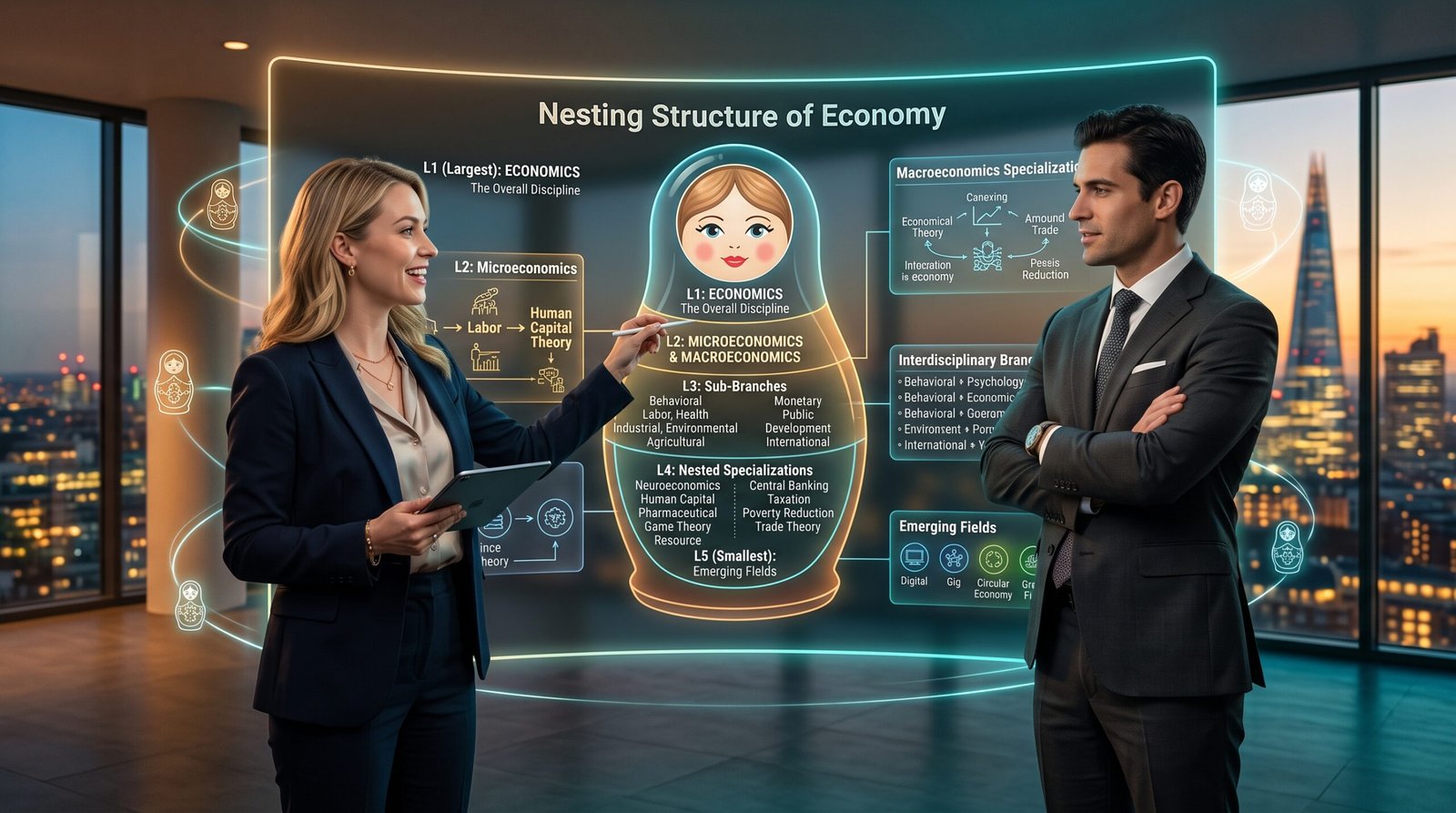
How Specialized Fields Fit Within Microeconomics and Macroeconomics
Nest. Connect. Understand. 🧩
When understanding the economy, it helps to see how different branches of economics relate to each other—like Russian nesting dolls (matryoshka), where smaller, specialized fields fit inside larger, broader ones. Whether you are in the United States 🇺🇸, United Kingdom 🇬🇧, Europe 🇪🇺, Asia 🌏, Australia 🇦🇺, or anywhere else globally 🌐, understanding this nested structure helps you see the big picture while appreciating the details.
This Segment focuses exclusively on the hierarchical/nested structure of economic branches. For a complete deep dive into microeconomics, please see Segment 4. For detailed definitions of all other branches, please see Segment 5.
👉 Master the nested structure of economics. [Get comprehensive economics learning resources here] 📚
The Hierarchical Structure of Economics (The Economic Tree)
The Core Trunks: Microeconomics and Macroeconomics
Just as a tree has a trunk that splits into major branches, economics has two core trunks:
                    ┌─────────────────────────────────────┐
                    │           ECONOMICS                 │
                    │  (The Study of Scarcity & Choice)   │
                    └──────────────┬──────────┬───────────┘
                                   │          │
                    ┌──────────────┘          └──────────────┐
                    │                                         │
            ┌───────▼───────┐                         ┌───────▼───────┐
            │  MICROECONOMICS│                         │  MACROECONOMICS│
            │ (Individual    │                         │ (Entire        │
            │  Units)        │                         │  Economy)      │
            └───────┬───────┘                         └───────┬───────┘
                    │                                         │
    ┌───────────────┼─────────────────┐           ┌───────────┼─────────────────┐
    │               │                 │           │           │                 │
┌───▼───┐     ┌─────▼─────┐     ┌─────▼─────┐   ┌─────▼─────┐   ┌───────▼───────┐
│Behav- │     │  Labor   │     │  Health  │   │ Monetary │   │   Public      │
│ioral  │     │Economics │     │Economics │   │Economics │   │  Economics    │
└───┬───┘     └─────┬─────┘     └─────┬─────┘   └─────┬─────┘   └───────┬───────┘
    │               │                 │               │                 │
┌───▼───┐     ┌─────▼─────┐     ┌─────▼─────┐   ┌─────▼─────┐   ┌───────▼───────┐
│Neuro- │     │  Human   │     │Pharma-   │   │ Central  │   │   Taxation    │
│eco-   │     │ Capital  │     │ceutical  │   │ Banking  │   │  Economics    │
│nomics │     │ Theory   │     │Economics │   │          │   │               │
└───────┘     └──────────┘     └──────────┘   └──────────┘   └───────────────┘
Why a Nested Structure Matters
| Reason | Explanation |
|---|---|
| Clarity | Shows how specialized fields relate to broader categories. |
| Education | Helps students learn economics systematically (core first, then specializations). |
| Research | Researchers know where their work fits (e.g., neuroeconomics is a subset of behavioral economics, which is a subset of microeconomics). |
| Policy | Policymakers can identify which branch (and sub-branch) is relevant to a specific problem. |
Examples:
📍Domestic Economy Example: In the United States, a policymaker designing a carbon tax draws on environmental economics (sub-branch of microeconomics). A central banker setting interest rates draws on monetary economics (sub-branch of macroeconomics).
📍 Global Example: In Europe (EU institutions) , a trade negotiator draws on international economics (sub-branch of macroeconomics). A public health official draws on health economics (sub-branch of microeconomics).
👉 Learn economics systematically. [Get structured economics courses here] 📖
Core Branches (The Trunk of the Tree)
Table: Microeconomics vs. Macroeconomics – The Two Main Trunks
| Aspect | Microeconomics 🔬 | Macroeconomics 🌍 |
|---|---|---|
| Definition | Study of individual economic units (consumers, firms, industries) | Study of the entire economy as a whole |
| Scope | Small picture (specific markets, individual decisions) | Big picture (national/global aggregates) |
| Key Questions | How does a coffee shop decide its price? Why do rents vary by neighborhood? | Is the economy growing? What causes inflation? Will there be a recession? |
| Primary Focus | Supply & demand, pricing, market structures, consumer behavior, production costs | GDP, inflation, unemployment, interest rates, fiscal/monetary policy |
| Key Players | Consumers, workers, business owners, firms, industries | Governments, central banks, international organizations (IMF, World Bank) |
| Policy Tools | Taxes on specific goods, subsidies, price controls, antitrust regulation | Interest rates, government spending, money supply, tax policy |
| Used By | Business owners, managers, investors, consumers, regulators | Policymakers, central bankers, economists, international investors |
Examples:
📍 Domestic Economy Example: In the United States, microeconomics explains why a cup of coffee costs $3 in Iowa but $7 in Manhattan (higher rent, higher wages). Macroeconomics explains why the Federal Reserve raised interest rates to fight 9% inflation.
📍 Global Example: In Europe (Germany, France) , microeconomics explains why Mercedes-Benz charges premium prices (brand value, quality perception). Macroeconomics explains why the European Central Bank (ECB) raised rates to fight eurozone inflation.
Nested Specializations in Microeconomics
Visual: How Microeconomics Branches Nest
                          ┌─────────────────────────────┐
                          │      MICROECONOMICS          │
                          │  (Individual Units)          │
                          └──────────────┬──────────────┘
                                         │
        ┌────────────────┬───────────────┼───────────────┬────────────────┐
        │                │               │               │                │
┌───────▼───────┐ ┌───────▼───────┐ ┌───────▼───────┐ ┌───────▼───────┐ ┌───────▼───────┐
│  Behavioral   │ │    Labor     │ │    Health    │ │ Industrial   │ │ Environmental│
│  Economics    │ │  Economics   │ │  Economics   │ │ Organization │ │  Economics   │
└───────┬───────┘ └───────┬───────┘ └───────┬───────┘ └───────┬───────┘ └───────┬───────┘
        │                 │                 │                 │                 │
┌───────▼───────┐ ┌───────▼───────┐ ┌───────▼───────┐ ┌───────▼───────┐ ┌───────▼───────┐
│ Neuroeco-     │ │   Human      │ │ Pharmaceutical│ │   Game       │ │   Resource   │
│ nomics        │ │   Capital    │ │   Economics   │ │   Theory     │ │   Economics  │
├───────────────┤ │   Theory     │ ├───────────────┤ ├───────────────┤ ├───────────────┤
│ Experimental  │ ├───────────────┤ │ Health        │ │ Antitrust     │ │   Climate    │
│ Economics     │ │   Wage       │ │ Insurance     │ │ Economics     │ │   Economics  │
│               │ │   Theory     │ │ Economics     │ │               │ │              │
└───────────────┘ └───────────────┘ └───────────────┘ └───────────────┘ └───────────────┘
Table: Nested Specializations Within Microeconomics
| Parent Field | Nested Specialization | Focus Area | Real-World Application |
|---|---|---|---|
| Behavioral Economics | Neuroeconomics | How brain activity influences economic decisions | Marketing strategies that trigger dopamine responses |
| Behavioral Economics | Experimental Economics | Controlled experiments to test economic theories | A/B testing pricing strategies in e-commerce |
| Labor Economics | Human Capital Theory | How education and training improve productivity | ROI calculations for college degrees vs. vocational training |
| Labor Economics | Wage Theory | How wages are determined (supply, demand, bargaining) | Minimum wage debates; gender pay gap analysis |
| Health Economics | Pharmaceutical Economics | Drug pricing, R&D incentives, accessibility | Medicare negotiating drug prices with manufacturers |
| Health Economics | Health Insurance Economics | Insurance design, risk pooling, moral hazard | Affordable Care Act (ACA) marketplace design |
| Industrial Organization | Game Theory | Strategic decision-making among competing firms | Airline pricing wars; cellular carrier plans |
| Industrial Organization | Antitrust Economics | Laws preventing monopolies and promoting competition | FTC blocking a merger between two large corporations |
| Environmental Economics | Resource Economics | Management of water, minerals, forests, fisheries | Sustainable fishing quotas in Alaska or Norway |
| Environmental Economics | Climate Economics | Economic impact of climate change; mitigation policies | Carbon tax design; cap-and-trade systems (EU ETS) |
Examples:
📍 Domestic Economy Example: In the United States, the FTC uses antitrust economics to block mergers that would reduce competition, such as the attempted Kroger-Albertsons supermarket merger.
📍 Global Example: In Europe, the EU uses climate economics to design the Emissions Trading System (ETS), which puts a price on carbon and forces polluters to pay.
👉 Invest in behavioral economics insights. [Discover consumer behavior analysis tools here] 🧠
Nested Specializations in Macroeconomics
Visual: How Macroeconomics Branches Nest
                          ┌─────────────────────────────┐
                          │      MACROECONOMICS          │
                          │   (Entire Economy)           │
                          └──────────────┬──────────────┘
                                         │
        ┌────────────────┬───────────────┼───────────────┬────────────────┐
        │                │               │               │                │
┌───────▼───────┐ ┌───────▼───────┐ ┌───────▼───────┐ ┌───────▼───────┐ ┌───────▼───────┐
│   Monetary    │ │   Public     │ │ Development  │ │International │ │    Growth    │
│   Economics   │ │  Economics   │ │  Economics   │ │  Economics   │ │   Theory     │
└───────┬───────┘ └───────┬───────┘ └───────┬───────┘ └───────┬───────┘ └───────┬───────┘
        │                 │                 │                 │                 │
┌───────▼───────┐ ┌───────▼───────┐ ┌───────▼───────┐ ┌───────▼───────┐ ┌───────▼───────┐
│   Central    │ │   Taxation    │ │   Poverty    │ │    Trade     │ │    Solow     │
│   Banking    │ │  Economics    │ │  Reduction   │ │   Theory     │ │    Model     │
├───────────────┤ ├───────────────┤ ├───────────────┤ ├───────────────┤ ├───────────────┤
│   Inflation  │ │   Welfare    │ │ Sustainable  │ │   Exchange   │ │ Endogenous   │
│   Dynamics   │ │  Economics   │ │ Development  │ │   Rate       │ │   Growth     │
│               │ │               │ │               │ │  Economics   │ │              │
└───────────────┘ └───────────────┘ └───────────────┘ └───────────────┘ └───────────────┘
Table: Nested Specializations Within Macroeconomics
| Parent Field | Nested Specialization | Focus Area | Real-World Application |
|---|---|---|---|
| Monetary Economics | Central Banking | Role of central banks in controlling money supply and interest rates | Federal Reserve rate decisions; Bank of England inflation targeting |
| Monetary Economics | Inflation Dynamics | Causes and effects of inflation; inflation expectations | Post-COVID inflation spike analysis; wage-price spiral monitoring |
| Public Economics | Taxation Economics | How taxes affect behavior, inequality, and government revenue | Income tax bracket design; corporate tax rate debates |
| Public Economics | Welfare Economics | Government programs for poverty reduction and social insurance | Social Security, unemployment benefits, food stamps (SNAP) |
| Development Economics | Poverty Reduction | Strategies to alleviate poverty (education, microfinance, infrastructure) | World Bank loans; USAID programs; microfinance in Bangladesh |
| Development Economics | Sustainable Development | Balancing economic growth with environmental and social goals | UN Sustainable Development Goals (SDGs); green infrastructure investment |
| International Economics | Trade Theory | Benefits and costs of international trade; tariffs, trade agreements | USMCA (US-Mexico-Canada Agreement); Brexit trade deals |
| International Economics | Exchange Rate Economics | How currency values are determined; impact on trade and investment | US dollar strength vs. euro; Japanese yen intervention |
Examples:
📍 Domestic Economy Example: In the United Kingdom, the Bank of England uses monetary economics and inflation dynamics to set interest rates, aiming for 2% inflation. If inflation rises above target, they raise rates.
📍 Global Example: In Asia (Japan) , the Ministry of Finance uses exchange rate economics to decide when to intervene in currency markets to prevent the yen from falling too low against the dollar.
👉 Track central bank decisions. [Get real-time economic calendar tools here] 📅
Interdisciplinary Branches (Nesting Within Larger Fields)
Visual: Interdisciplinary Overlaps
┌─────────────────────────────────────────────────────────────────────────────┐
│                    INTERDISCIPLINARY BRANCHES                               │
│                                                                             │
│   ┌─────────────────┐    ┌─────────────────┐    ┌─────────────────┐       │
│   │   Psychology    │    │  Public Health  │    │  Ecology &      │       │
│   │                 │    │                 │    │  Environmental  │       │
│   │                 │    │                 │    │  Science        │       │
│   └────────┬────────┘    └────────┬────────┘    └────────┬────────┘       │
│            │                      │                      │                 │
│            ▼                      ▼                      ▼                 │
│   ┌─────────────────┐    ┌─────────────────┐    ┌─────────────────┐       │
│   │   Behavioral    │    │     Health      │    │  Environmental  │       │
│   │   Economics     │    │   Economics     │    │   Economics     │       │
│   │  (Micro)        │    │   (Micro)       │    │  (Micro/Macro)  │       │
│   └─────────────────┘    └─────────────────┘    └─────────────────┘       │
│                                                                             │
│   ┌─────────────────┐    ┌─────────────────┐                               │
│   │  Political      │    │   Urban &       │                               │
│   │  Science        │    │   Geography     │                               │
│   │                 │    │                 │                               │
│   └────────┬────────┘    └────────┬────────┘                               │
│            │                      │                                         │
│            ▼                      ▼                                         │
│   ┌─────────────────┐    ┌─────────────────┐                               │
│   │   Political     │    │   Urban &       │                               │
│   │   Economy       │    │   Regional      │                               │
│   │  (Macro/Public) │    │   Economics    │                               │
│   │                 │    │   (Macro)      │                               │
│   └─────────────────┘    └─────────────────┘                               │
│                                                                             │
└─────────────────────────────────────────────────────────────────────────────┘
Table: Interdisciplinary Branches
| Branch | Parent Field(s) | Interdisciplinary Overlap | Real-World Application |
|---|---|---|---|
| Behavioral Economics | Microeconomics | Psychology (emotions, biases, heuristics) | “Nudge” units in government (UK Behavioural Insights Team) |
| Health Economics | Microeconomics | Public Health (healthcare systems, disease prevention) | CDC cost-effectiveness analysis for vaccination programs |
| Environmental Economics | Micro + Macro | Ecology, Environmental Science (ecosystem services, climate models) | Valuing a forest’s carbon sequestration for offset markets |
| Political Economy | Macro + Public Economics | Political Science (institutions, power, policy) | Analyzing how lobbying affects tax policy |
| Urban & Regional Economics | Macroeconomics | Urban Planning, Geography (cities, housing, transportation) | Congestion pricing in London or New York City |
Examples:
📍 Domestic Economy Example: In the United States, the White House Social and Behavioral Sciences Team (a “nudge unit”) applies behavioral economics to improve policy outcomes, such as increasing retirement savings enrollment.
📍 Global Example: In Europe (UK) , the Behavioural Insights Team (popularly known as the “Nudge Unit”) applied behavioral economics to increase tax compliance and organ donation registration.
👉 Explore interdisciplinary economics. [Find economics and public policy courses here] 📚
Global and Emerging Fields (Nested Within Broader Areas)
Visual: Emerging Fields
┌─────────────────────────────────────────────────────────────────────────────┐
│                         EMERGING FIELDS                                     │
│                                                                             │
│   ┌─────────────────────────────────────────────────────────────────────┐   │
│   │                    DIGITAL ECONOMICS                                 │   │
│   │        (Spanning Microeconomics & Macroeconomics)                   │   │
│   │                                                                     │   │
│   │   • E-commerce • Cryptocurrencies • Data-driven markets            │   │
│   └─────────────────────────────────────────────────────────────────────┘   │
│                                                                             │
│   ┌─────────────────────────────────────────────────────────────────────┐   │
│   │                      GIG ECONOMY                                     │   │
│   │                 (Nested in Labor Economics)                         │   │
│   │                                                                     │   │
│   │   • Freelance platforms • Flexible labor • App-based work          │   │
│   └─────────────────────────────────────────────────────────────────────┘   │
│                                                                             │
│   ┌─────────────────────────────────────────────────────────────────────┐   │
│   │                    CIRCULAR ECONOMY                                  │   │
│   │              (Nested in Environmental Economics)                    │   │
│   │                                                                     │   │
│   │   • Reuse • Recycling • Waste reduction • Product-as-a-service     │   │
│   └─────────────────────────────────────────────────────────────────────┘   │
│                                                                             │
│   ┌─────────────────────────────────────────────────────────────────────┐   │
│   │                      GREEN ECONOMY                                   │   │
│   │        (Nested in Development & Environmental Economics)            │   │
│   │                                                                     │   │
│   │   • Renewable energy • Sustainable agriculture • Green tech        │   │
│   └─────────────────────────────────────────────────────────────────────┘   │
│                                                                             │
└─────────────────────────────────────────────────────────────────────────────┘
Table: Global and Emerging Fields
| Emerging Field | Parent Field(s) | Focus Area | Real-World Application |
|---|---|---|---|
| Digital Economics | Micro + Macro | Impact of e-commerce, cryptocurrencies, big data, AI on traditional economic structures | Analyzing how Amazon disrupts retail; how Bitcoin affects monetary policy |
| Gig Economy | Labor Economics | Freelance, short-term, flexible labor (Uber, Airbnb, Fiverr, Upwork) | California’s Prop 22 (gig worker classification); minimum wage for app-based drivers |
| Circular Economy | Environmental Economics | Reuse, recycling, waste reduction; moving away from “take-make-dispose” | EU Right to Repair laws; Patagonia’s repair and resale programs |
| Green Economy | Development + Environmental | Renewable energy, sustainable agriculture, green technologies | Solar and wind investment tax credits; EV charging infrastructure |
Examples:
📍 Domestic Economy Example: In the United States, the gig economy has transformed labor markets. Uber and DoorDash drivers are classified as independent contractors, which affects their eligibility for benefits, minimum wage, and unionization rights.
📍 Global Example: In Europe (EU) , the circular economy is a major policy priority. The EU has banned single-use plastics and mandates that electronics manufacturers design products that can be repaired and recycled (Right to Repair).
👉 Invest in emerging economic trends. [Explore future-focused investment platforms here] 🚀
Segment Summary: Nesting Branches of Economy
| Level | Category | Examples |
|---|---|---|
| Level 1 (Trunk) | Economics (The Overall Discipline) | Study of scarcity, choice, resource allocation |
| Level 2 (Main Branches) | Microeconomics | Macroeconomics |
| Level 3 (Sub-Branches – Micro) | Behavioral, Labor, Health, Industrial, Environmental, Agricultural | Neuroeconomics, Human Capital Theory, Pharmaceutical Economics, Game Theory, Resource Economics |
| Level 3 (Sub-Branches – Macro) | Monetary, Public, Development, International | Central Banking, Taxation Economics, Poverty Reduction, Trade Theory |
| Level 4 (Interdisciplinary) | Political Economy, Urban & Regional, Health Economics (with Public Health) | Lobbying analysis, congestion pricing, pandemic response |
| Level 5 (Emerging Fields) | Digital Economics, Gig Economy, Circular Economy, Green Economy | Cryptocurrency regulation, gig worker laws, Right to Repair, carbon credits |
🪆 Complete Hierarchical Summary (From Trunk to Leaves)
┌─────────────────────────────────────────────────────────────────────────────┐
│                    HIERARCHICAL STRUCTURE OF ECONOMICS                      │
├─────────────────────────────────────────────────────────────────────────────┤
│                                                                             │
│   LEVEL 1 (TRUNK)                                                          │
│   ┌─────────────────────────────────────────────────────────────────────┐   │
│   │                         ECONOMICS                                    │   │
│   │                (Study of Scarcity & Choice)                          │   │
│   └───────────────────────────────┬─────────────────────────────────────┘   │
│                                   │                                         │
│   LEVEL 2 (MAIN BRANCHES)          │                                         │
│                    ┌──────────────┴──────────────┐                         │
│                    │                             │                         │
│         ┌─────────▼─────────┐           ┌─────────▼─────────┐               │
│         │   MICROECONOMICS   │           │   MACROECONOMICS   │               │
│         └─────────┬─────────┘           └─────────┬─────────┘               │
│                   │                               │                         │
│   LEVEL 3         │                               │                         │
│   (SUB-BRANCHES)  │                               │                         │
│         ┌─────────┼─────────┬─────────┐           ┌─────────┼─────────┬─────┐
│         │         │         │         │           │         │         │     │
│    ┌────▼────┐ ┌───▼───┐ ┌───▼───┐ ┌───▼───┐   ┌───▼───┐ ┌───▼───┐ ┌───▼───┐
│    │Behavior│ │ Labor │ │ Health│ │  IO   │   │Monetary│ │ Public│ │International│
│    └────┬────┘ └───┬───┘ └───┬───┘ └───┬───┘   └───┬───┘ └───┬───┘ └───┬───┘
│         │          │         │         │           │         │         │      │
│   LEVEL 4          │         │         │           │         │         │      │
│   (NESTED)         │         │         │           │         │         │      │
│         ┌──────────┼─────────┼─────────┼───────────┼─────────┼─────────┼──────┐
│         │          │         │         │           │         │         │      │
│    ┌────▼────┐ ┌───▼───┐ ┌───▼───┐ ┌───▼───┐   ┌───▼───┐ ┌───▼───┐ ┌───▼───┐
│    │Neuro-  │ │Human  │ │Pharma-│ │ Game  │   │Central│ │Taxation│ │ Trade │
│    │economics│ │Capital│ │ceutical│ │Theory │   │Banking│ │Economics│ │Theory │
│    └────────┘ └───────┘ └───────┘ └───────┘   └───────┘ └───────┘ └───────┘
│                                                                             │
│   LEVEL 5 (EMERGING FIELDS)                                                 │
│   ┌─────────────────────────────────────────────────────────────────────┐   │
│   │ Digital Economics • Gig Economy • Circular Economy • Green Economy  │   │
│   └─────────────────────────────────────────────────────────────────────┘   │
│                                                                             │
└─────────────────────────────────────────────────────────────────────────────┘
🌟 Final Thoughts on Nesting Branches of Economy
Understanding the economy means appreciating how specialized fields fit within broader categories—like Russian nesting dolls.
| Do This | Don’t Do This |
|---|---|
| ✅ Recognize that microeconomics and macroeconomics are the core trunks. | ❌ Assume that every economic question fits neatly into one branch (overlaps exist). |
| ✅ Explore nested sub-fields based on your interests (behavioral, health, environmental, development). | ❌ Forget that emerging fields (digital, gig, circular, green) are rapidly evolving. |
| ✅ Use the nesting structure to guide your learning (core first, then specializations). | ❌ Ignore interdisciplinary connections (urban economics requires geography; health economics requires public health). |
| ✅ Apply insights from multiple branches to solve complex problems (climate change requires environmental, international, development, and public economics). | ❌ Believe that economics is only about markets (it also studies families, crime, politics, environment, and health). |
The nested structure of economics reflects the complexity of the domestic and global economy. No single economist can master every branch—but understanding how they fit together helps you see the big picture while diving deep where it matters.
For a deep dive into microeconomics, see Segment 4. For detailed definitions of all other branches, see Segment 5.
👉 Continue your economics journey. [Get comprehensive economics courses, books, and resources here] 🚀
❓ Frequently Asked Questions (FAQs) – Nesting Branches of Economy
Read More
Q1: What is the difference between microeconomics and macroeconomics?
Microeconomics studies individual consumers, firms, and markets (small picture). Macroeconomics studies the entire economy (GDP, inflation, unemployment, big picture).
Q2: What is nested within behavioral economics?
Neuroeconomics (brain imaging) and experimental economics (lab experiments) are nested within behavioral economics.
Q3: What is nested within labor economics?
Human capital theory (education and training) and wage theory (how wages are determined) are nested within labor economics.
Q4: What is nested within monetary economics?
Central banking (role of central banks) and inflation dynamics (causes of inflation) are nested within monetary economics.
Q5: What are the emerging fields of economics?
Digital economics (platforms, AI, crypto), gig economy (Uber, DoorDash, freelance), circular economy (reuse, recycle, reduce waste), and green economy (renewable energy, sustainability).
Q6: Why is the nesting structure useful?
It helps students learn economics systematically (core first, then specializations), helps researchers situate their work, and helps policymakers identify relevant expertise.
Q7: Can a field be nested under both micro and macro?
Yes. Environmental economics and health economics have both micro (individual behavior, market failures) and macro (aggregate costs, policy) dimensions.
👉 Deepen your understanding of economic branches. [Get specialized economics courses and resources here] 📚
📑 Table of Contents
- Page 1 – Segment 1 – Fabrics of Economy – The Interconnected Threads That Weave the Domestic and Global Economy 🧵🌍🔗
- Page 2 – Segment 2 – Introduction to Economy – What Is an Economy? 🌍📦💰
- Page 3 – Segment 3 – Metrics of Economy (Economic Indicators) 📊📈💰
- Page 4 – Segment 3.3 – Deep Dive: GDP and Economic Growth Indicators
- Page 5 – Segment 3.4 – Unemployment Rate – The Job Market Thermometer 👥📊💼
- Page 6 – Segment 3.5 – Inflation Rate – The Thief of Purchasing Power 🔥💸📉
- Page 7 – Segment 3.6 – Interest Rates – The Price of Money 🏦💰📊
- Page 8 – Segment 3.7 – Balance of Trade – Exports vs. Imports 📦🌍📊
- Page 9 – Segment 3.8 – Exchange Rates – The Price of Money in Global Markets 💱🌍📊
- Page 10 – Segment 3.9 – Public Debt (Government Debt) – The National Credit Card 🏦📊💰
- Page 11 – Segment 3.10 – Poverty Rate – Measuring Economic Hardship 📊💔💰
- Page 12 – Segment 3.11 – Income Inequality (Gini Coefficient) – Measuring the Wealth Gap ⚖️📊💰
- Page 13 – Segment 3.12 – Labor Productivity – The Engine of Prosperity 📈👥💰
- Page 14 – Segment 3.13 – Foreign Direct Investment (FDI) – Global Capital Flows 🌍💰🏭
- Page 15 – Segment 3.14 – Budget Deficit / Surplus – The Government's Checkbook 📋💰
- Page 16 – Segment 3.15 – Human Development Index (HDI) – Beyond GDP 📊❤️
- Page 17 – Segment 3.16 – Stock Market Performance – The Investor's Dashboard 📈📊💰
- Page 18 – Segment 3.17 – Savings Rate – The Foundation of Financial Security 🏦💰
- Page 19 – Segment 4 – Microeconomics – The Science of Individual Economic Decisions 🔬🏪📊
- Page 20 – Segment 5 – Other Branches of Economics – Specialized Fields Beyond Microeconomics 🌍📚🔬
- Page 21 – Segment 6 – Nesting Branches of Economy – The Hierarchical Structure of Economic Knowledge 🪆📚🔬 📍
- Page 22 – Segment 7 – Products Related to the Economy – Tools for Financial Success 🛍️📊💰
- Page 23 – Segment 8 – Economics vs. Economy – The Difference Between the Study and the System 🎓🌍
- Page 24 – Segment 9 – Economic Systems & Related Concepts – How Societies Organize Resources ⚖️🌍🏛️
- Page 25 – Segment 10 – Globalization and Economic Interdependence – The Connected World 🌐🤝📦
- Page 26 – Segment 11 – Role of Fiscal and Monetary Policies – The Government's Economic Toolkit 🏛️🏦
- Page 27 – Segment 12 – Inflation and Its Impact – The Silent Thief of Purchasing Power 🔥💸
- Page 28 – Segment 13 – Introduction to Economy – Expanded SEO FAQs ❓📚🔍
- Page 29 – Segment 14 – Micro-Categories within the Economy Category – Specialized Areas for Deeper Understanding 🎯📊🔍
- Page 30 – Segment 15 – Understanding the Economy – A Practical Guide to Your Financial Life 🚀📊💰
- Page 31 – Segment 16 – The "Economics of the Economy" – Foundational Principles 📚🔑
- Page 32 – Segment 17 – Closing Thoughts – Mastering the Domestic and Global Economy 🌟🌍
- Page 33 – Segment 18 – 300 FAQS