Understanding the Economy: 7 Powerful Ways the Domestic and Global Economy Shapes Your Money in 2026

yelli

June 3, 2026

4:24 am

Role of Fiscal and Monetary Policies – The Government’s Economic Toolkit πŸ›οΈπŸ¦πŸ“Š

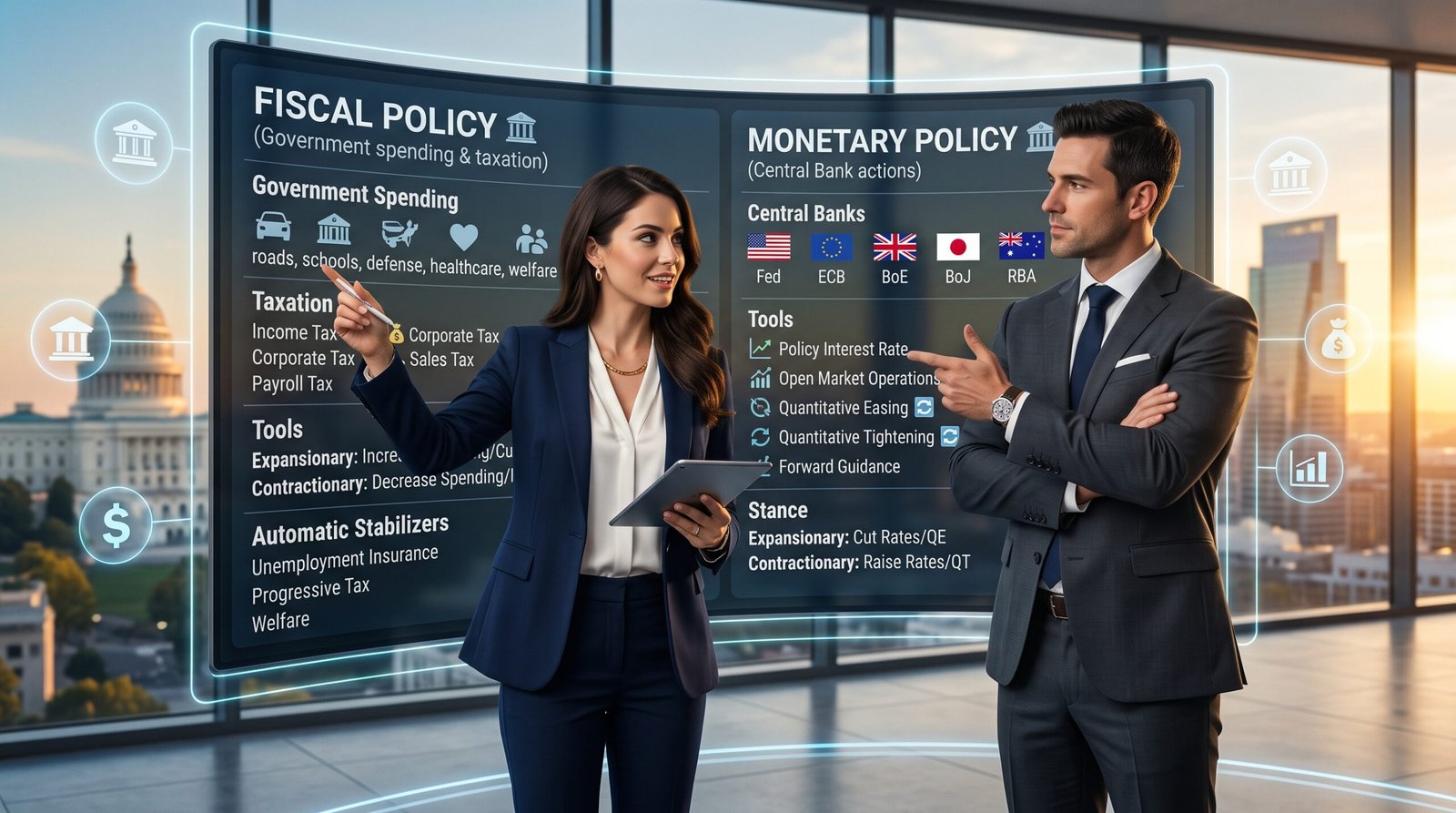
Understanding the economy fiscal and monetary policies government economic toolkit guide featuring fiscal policy government spending and taxation, monetary policy central bank interest rates and money supply, expansionary vs contractionary policy comparison, automatic stabilizers, major central banks Federal Reserve ECB BoE BoJ RBA, policy tools interest rates OMO QE QT forward guidance, and real-world case studies 2008 2020 2022-2024
πŸ›οΈπŸ¦ Understanding the economy through fiscal and monetary policies – the government’s economic toolkit. Explore Fiscal Policy (government spending and taxation) vs Monetary Policy (central bank interest rates and money supply), expansionary vs contractionary policy, automatic stabilizers, major central banks (Fed, ECB, BoE, BoJ, RBA), policy tools (interest rates, OMO, QE, QT, forward guidance), and real-world case studies (2008, 2020, 2022-2024). πŸ‡ΊπŸ‡ΈπŸ‡¬πŸ‡§πŸ‡ͺπŸ‡ΊπŸŒπŸ‡¦πŸ‡ΊπŸŒ

How Taxation, Spending, and Interest Rates Shape the Domestic and Global Economy

Tax. Spend. Stabilize.Β βš–οΈ

WhenΒ understanding the economy, two of the most powerful tools areΒ fiscal policyΒ (government spending and taxation) andΒ monetary policyΒ (central bank control of money supply and interest rates). Whether you are in theΒ United States πŸ‡ΊπŸ‡Έ, United Kingdom πŸ‡¬πŸ‡§, Europe πŸ‡ͺπŸ‡Ί, Asia 🌏, Australia πŸ‡¦πŸ‡Ί, or anywhere else globally 🌐, these policies determine your tax bill, the interest rate on your mortgage, the health of the job market, and the stability of prices.

In this comprehensive Segment, we explore:

  • Fiscal PolicyΒ (government spending, taxation, budget deficits/surpluses)

  • Monetary PolicyΒ (interest rates, money supply, central banks)

  • How they work togetherΒ (coordination and conflict)

  • Real-world examplesΒ (2008 financial crisis, COVID-19 response, 2022-2023 inflation fighting)

πŸ‘‰ Track fiscal and monetary policy.Β [Get economic calendar and policy analysis tools here]Β πŸ“Š

What Is Fiscal Policy? (Definition)

The Simple Definition

Fiscal policyΒ refers to the use of governmentΒ spendingΒ andΒ taxationΒ to influence the economy. It is controlled by theΒ executive and legislative branchesΒ (President/Congress, Prime Minister/Parliament, Chancellor/Bundestag, etc.).

Simple Definition:Β How the government spends money and collects taxes. πŸ’°

The Two Main Tools of Fiscal Policy

ToolDefinitionExamples
Government SpendingExpenditure on goods, services, infrastructure, defense, education, healthcare, welfare, etc.Building roads, paying teachers, funding military, sending stimulus checks, unemployment benefits.
TaxationRevenue collected from individuals and businesses (income tax, corporate tax, sales tax, payroll tax, property tax, tariffs).Income tax brackets, corporate tax rate, sales tax, Social Security payroll tax, gas tax, estate tax.

Examples:

πŸ“Β Domestic Economy Example:Β In theΒ United States, fiscal policy is set by Congress and the President. The 2017 Tax Cuts and Jobs Act (Trump) lowered corporate and individual tax rates (expansionary). The CARES Act (2020) and American Rescue Plan (2021) sent stimulus checks, expanded unemployment benefits, and provided PPP loans (expansionary).

πŸ“Β Global Example:Β InΒ Europe (Germany, France, UK, EU)Β , fiscal policy is set by national governments (but constrained by EU fiscal rules: deficit <3% of GDP, debt <60% of GDP). Germany’s “debt brake” (Schuldenbremse) limits structural deficits; France and Italy have run larger deficits; the EU suspended fiscal rules during COVID-19.

πŸ‘‰ Understand fiscal policy’s impact on your taxes.Β [Get tax planning and financial advisory tools here]Β πŸ“‹

Types of Fiscal Policy (Expansionary vs. Contractionary)

Comparison Table

AspectExpansionary Fiscal PolicyContractionary Fiscal Policy
DefinitionGovernment increases spending OR cuts taxes to stimulate the economy.Government decreases spending OR raises taxes to cool the economy.
When UsedDuring recessions, high unemployment, or slow growth.During booms, high inflation, or overheating (economy growing too fast).
Effect on GDPIncreases GDP (stimulates demand).Decreases GDP (reduces demand).
Effect on UnemploymentLowers unemployment (firms hire to meet demand).Raises unemployment (firms cut back).
Effect on InflationIncreases inflation (more demand pushes prices up).Decreases inflation (less demand pushes prices down).
Effect on BudgetWorsens deficit (spending ↑ or taxes ↓ β†’ deficit ↑).Improves deficit (spending ↓ or taxes ↑ β†’ deficit ↓).
ExamplesStimulus checks (2020-2021), infrastructure spending, tax cuts.Austerity (Europe 2010-2015), tax increases, spending cuts.

Visual: Expansionary vs. Contractionary Fiscal Policy

                    EXPANSIONARY                          CONTRACTIONARY
                    (Recession)                           (Inflation)
                         β”‚                                       β”‚
                         β–Ό                                       β–Ό
              β”Œβ”€β”€β”€β”€β”€β”€β”€β”€β”€β”€β”€β”€β”€β”€β”€β”€β”€β”€β”€β”€β”€β”                β”Œβ”€β”€β”€β”€β”€β”€β”€β”€β”€β”€β”€β”€β”€β”€β”€β”€β”€β”€β”€β”€β”€β”
              β”‚  Increase Spending  β”‚                β”‚  Decrease Spending  β”‚
              β”‚  OR                 β”‚                β”‚  OR                 β”‚
              β”‚  Cut Taxes          β”‚                β”‚  Raise Taxes        β”‚
              β””β”€β”€β”€β”€β”€β”€β”€β”€β”€β”€β”¬β”€β”€β”€β”€β”€β”€β”€β”€β”€β”€β”˜                β””β”€β”€β”€β”€β”€β”€β”€β”€β”€β”€β”¬β”€β”€β”€β”€β”€β”€β”€β”€β”€β”€β”˜
                         β”‚                                       β”‚
                         β–Ό                                       β–Ό
              β”Œβ”€β”€β”€β”€β”€β”€β”€β”€β”€β”€β”€β”€β”€β”€β”€β”€β”€β”€β”€β”€β”€β”                β”Œβ”€β”€β”€β”€β”€β”€β”€β”€β”€β”€β”€β”€β”€β”€β”€β”€β”€β”€β”€β”€β”€β”
              β”‚   Demand Increases  β”‚                β”‚   Demand Decreases  β”‚
              β””β”€β”€β”€β”€β”€β”€β”€β”€β”€β”€β”¬β”€β”€β”€β”€β”€β”€β”€β”€β”€β”€β”˜                β””β”€β”€β”€β”€β”€β”€β”€β”€β”€β”€β”¬β”€β”€β”€β”€β”€β”€β”€β”€β”€β”€β”˜
                         β”‚                                       β”‚
            β”Œβ”€β”€β”€β”€β”€β”€β”€β”€β”€β”€β”€β”€β”Όβ”€β”€β”€β”€β”€β”€β”€β”€β”€β”€β”€β”€β”              β”Œβ”€β”€β”€β”€β”€β”€β”€β”€β”€β”€β”€β”€β”Όβ”€β”€β”€β”€β”€β”€β”€β”€β”€β”€β”€β”€β”
            β–Ό            β–Ό            β–Ό              β–Ό            β–Ό            β–Ό
         GDP ↑      Jobs ↑      Prices ↑         GDP ↓      Jobs ↓      Prices ↓

Examples:

πŸ“Β Domestic Economy Example (Expansionary):Β In theΒ United States, the American Recovery and Reinvestment Act (2009, ~$800 billion) and CARES Act (2020, ~$2.2 trillion) were expansionary fiscal policies designed to combat the 2008 recession and COVID-19 recession.

πŸ“Β Global Example (Contractionary):Β InΒ Europe (Greece, Spain, Portugal, Italy)Β , the eurozone debt crisis (2010-2015) forced austerity (spending cuts, tax increases). This contractionary policy deepened recessions (Greek GDP fell 25%) but was required for bailout loans.

πŸ‘‰ Prepare for fiscal policy changes.Β [Get economic forecasting and investment tools here]Β πŸ“ˆ

Automatic Stabilizers (Fiscal Policy That Works Automatically)

What Are Automatic Stabilizers?

Automatic stabilizers are fiscal policies that automatically adjust to the business cycle without new legislation. They dampen booms and soften recessions.

StabilizerHow It Works in RecessionHow It Works in Boom
Unemployment InsuranceMore people claim benefits β†’ more spending β†’ cushions recession.Fewer people claim benefits β†’ less spending β†’ dampens boom.
Income Tax (Progressive)Incomes fall β†’ tax revenues fall β†’ less drag on economy.Incomes rise β†’ tax revenues rise β†’ more drag on economy.
Welfare / SNAP (Food Stamps)More people qualify β†’ more spending β†’ cushions recession.Fewer people qualify β†’ less spending β†’ dampens boom.
Corporate TaxProfits fall β†’ tax revenues fall β†’ less drag.Profits rise β†’ tax revenues rise β†’ more drag.

Examples:

πŸ“Β Domestic Economy Example:Β In theΒ United States, unemployment insurance claims automatically spike during recessions (2008-2009, 2020). This puts money in the pockets of the unemployed, who spend it, supporting demand. No new law neededβ€”it’s automatic.

πŸ“Β Global Example:Β InΒ Europe (Germany, France, UK)Β , automatic stabilizers are stronger than in the US (more generous unemployment benefits, stronger welfare states). This makes European economies more stable (less volatile) but also increases tax burdens.

πŸ‘‰ Understand your automatic stabilizers.Β [Get personal finance and safety net planning tools here]Β πŸ›‘οΈ

What Is Monetary Policy? (Definition)

The Simple Definition

Monetary policyΒ refers to the actions taken by aΒ central bankΒ to manage theΒ money supplyΒ andΒ interest ratesΒ to achieve macroeconomic goals (price stability, maximum employment, moderate long-term interest rates).

Simple Definition: How the central bank manages money and credit. 🏦

Major Central Banks Around the World

Central BankCountry/RegionPolicy Rate NameInflation TargetKey Mandate
Federal Reserve (Fed)United StatesFederal Funds Rate2% (PCE inflation)Maximum employment + price stability (dual mandate)
European Central Bank (ECB)Eurozone (20 countries)Main Refinancing Rate2% (HICP inflation)Price stability (primary)
Bank of England (BoE)United KingdomBank Rate2% (CPI inflation)Price stability + financial stability
Bank of Japan (BoJ)JapanPolicy Rate (short-term)2% (but rarely achieved)Price stability (fighting deflation)
Reserve Bank of Australia (RBA)AustraliaCash Rate2-3% (inflation targeting)Price stability + full employment
People’s Bank of China (PBOC)ChinaLoan Prime Rate (LPR)~3% (implicit)Growth + stability (managed currency)
Reserve Bank of India (RBI)IndiaRepo Rate4% (Β±2% band)Price stability + growth

Examples:

πŸ“Domestic Economy Example:Β In theΒ United States, the Federal Reserve (Fed) sets the Federal Funds Rate (the rate banks charge each other overnight). When the Fed raises rates, mortgage, auto loan, and credit card rates rise; when the Fed cuts rates, borrowing becomes cheaper.

πŸ“Β Global Example:Β InΒ Europe (Eurozone)Β , the European Central Bank (ECB) sets interest rates for 20 countries sharing the euro. The ECB’s decisions affect borrowing costs from Dublin to Athens, making monetary policy complex (one size fits all).

πŸ‘‰ Follow central bank decisions.Β [Get economic calendar and central bank tracking tools here]Β πŸ“…

Tools of Monetary Policy

Policy Interest Rate (The Main Tool)

AspectDescription
What It IsThe interest rate that the central bank pays on reserves (or charges banks for loans).
How It WorksRaising rates β†’ banks raise rates on loans (mortgages, credit cards, auto, business) β†’ borrowing costs increase β†’ spending slows β†’ inflation falls. Lowering rates β†’ opposite.
Transmission MechanismPolicy rate β†’ interbank rate β†’ prime rate β†’ mortgage, auto, credit card, business loan rates β†’ consumer spending & business investment β†’ GDP & inflation.

Open Market Operations (OMO)

AspectDescription
What It IsCentral bank buys or sells government bonds to increase or decrease the money supply.
How It WorksBuying bonds β†’ adds money to banking system β†’ lower rates β†’ stimulates economy. Selling bonds β†’ removes money from banking system β†’ higher rates β†’ cools economy.

Quantitative Easing (QE) and Quantitative Tightening (QT)

AspectDescription
What It IsCentral bank buys large quantities of government bonds (and sometimes corporate bonds, mortgage-backed securities) to lower long-term interest rates when short-term rates are already near zero.
When UsedDuring severe recessions (2008-2014, 2020-2022) when policy rates were near 0% and could not be cut further.
Quantitative Tightening (QT)The reverse: central bank sells bonds (or lets them mature without reinvesting) to reduce the money supply and raise long-term rates.

Forward Guidance

AspectDescription
What It IsCentral bank communicates its future policy intentions to shape market expectations.
Example“We expect to keep rates low until inflation reaches 2% and unemployment falls to 4%.”

Examples:

πŸ“Domestic Economy Example:Β In theΒ United States, the Fed used QE (2008-2014, 2020-2022) to buy trillions in Treasury bonds and mortgage-backed securities, lowering long-term rates. The Fed also used forward guidance (“rates will stay low for a long time”).

πŸ“Β Global Example:Β InΒ Europe (Eurozone)Β , the ECB used QE (2015-2018, 2020-2022) to fight deflation and stimulate growth. The ECB also used negative interest rates (charging banks to hold reserves) to encourage lendingβ€”an unconventional policy the Fed never used.

πŸ‘‰ Understand unconventional monetary policy.Β [Get fixed-income and bond market analysis tools here]Β πŸ“‰

Types of Monetary Policy (Expansionary vs. Contractionary)

Comparison Table

AspectExpansionary Monetary PolicyContractionary Monetary Policy
DefinitionCentral bank lowers interest rates OR increases money supply to stimulate the economy.Central bank raises interest rates OR decreases money supply to cool the economy.
When UsedDuring recessions, high unemployment, deflation risk, or slow growth.During booms, high inflation, or overheating.
Policy Rate ActionCUT (lower) interest rates.RAISE (increase) interest rates.
Money Supply ActionINCREASE (buy bonds via QE, lower reserve requirements).DECREASE (sell bonds via QT, raise reserve requirements).
Effect on GDPIncreases GDP (stimulates borrowing, spending, investment).Decreases GDP (reduces borrowing, spending, investment).
Effect on UnemploymentLowers unemployment (more spending β†’ more hiring).Raises unemployment (less spending β†’ layoffs).
Effect on InflationIncreases inflation (more demand).Decreases inflation (less demand).
Effect on SaversHurts savers (low interest rates on savings accounts, CDs, bonds).Helps savers (higher interest rates on savings accounts, CDs, bonds).
Effect on BorrowersHelps borrowers (lower mortgage, auto, credit card rates).Hurts borrowers (higher mortgage, auto, credit card rates).
ExamplesFed cutting rates to 0% in 2008-2015 and 2020; QE.Fed raising rates to 5%+ in 2022-2024 to fight 9% inflation.

Examples:

πŸ“Β Domestic Economy Example (Expansionary):Β TheΒ Federal ReserveΒ cut interest rates to near 0% in 2008 (financial crisis) and 2020 (COVID-19) and used QE (buying bonds). This expansionary policy helped stabilize the economy, but also contributed to asset bubbles (stocks, housing).

πŸ“Β Global Example (Contractionary):Β TheΒ Federal ReserveΒ raised rates 11 times between 2022-2024 (from near 0% to over 5%). TheΒ ECBΒ andΒ Bank of EnglandΒ followed. This contractionary policy was necessary to fight 9% inflation, but caused a bear market in stocks (2022) and higher mortgage rates.

πŸ‘‰ Position your portfolio for monetary policy changes.Β [Get asset allocation and interest rate tracking tools here]Β πŸ“Š

The Taylor Rule (How Central Banks Set Rates)

What Is the Taylor Rule?

TheΒ Taylor RuleΒ is a guideline for how central banks should set interest rates based on economic conditions (inflation and output gap).

Simple Formula: Policy Rate = Neutral Rate + (1.5 Γ— Inflation Gap) + (0.5 Γ— Output Gap)

VariableDefinitionExample (US, 2022)
Neutral RateInterest rate when economy is at full employment and 2% inflation (~2-3% real).2% (real) + 2% (inflation target) = 4% nominal.
Inflation GapActual inflation minus target (2%).9% inflation – 2% target = +7% gap.
Output GapActual GDP minus potential GDP (as %).Positive (overheating) or negative (slack).

Taylor Rule Implication for the Fed (2022):Β Rate = 4% + (1.5 Γ— 7%) + (0.5 Γ— 0%) = 4% + 10.5% =Β 14.5%Β β€” far higher than actual rates (3-5%). This suggests the Fed was “behind the curve” in 2022, raising rates later than the rule recommended.

Examples:

πŸ“Β Domestic Economy Example:Β In theΒ United States, the Taylor Rule would have recommended much higher rates in 2022 (to fight inflation). The Fed raised rates more slowly, trying to avoid a hard recession. Whether this was wise is debated.

πŸ“Β Global Example:Β InΒ Europe (Eurozone)Β , the ECB also follows a similar framework. But because the ECB must set one rate for 20 countries (different inflation rates, output gaps), the Taylor Rule is less precise.

πŸ‘‰ Understand central bank decision-making.Β [Get monetary policy analysis tools here]Β πŸ“ˆ

How Fiscal and Monetary Policies Work Together

The Policy Mix (Coordination vs. Conflict)

ScenarioFiscal PolicyMonetary PolicyResult
Recession (2008, 2020)Expansionary (stimulus, tax cuts)Expansionary (low rates, QE)CoordinatedΒ β†’ effective recovery (but may cause inflation later).
Inflation (2022-2023)Mixed (some stimulus (IRA, CHIPS) but Inflation Reduction Act included revenue increases)Contractionary (rate hikes, QT)Slightly conflictingΒ (fiscal expansion while monetary contraction).
1970s StagflationExpansionary (spending)Initially expansionary (too slow to tighten)ConflictΒ β†’ both high inflation and high unemployment.

The Fiscal-Monetary Policy Mix Matrix

                    FISCAL POLICY
              Expansionary     Contractionary
        β”Œβ”€β”€β”€β”€β”€β”€β”€β”€β”€β”€β”€β”€β”€β”€β”€β”€β”€β”€β”¬β”€β”€β”€β”€β”€β”€β”€β”€β”€β”€β”€β”€β”€β”€β”€β”€β”€β”€β”
        β”‚                  β”‚                  β”‚
        β”‚   Strong Growth  β”‚  Government       β”‚
Expansionβ”‚   (maybe         β”‚  Pulls Back,      β”‚
ary      β”‚   inflation)     β”‚  Central Bank     β”‚
        β”‚                  β”‚  Stimulates       β”‚
        β”œβ”€β”€β”€β”€β”€β”€β”€β”€β”€β”€β”€β”€β”€β”€β”€β”€β”€β”€β”Όβ”€β”€β”€β”€β”€β”€β”€β”€β”€β”€β”€β”€β”€β”€β”€β”€β”€β”€β”€
        β”‚                  β”‚                  β”‚
        β”‚  Central Bank    β”‚  Austerity +      β”‚
Contrac-β”‚  Fights Inflationβ”‚  Tight Money      β”‚
tionaryβ”‚  (maybe           β”‚  (Recession       β”‚
        β”‚  recession)      β”‚  Likely)          β”‚
        β””β”€β”€β”€β”€β”€β”€β”€β”€β”€β”€β”€β”€β”€β”€β”€β”€β”€β”€β”΄β”€β”€β”€β”€β”€β”€β”€β”€β”€β”€β”€β”€β”€β”€β”€β”€β”€β”€β”˜

Examples:

πŸ“Β Domestic Economy Example:Β In theΒ United StatesΒ during COVID-19, fiscal policy (stimulus checks, PPP, unemployment benefits) AND monetary policy (0% rates, QE) were both expansionary and coordinated. This prevented depression but contributed to 2022-2024 inflation.

πŸ“Β Global Example:Β InΒ Europe (Greece, Spain, Italy)Β during the eurozone debt crisis (2010-2015), fiscal policy was contractionary (austerity: spending cuts, tax increases) while monetary policy was expansionary (ECB low rates, then QE). This mix prolonged the recession (austerity offset monetary stimulus).

πŸ‘‰ Monitor the policy mix.Β [Get macroeconomics and policy analysis tools here]Β πŸ“Š

Real-World Case Studies

Case Study #1: 2008 Financial Crisis

PolicyActionsEffectiveness
Fiscal (US)TARP (bank bailouts, $700B), stimulus ($800B), auto bailouts.Stabilized financial system; prevented depression; increased deficit.
Monetary (Fed)Cut rates to 0%; QE (bought $ trillions in bonds); forward guidance.Lowered long-term rates; boosted asset prices (stocks, housing); prevented deflation.
ResultSlow recovery (job market recovered by 2015), but depression avoided.Lessons: aggressive policy works, but recovery takes time.

Case Study #2: COVID-19 Pandemic (2020-2021)

PolicyActionsEffectiveness
Fiscal (US)CARES Act ($2.2T), stimulus checks, PPP, enhanced unemployment, state/local aid.Prevented depression (GDP fell -31% annualized Q2 2020, then recovered rapidly).
Monetary (Fed)Cut rates to 0%; unlimited QE (bought $ trillions); lending facilities.Stabilized markets (bonds, money markets); lowered rates; boosted asset prices.
ResultFastest recovery in history (stocks recovered by Aug 2020; jobs recovered by 2022). But high inflation followed (2022-2024).Lesson: aggressive policy

Study #3: 2022-2024 Inflation Fight

PolicyActionsEffectiveness
Fiscal (US)Inflation Reduction Act (climate, healthcare, tax credits); CHIPS Act; student loan forgiveness (blocked).Mixed: some stimulus (IRA tax credits, CHIPS subsidies) while other policies (revenue increases) contractionary.
Monetary (Fed)Raised rates 11 times (0% β†’ 5%+); QT (reducing balance sheet).Inflation fell from 9.1% (June 2022) to 3-4% (2024-2025).
Result“Soft landing” (inflation down without deep recession) likely but not certain.Lesson: monetary policy can fight inflation without causing depression? Unclear.

Examples:

πŸ“Β Domestic Economy Example:Β In theΒ United States, the Fed’s aggressive rate hikes (2022-2024) successfully reduced inflation from 9% to ~3%. Unemployment remained low (3.5-4%). A “soft landing” (no recession) appeared possibleβ€”rare after an inflation spike.

πŸ“Β Global Example:Β InΒ Europe (UK, Germany, France)Β , the ECB and Bank of England also raised rates, but European inflation fell more slowly (energy prices, weaker exchange rates). Some European economies flirted with recession.

πŸ‘‰ Learn from policy case studies.Β [Get economic history and policy analysis resources here]Β πŸ“š

Segment Summary: Role of Fiscal and Monetary Policies

Sub-SegmentKey Takeaway
11.1 What Is Fiscal Policy?Government spending + taxation to influence economy (controlled by elected officials).
11.2 Types of Fiscal PolicyExpansionary (stimulate) vs. Contractionary (cool).
11.3 Automatic StabilizersUnemployment insurance, progressive taxes (work automatically).
11.4 What Is Monetary Policy?Central bank control of interest rates + money supply.
11.5 Tools of Monetary PolicyPolicy rate, OMO, QE/QT, forward guidance.
11.6 Types of Monetary PolicyExpansionary (cut rates) vs. Contractionary (raise rates).
11.7 Taylor RuleGuideline for setting rates based on inflation + output gap.
11.8 How They Work TogetherCoordinated (recessions) vs. conflicting (stagflation) mixes.
11.9 Case Studies2008 (successful prevention of depression), 2020 (fastest recovery), 2022-2024 (inflation fight).

🌼 Final Thoughts on Fiscal and Monetary Policies

Understanding the economy requires mastering both fiscal and monetary policyβ€”the government’s two most powerful tools.

Do ThisDon’t Do This
βœ… Recognize that fiscal policy is set by elected officials (Congress, President); monetary policy by central bankers (Fed, ECB, BoE).❌ Assume that one policy tool is always better (both are needed; they work best together).
βœ… Understand the trade-offs: expansionary policy boosts growth but risks inflation; contractionary policy fights inflation but risks recession.❌ Forget that monetary policy works with lags (6-18 months); the Fed’s 2022 rate hikes won’t fully impact the economy until 2023-2024.
βœ… Follow central bank communications (forward guidance) to anticipate rate changes.❌ Ignore fiscal policy (taxes, spending) when planning personal finances (tax changes affect your take-home pay).
βœ… Diversify your portfolio to handle both expansionary and contractionary phases.❌ Assume that what worked in the past will work again (the economy evolves).

Fiscal and monetary policies are not magic wandsβ€”they have limits, lags, and unintended consequences. But when used wisely (and coordinated), they can smooth the business cycle, prevent depressions, and maintain prosperity. ByΒ understanding the economyΒ through the lens of these policies, you can make better investment decisions, understand political debates, and plan for your financial future.

πŸ‘‰ Apply policy insights to your finances.Β [Get economic analysis, investment tools, and financial planning resources here]Β πŸš€

❓ Frequently Asked Questions (FAQs) – Fiscal and Monetary Policies

Q1: What is the difference between fiscal and monetary policy?

Fiscal policy is government spending + taxation (controlled by elected officials). Monetary policy is central bank control of interest rates + money supply (controlled by central bankers). Fiscal policy affects the economy through changes in government budgets; monetary policy affects the economy through changes in borrowing costs.

Monetary policy is faster (central banks can change rates at any meeting) and less political (central bankers are appointed, not elected). Fiscal policy can be more targeted (spending on specific sectors, tax cuts for specific groups) but slower (requires legislation) and more political. Both are powerful; they work best together.

To fight inflation. Higher rates β†’ more expensive borrowing β†’ less spending β†’ less demand β†’ prices rise more slowly. The Fed raises rates when inflation is above its 2% target.

QE is when a central bank buys large quantities of government bonds (and sometimes other assets) to lower long-term interest rates. Used when short-term rates are already near 0% (cannot be cut further). QE increases the money supply and stimulates the economy.

Expansionary = stimulate economy (lower rates, cut taxes, increase spending) β†’ used during recessions. Contractionary = cool economy (raise rates, raise taxes, cut spending) β†’ used during booms to fight inflation.

A guideline for how central banks should set interest rates based on inflation and the output gap (how far the economy is from full employment). It’s a reference, not a strict rule (central banks have discretion).

Yes. Example: 2010-2015 Europe. Fiscal policy was contractionary (austerity), while monetary policy was expansionary (ECB low rates, then QE). The mix prolonged the recession (austerity offset monetary stimulus).

πŸ‘‰ Stay ahead of policy changes. [Get economic news, analysis, and investment tools here] 🌟

πŸ“„ Page 26 – Segment 11 – Role of Fiscal and Monetary Policies – The Government's Economic Toolkit πŸ›οΈπŸ¦ (26 of 33)
33 πŸ“‘
πŸ“š Table of Contents

πŸ“‘ Table of Contents