
Resource and Economy Tools Posts Menu
Understanding the Economy: 7 Powerful Ways the Domestic and Global Economy Shapes Your Money in 2026
yelli
June 3, 2026
4:24 am
Other Branches of Economics – Specialized Fields Beyond Microeconomics 🌍📚🔬
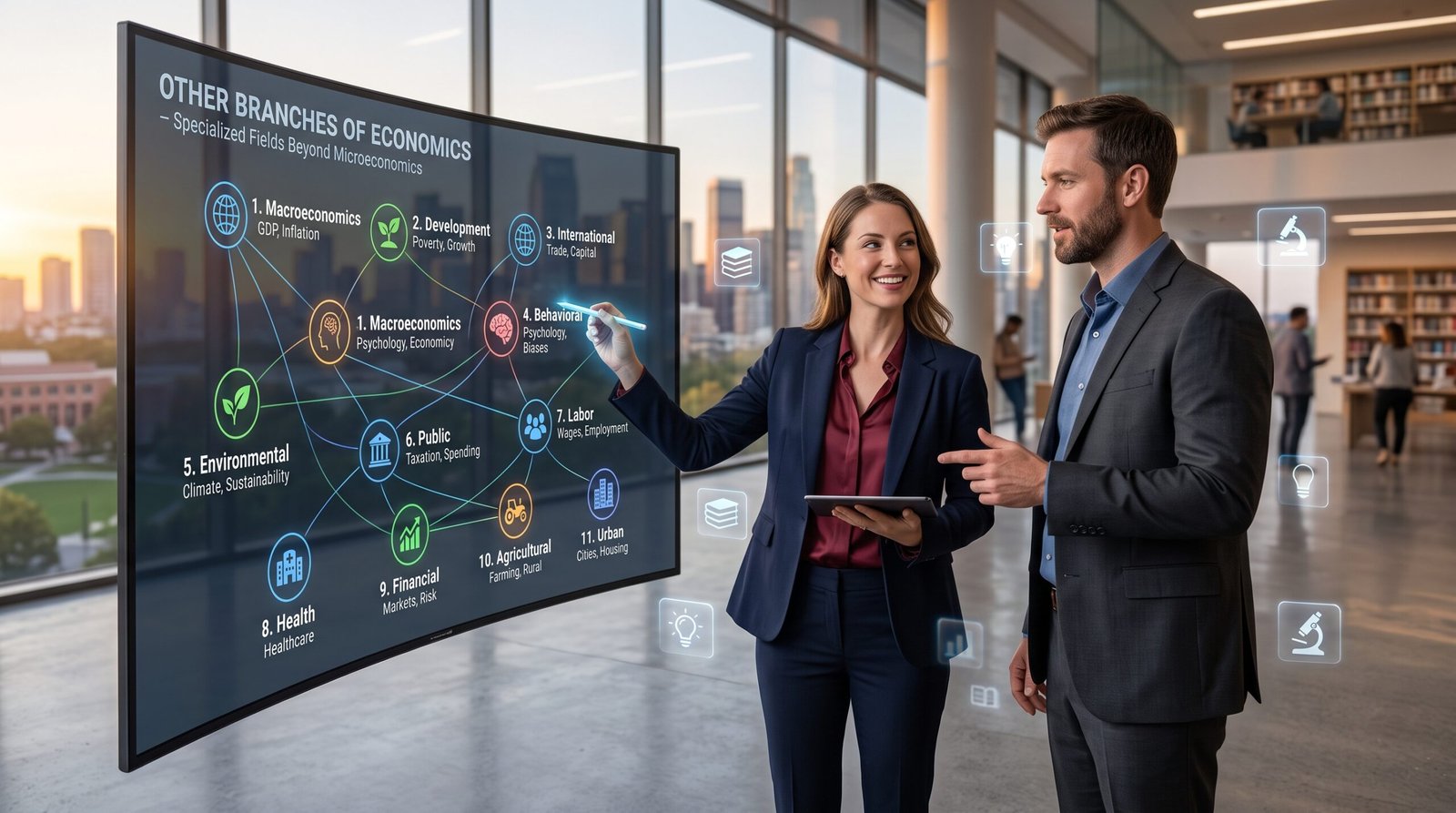
Exploring Macroeconomics, Development, Behavioral, Environmental, and More
Specialize. Apply. Solve. 🎯
When understanding the economy, microeconomics and macroeconomics form the foundation—but they are just the beginning. The domestic and global economy is too complex to be captured by only two branches. That’s why economists have developed specialized fields to address specific sectors, problems, and policy questions. Whether you are in the United States 🇺🇸, United Kingdom 🇬🇧, Europe 🇪🇺, Asia 🌏, Australia 🇦🇺, or anywhere else globally 🌐, these branches explain everything from poverty and climate change to healthcare costs and international trade.
This Segment provides a descriptive list of all major branches of economics EXCEPT microeconomics. For a complete deep dive into microeconomics, please see Segment 4. For how these branches nest within micro and macro, please see Segment 6.
👉 Explore specialized economics fields. [Discover economics courses and career resources here] 📚
Overview: The Family Tree of Economics (Beyond Micro)
Before diving deep, here is a roadmap of the branches we will explore in this Segment.
| # | Branch | Focus Area | Key Questions |
|---|---|---|---|
| 1 | Macroeconomics | The entire economy (GDP, inflation, unemployment, growth) | Is the economy growing? What causes recessions? How do interest rates affect inflation? |
| 2 | Development Economics | Poverty, growth, and development in low-income countries | How can poor countries escape poverty? What policies work? |
| 3 | International Economics | Trade, investment, and finance across borders | Why do countries trade? What causes currency crises? |
| 4 | Behavioral Economics | Psychology and irrational decision-making | Why do people make “bad” economic choices? How can we nudge better behavior? |
| 5 | Environmental Economics | Pollution, resources, climate change, sustainability | How do we price pollution? What’s the economic impact of climate change? |
| 6 | Public Economics | Government taxation, spending, and public goods | How should we tax? What should the government provide? |
| 7 | Labor Economics | Labor markets, wages, employment, human capital | What determines wages? How does minimum wage affect jobs? |
| 8 | Health Economics | Healthcare markets, insurance, public health | Why is healthcare so expensive? How to design insurance? |
| 9 | Financial Economics | Financial markets, investments, risk, asset pricing | How to price stocks and bonds? What is risk? |
| 10 | Agricultural Economics | Food production, farming, rural development | How do subsidies affect farmers? What about food security? |
| 11 | Urban & Regional Economics | Cities, regions, housing, transportation | Why do cities grow? How to fix traffic and housing affordability? |
Examples:
📍 Domestic Economy Example: In the United States, all 11 branches are actively studied and applied. The Federal Reserve uses macroeconomics to set interest rates. The Treasury uses public economics to design tax policy. The EPA uses environmental economics to regulate pollution. HHS uses health economics to design Medicare and Medicaid.
📍 Global Example: In Europe (Germany, France, UK, EU institutions) , the European Central Bank (ECB) uses macroeconomics for monetary policy. The World Bank and IMF use development economics for loans to poor countries. The EU uses international economics for trade agreements and environmental economics for climate policy (EU Green Deal).
👉 Learn about all branches of economics. [Get comprehensive economics education resources here] 📖
Macroeconomics – The Big Picture 🌍
Definition and Scope
Macroeconomics is the branch of economics that studies the behavior and performance of an economy as a whole. It focuses on aggregate indicators (GDP, inflation, unemployment) and the policies (fiscal and monetary) that governments and central banks use to influence them.
Simple Definition: Macroeconomics is the study of the entire forest, not individual trees. 🌳🌲🌴
Key Topics in Macroeconomics
| Topic | Definition | Real-World Example |
|---|---|---|
| Gross Domestic Product (GDP) | Total value of all goods and services produced. | US GDP ~$27 trillion; China ~$18 trillion. |
| Inflation | The rate at which prices rise (purchasing power falls). | US inflation peaked at 9.1% in 2022; Fed targets 2%. |
| Unemployment | Percentage of labor force seeking work but unable to find it. | US unemployment fell to 3.4% in 2023 (50-year low). |
| Fiscal Policy | Government taxation and spending decisions. | Stimulus checks (2020); Inflation Reduction Act (2022). |
| Monetary Policy | Central bank control of money supply and interest rates. | Fed raised rates 11 times in 2022-2023 to fight inflation. |
| Economic Growth | Increase in GDP over time (business cycle: expansion, peak, recession, recovery). | US growth averaged 2-3% annually pre-pandemic. |
| International Trade | Exchange of goods, services, and capital across borders. | US trade deficit with China; EU single market. |
Examples:
📍 Domestic Economy Example: In the United States, macroeconomics guides Federal Reserve decisions. When inflation rose to 9.1% in 2022, the Fed raised interest rates aggressively (monetary policy) to cool the economy. This affected every American’s mortgage, credit card, and savings rates.
📍 Global Example: In Europe (Eurozone) , the European Central Bank (ECB) uses macroeconomics to set interest rates for 20 countries using the euro. When inflation spiked, the ECB raised rates—affecting borrowing costs from Dublin to Athens.
👉 Track macroeconomic indicators. [Get economic data and analysis tools here] 📊
Development Economics – Escaping Poverty 🌱
Definition and Scope
Development economics studies the economic aspects of the development process in low-income and developing countries, with the aim of improving living conditions, reducing poverty, and fostering economic growth.
Simple Definition: How do poor countries become rich(er)? 🌏
Key Topics in Development Economics
| Topic | Definition | Real-World Example |
|---|---|---|
| Poverty Reduction | Strategies to reduce the number of people living in extreme poverty (<$2.15/day). | China lifted 800+ million out of poverty (1980-2020). |
| Economic Growth Models | Theories explaining why some countries grow while others stagnate. | Solow model; endogenous growth theory; institutional economics. |
| Human Capital | Investment in education, health, and skills to increase productivity. | South Korea’s investment in education drove its transformation. |
| Infrastructure | Roads, ports, electricity, internet, water, sanitation. | China’s Belt and Road Initiative; India’s rural electrification. |
| Foreign Aid | Transfers from rich to poor countries (bilateral, multilateral). | USAID; World Bank loans; IMF programs; Gates Foundation. |
| Institutions | Property rights, rule of law, corruption, governance. | Botswana (strong institutions) vs. Zimbabwe (weak). |
| Microfinance | Small loans to poor entrepreneurs (no collateral). | Grameen Bank (Bangladesh, Nobel Prize 2006). |
| Sustainable Development | Balancing growth with environment and social equity. | UN Sustainable Development Goals (SDGs). |
Development Success Stories
| Country | 1960 GDP per Capita (USD) | 2024 GDP per Capita (USD) | Key Factors |
|---|---|---|---|
| South Korea | $1,500 | $45,000+ | Education, exports, strong institutions, US alliance |
| China | $200 | $13,000+ | Market reforms (1978), trade, investment, infrastructure |
| Vietnam | $100 | $4,500+ | Doi Moi reforms (1986), trade, FDI |
| Botswana | $500 | $8,000+ | Diamonds, strong institutions, democracy |
| Ireland | $2,000 | $100,000+ | Education, FDI (low taxes), EU membership |
Examples:
📍 Domestic Economy Example: The United States provides foreign aid (~$50 billion/year) through USAID, supports World Bank and IMF loans, and offers trade preferences (African Growth and Opportunity Act). Development economics research informs these policies.
📍 Global Example: China’s rise from low-income to upper-middle-income in one generation is the largest poverty reduction in human history (800+ million lifted out of poverty). Development economists study China’s policies: market reforms, infrastructure investment, education, and export-led growth.
👉 Support global development. [Explore impact investing and charitable giving platforms here] 🤝
International Economics – Connecting Economies 🌐
Definition and Scope
International economics studies how countries interact through trade, investment, and finance. It explores the impact of international trade and capital flows on economies, as well as policies (tariffs, trade agreements, exchange rate regimes) that shape these interactions.
Simple Definition: How do money, goods, and services cross borders? ✈️
Key Topics in International Economics
| Topic | Definition | Real-World Example |
|---|---|---|
| International Trade Theory | Why do countries trade? Who benefits? | Comparative advantage (David Ricardo): Portugal wine vs. England cloth. |
| Trade Policy | Tariffs, quotas, subsidies, trade agreements. | US-China trade war; USMCA (NAFTA replacement); EU single market. |
| Balance of Payments | Record of all transactions between a country and the rest of the world. | Current account (trade) + capital account + financial account. |
| Exchange Rates | Price of one currency in terms of another. | USD/EUR, USD/JPY, GBP/USD. |
| International Finance | Capital flows, foreign direct investment, portfolio investment. | China buying US Treasury bonds; US companies investing in Europe. |
| Globalization | Increasing economic integration across borders. | Supply chains (iPhone designed in US, made in China); migration; technology. |
Examples:
📍 Domestic Economy Example: The United States and China have been in a trade war since 2018 (Trump tariffs, Biden tariffs). The US imposed tariffs on hundreds of billions of dollars of Chinese goods (electronics, machinery, clothing). US consumers paid higher prices; some manufacturing returned to the US (but not as much as promised).
📍 Global Example: The European Union is a customs union and single market: free trade among 27 member countries, plus a common external tariff. This has boosted trade and growth within Europe, but also created trade diversion (EU countries buy from each other instead of cheaper non-EU sources).
👉 Invest in international markets. [Get global brokerage and currency tools here] 🌍
Behavioral Economics – The Psychology of Money 🧠
Definition and Scope
Behavioral economics merges insights from psychology and economics to better understand how individuals make economic decisions that deviate from the rational models traditionally assumed in economics.
Simple Definition: People aren’t always rational. We have biases, emotions, and self-control problems. 😵
Traditional Economics vs. Behavioral Economics
| Assumption | Traditional Economics (Homo Economicus) | Behavioral Economics (Real Humans) |
|---|---|---|
| Rationality | People always make optimal choices. | People make systematic errors (biases). |
| Self-interest | People care only about themselves. | People care about fairness, reciprocity, altruism. |
| Perfect information | People have all relevant information. | People have limited attention, ignore relevant info. |
| Stable preferences | Preferences never change. | Preferences are context-dependent (framing effects). |
| No self-control problems | People save optimally for retirement. | People procrastinate, lack willpower (present bias). |
Key Concepts in Behavioral Economics
| Concept | Definition | Example |
|---|---|---|
| Anchoring | Relying too heavily on the first piece of information encountered. | $100 “suggested price” makes $70 seem like a bargain (even if $70 is still expensive). |
| Loss Aversion | Losses hurt twice as much as gains feel good. | People refuse a coin flip that could win $100 or lose $100 (even though expected value = $0). |
| Present Bias | Overvaluing immediate rewards at the expense of future rewards. | Choosing $10 today over $15 in a week (even though waiting yields higher return). |
| Confirmation Bias | Seeking information that confirms existing beliefs. | Ignoring evidence that contradicts your political or investment views. |
| Overconfidence | Overestimating one’s own abilities, knowledge, or prediction accuracy. | 90% of drivers think they are above average; most active traders underperform. |
| Framing | Decisions affected by how choices are presented. | 90% survival rate vs. 10% mortality rate (same information, different reaction). |
| Mental Accounting | Treating money differently depending on its source or intended use. | Tax refund feels like “free money” (spent frivolously) vs. salary (spent carefully). |
| Nudge | Subtle changes to choice architecture that steer behavior without banning options. | Default enrollment in retirement savings (opt-out vs. opt-in). |
Examples:
📍 Domestic Economy Example: In the United States, automatic enrollment in 401(k) retirement plans (opt-out rather than opt-in) dramatically increased participation rates. This “nudge” leverages inertia (people stick with default) and present bias (people would procrastinate if they had to opt-in).
📍 Global Example: In Europe (UK) , the Behavioural Insights Team (“Nudge Unit”) applied behavioral economics to policy: simplifying tax forms increased compliance; changing organ donation to opt-out increased donor registration; social norms messaging reduced energy use.
👉 Use behavioral economics to make better decisions. [Get personal finance and decision-making tools here] 🧠
Environmental Economics – Greening the Economy 🌿
Definition and Scope
Environmental economics focuses on the economic effects of environmental policies and the impact of economic activity on the environment. It addresses issues such as pollution, resource depletion, climate change, and sustainable economic growth.
Simple Definition: How do we price nature? 🌳💨💧
Key Topics in Environmental Economics
| Topic | Definition | Real-World Example |
|---|---|---|
| Externalities (Negative) | Pollution imposes costs on society not reflected in market prices. | CO2 emissions → climate change (costs borne by everyone). |
| Externalities (Positive) | Environmental protection creates benefits for society not captured by market prices. | Preserving a forest provides clean air, water filtration, biodiversity. |
| Pigouvian Taxes | Tax on negative externalities to internalize the cost (make polluters pay). | Carbon tax ($50/ton of CO2); sugar tax; congestion pricing. |
| Cap-and-Trade | Limit total pollution, allow trading of permits. | EU Emissions Trading System (ETS); US SO2 trading (acid rain). |
| Renewable vs. Non-Renewable Resources | Solar, wind, hydro (renewable); oil, gas, coal (non-renewable). | Peak oil; energy transition to renewables. |
| Valuation of Ecosystem Services | Putting a price on what nature provides (clean air, water, pollination). | Pollination by bees: value estimated at billions of dollars. |
| Climate Change Economics | Cost-benefit analysis of mitigation vs. adaptation. | Stern Review (2006): cost of inaction >> cost of action. |
Examples:
📍Domestic Economy Example: In the United States, the Clean Air Act (1970, amended 1990) significantly reduced air pollution (SO2, NOx, lead, particulates). The benefits (health, visibility, ecosystems) are estimated to exceed costs by 30:1. The EPA also regulates CO2 as a pollutant under the Clean Air Act.
📍 Global Example: The European Union’s Emissions Trading System (ETS) is the world’s largest cap-and-trade system for CO2. It covers power generation, industry, and aviation within the EU. The price of carbon allowances has risen to €80-100/ton, driving investment in cleaner technologies.
👉 Invest in the green economy. [Explore renewable energy and ESG investment platforms here] 🌞
Public Economics – Government and the Economy 🏛️
Definition and Scope
Public economics (also called public finance) studies how government policy affects the economy, including taxation, government spending, and the provision of public goods. It examines the role of government in addressing market failures and redistributing income.
Simple Definition: What should the government do, and how should it pay for it? 💼
Key Topics in Public Economics
| Topic | Definition | Real-World Example |
|---|---|---|
| Taxation | How governments raise revenue (income tax, corporate tax, sales tax, property tax, payroll tax, wealth tax). | US federal income tax (progressive); payroll tax for Social Security/Medicare. |
| Government Spending | Expenditure on public goods, social programs, defense, infrastructure, education, healthcare. | US: Social Security, Medicare, Medicaid, defense, infrastructure. |
| Public Goods | Goods that are non-excludable and non-rivalrous (markets underprovide). | National defense, streetlights, clean air, lighthouses. |
| Externalities | Government can tax negative externalities, subsidize positive externalities. | Carbon tax; subsidy for vaccines, education, R&D. |
| Redistribution | Transferring income/wealth from rich to poor via taxes and transfers. | Progressive income tax; EITC; welfare; food stamps; Social Security. |
| Social Insurance | Government programs that insure against risk (unemployment, disability, old age, health). | Social Security; Medicare; Medicaid; Unemployment Insurance. |
Examples:
📍Domestic Economy Example: In the United States, the Earned Income Tax Credit (EITC) is a refundable tax credit for low-income workers. It is widely supported by economists because it encourages work while reducing poverty (efficiency + equity).
📍 Global Example: In Europe (Nordic countries) , high taxes fund generous welfare states (universal healthcare, free education, parental leave). This reflects a different trade-off between efficiency and equity than in the US.
👉 Understand tax policy. [Get tax planning and financial advisory tools here] 📋
Labor Economics – The World of Work 👥
Definition and Scope
Labor economics studies the functioning and dynamics of markets for labor. It focuses on the behavior of employers and employees and the factors that influence wages, employment, and working conditions.
Simple Definition: How do people find jobs, and how are they paid? 💼
Key Topics in Labor Economics
| Topic | Definition | Real-World Example |
|---|---|---|
| Labor Supply | How individuals decide whether to work, how many hours, and what occupation. | Income tax changes affect work incentives (substitution vs. income effect). |
| Labor Demand | How firms decide how many workers to hire. | Minimum wage increase → firms may hire fewer low-skilled workers. |
| Wage Determination | How wages are set (supply and demand, bargaining, efficiency wages, discrimination). | CEO pay vs. average worker pay (300x in US). |
| Human Capital | Investment in education, training, and health increases productivity and wages. | College graduates earn ~2x high school graduates. |
| Discrimination | Wage gaps based on race, gender, ethnicity, etc. (not explained by productivity). | Gender pay gap (women earn ~82 cents on the dollar in US). |
| Unemployment | Frictional, structural, cyclical (types). | COVID-19 caused cyclical unemployment; automation causes structural. |
| Minimum Wage | Legal floor on hourly wages. | Federal $7.25; many states/cities $15+. |
| Unionization | Collective bargaining by workers to raise wages and improve conditions. | United Auto Workers (UAW); teachers’ unions; SEIU. |
| Immigration | Effects of immigrant workers on native wages and employment. | Debate: immigrants complement or substitute for native workers? |
Examples:
📍Domestic Economy Example: In the United States, the federal minimum wage has been $7.25 since 2009. Many states and cities have raised their own minimum wages to $15 or higher (California, New York, Seattle, Washington DC). Labor economists study the effects on employment, hours, and poverty.
📍 Global Example: In Europe (Germany, France, UK) , minimum wages are generally higher than in the US (Germany ~$12-13/hour, UK ~$11-12/hour, France ~$12-13/hour). France also has strong labor protections (difficult to fire workers), which may reduce hiring but increase job security.
👉 Advance your career. [Get job search, resume, and career development tools here] 📄
Health Economics – The Economics of Medicine and Wellness 🏥
Definition and Scope
Health economics applies economic theories and principles to the healthcare sector. It studies the allocation of resources within healthcare systems and the impact of healthcare policies on public health.
Simple Definition: Why is healthcare so expensive, and how do we pay for it? 💊
Key Topics in Health Economics
| Topic | Definition | Real-World Example |
|---|---|---|
| Healthcare Costs | Why does healthcare cost so much? (Technology, aging, chronic disease, fee-for-service, lack of price transparency). | US spends 18% of GDP on healthcare (twice the OECD average) with worse outcomes. |
| Health Insurance | Insurance markets, risk pooling, adverse selection, moral hazard. | ACA (Obamacare) marketplaces; employer-sponsored insurance; Medicare; Medicaid. |
| Moral Hazard | Having insurance leads to more healthcare consumption (overuse). | People with generous insurance visit the doctor more often. |
| Adverse Selection | Only sick people buy insurance, driving up premiums. | Pre-ACA individual market: sick people bought, healthy people didn’t. |
| Pharmaceutical Economics | Drug pricing, R&D incentives, patents, generic competition. | Insulin prices; patent protection for new drugs; generic entry. |
| Public Health | Preventive care, vaccination, disease surveillance, health promotion. | COVID-19 testing, vaccines, and public health measures. |
Examples:
📍 Domestic Economy Example: In the United States, the Affordable Care Act (ACA, “Obamacare”) expanded insurance coverage via Medicaid expansion, subsidies for marketplace plans, and mandates (individual mandate penalty was later removed). The uninsured rate fell from ~16% to ~9%, but millions remain uninsured.
📍 Global Example: In Europe (UK, Germany, France) , every country has universal healthcare, but with different models: UK (National Health Service, tax-funded, government-provided); Germany (Bismarck model, social insurance with regulated private insurers); France (hybrid). All achieve better health outcomes at lower cost than the US.
👉 Navigate healthcare costs. [Get health insurance comparison and healthcare savings tools here] 🩺
Financial Economics – Money, Markets, and Risk 💹
Definition and Scope
Financial economics examines how individuals and institutions manage money, focusing on financial markets, investments, and asset pricing. It also looks at how financial instruments (stocks, bonds, derivatives) are used for risk management and speculation.
Simple Definition: How do we price stocks, bonds, and other assets? 📈
Key Topics in Financial Economics
| Topic | Definition | Real-World Example |
|---|---|---|
| Asset Pricing | Determining the fair price of financial assets. | Discounted cash flow (DCF); Capital Asset Pricing Model (CAPM). |
| Risk and Return | Higher expected returns require bearing higher risk. | Stocks have higher expected returns than bonds (but more volatile). |
| Portfolio Theory | Diversification reduces risk without reducing expected return. | Don’t put all eggs in one basket (S&P 500 vs. single stock). |
| Efficient Markets Hypothesis (EMH) | Stock prices reflect all available information (can’t beat the market consistently). | Most active fund managers underperform index funds after fees. |
| Behavioral Finance | Psychological biases cause market inefficiencies (anomalies, bubbles, crashes). | Dot-com bubble (1999-2000); housing bubble (2005-2007). |
| Derivatives | Options, futures, swaps (used for hedging or speculation). | Farmers use futures to lock in crop prices; airlines hedge fuel costs. |
| Corporate Finance | How firms raise capital (debt vs. equity), invest, and return profits to shareholders. | IPO; stock buybacks; dividends; mergers and acquisitions. |
Examples:
📍 Domestic Economy Example: In the United States, index funds (Vanguard S&P 500, Fidelity Total Market) have become hugely popular because they offer low-cost diversification. The efficient markets hypothesis suggests that active stock picking is unlikely to beat the market after fees.
📍 Global Example: In Europe (UK, Germany, France) , investors can buy global index funds (MSCI World, FTSE All-World). Diversification across countries reduces risk (Japan’s lost decades would have hurt a Japan-only investor, but not a global investor).
👉 Invest wisely. [Get brokerage accounts, research tools, and investment education here] 📊
Agricultural Economics – From Farm to Fork 🚜
Definition and Scope
Agricultural economics deals with the production, distribution, and consumption of agricultural goods and services. It addresses issues like food security, resource management, and the economic impact of agriculture on rural development.
Simple Definition: How do we grow, trade, and price food? 🌾
Key Topics in Agricultural Economics
| Topic | Definition | Real-World Example |
|---|---|---|
| Farm Management | Optimal use of land, labor, capital, and inputs to maximize profit. | Crop rotation; fertilizer application; irrigation decisions. |
| Agricultural Policy | Government subsidies, price supports, crop insurance, trade barriers. | US Farm Bill (subsidies for corn, soy, wheat, cotton, rice). |
| Commodity Markets | Prices of agricultural products (wheat, corn, soy, coffee, cocoa, sugar). | Chicago Board of Trade (CBOT); ICE Futures. |
| Food Security | Access to sufficient, safe, nutritious food for all people. | Global hunger; food price spikes (2008, 2010-2011). |
| Sustainable Agriculture | Farming methods that protect the environment and preserve resources for future generations. | Organic farming; regenerative agriculture; agroecology. |
| Rural Development | Economic development in rural areas (jobs, infrastructure, services). | Rural broadband; agricultural extension services. |
Examples:
📍 Domestic Economy Example: In the United States, the Farm Bill (renewed every 5 years) provides subsidies to farmers ($10-20 billion/year). Critics argue subsidies distort markets (encourage overproduction of corn and soy, leading to cheap animal feed and high-fructose corn syrup). Defenders argue subsidies ensure food security and stabilize farm incomes.
📍 Global Example: In Europe, the Common Agricultural Policy (CAP) is the EU’s agricultural subsidy program (~€50 billion/year, ~30% of EU budget). CAP has evolved from price supports (leading to “butter mountains” and “wine lakes”) to decoupled payments (income support not tied to production) and environmental programs.
👉 Learn about food systems. [Get agricultural investment and food security resources here] 🌱
Urban and Regional Economics – Cities and Spaces 🏙️
Definition and Scope
Urban and regional economics focuses on the economic activities in specific geographic areas, such as cities, regions, and metropolitan areas. It explores how spatial factors influence economic behavior, growth, and development.
Simple Definition: Why do cities exist, and why are some richer than others? 🗺️
Key Topics in Urban and Regional Economics
| Topic | Definition | Real-World Example |
|---|---|---|
| Urbanization | The growth of cities (people moving from rural to urban areas). | China’s urbanization (20% in 1980 to 65%+ today). |
| Agglomeration Economies | Benefits of clustering (knowledge spillovers, labor pooling, shared suppliers). | Silicon Valley (tech); New York (finance); London (finance). |
| Housing Markets | Supply and demand for housing (rents, prices, affordability). | Housing affordability crisis in San Francisco, New York, London, Sydney. |
| Land Use | Zoning, density, parking requirements, height restrictions. | Exclusionary zoning (limits apartment construction, raises housing costs). |
| Transportation Economics | Congestion pricing, public transit, roads, bridges, tunnels. | London Congestion Charge; New York congestion pricing (coming). |
| Regional Inequality | Differences in income, growth, opportunity across regions. | US coastal vs. interior; Northern vs. Southern Italy; East vs. West Germany. |
| Local Public Finance | How cities and regions fund services (property tax, sales tax, bonds). | Property taxes fund local schools (leading to inequality between rich and poor districts). |
Examples:
📍 Domestic Economy Example: In the United States, the housing affordability crisis in coastal cities (San Francisco, Los Angeles, New York, Boston, Seattle, Washington DC) reflects restrictive zoning (limits new construction) and high demand (good jobs, amenities). Economists recommend upzoning (allow more apartments) and building more transit to reduce housing costs.
📍 Global Example: In Europe (London, Paris, Berlin, Milan) , housing affordability is also a crisis. London’s housing costs have risen much faster than incomes. Policies include rent control (controversial, may reduce supply), social housing (government-built), and inclusionary zoning (require affordable units in new developments).
👉 Navigate urban economics. [Get real estate, housing, and transportation tools here] 🏠
Segment Summary: Other Branches of Economics
| # | Branch | Focus | Key Takeaway |
|---|---|---|---|
| 1 | Macroeconomics | Whole economy (GDP, inflation, unemployment) | Big picture: growth, recessions, policy. |
| 2 | Development Economics | Poverty, growth, low-income countries | How poor countries escape poverty. |
| 3 | International Economics | Trade, exchange rates, capital flows | Why countries trade; gains from trade; policy. |
| 4 | Behavioral Economics | Psychology, irrationality, biases | Humans aren’t rational (nudges help). |
| 5 | Environmental Economics | Pollution, climate, resources | Price externalities (carbon tax, cap-and-trade). |
| 6 | Public Economics | Taxes, spending, public goods | Role of government; redistribution; social insurance. |
| 7 | Labor Economics | Jobs, wages, human capital | Minimum wage, discrimination, unions, immigration. |
| 8 | Health Economics | Healthcare, insurance, public health | Why healthcare costs so much; universal coverage. |
| 9 | Financial Economics | Markets, investments, risk | Pricing assets; diversification; EMH. |
| 10 | Agricultural Economics | Farming, food, rural development | Commodity markets; subsidies; food security. |
| 11 | Urban & Regional Economics | Cities, housing, transportation | Agglomeration; zoning; regional inequality. |
🌟 Final Thoughts on Other Branches of Economics
Understanding the economy requires more than just micro and macro. The specialized branches of economics address the most pressing problems of our time: poverty, climate change, healthcare costs, housing affordability, and financial instability.
| Do This | Don’t Do This |
|---|---|
| ✅ Recognize that different branches address different problems (use the right tool for the job). | ❌ Assume that one branch (e.g., macroeconomics) can answer all questions. |
| ✅ Apply behavioral economics to your own decisions (save for retirement, avoid biases). | ❌ Ignore externalities like pollution (they affect you even if you don’t pay directly). |
| ✅ Support evidence-based policies (carbon tax, congestion pricing, universal healthcare). | ❌ Believe that “the market can solve everything” (market failures are real). |
| ✅ Diversify your investments globally (international economics and financial economics). | ❌ Forget that development economics matters for global stability and poverty reduction. |
The branches of economics are not isolated silos—they overlap and inform each other. Environmental economics draws on public economics (taxes) and international economics (global climate agreements). Health economics draws on labor economics (health workforce) and public economics (insurance design). By understanding the full family tree of economics, you become a more informed citizen, a smarter investor, and a better problem-solver.
For a deep dive into microeconomics, see Segment 4. For how these branches nest within micro and macro, see Segment 6.
👉 Continue your economics education. [Get comprehensive courses, books, and resources here] 🚀
❓ Frequently Asked Questions (FAQs) – Other Branches of Economics
Read More
Q1: What is the difference between microeconomics and macroeconomics?
Microeconomics studies individual consumers, firms, and markets (small picture). Macroeconomics studies the entire economy (GDP, inflation, unemployment, big picture).
Q2: Which branch of economics is most relevant to climate change?
Environmental economics is the primary branch, focusing on externalities (pollution), carbon pricing, cap-and-trade, renewable energy, and sustainable development.
Q3: What is behavioral economics?
Behavioral economics merges psychology and economics to explain why people make irrational decisions (biases, heuristics, self-control problems). It explains phenomena that traditional economics cannot.
Q4: Why is health economics important?
Healthcare costs are rising rapidly (especially in the US). Health economics studies why, and designs policies (insurance, payment reform, public health) to improve outcomes and control costs.
Q5: What is development economics?
Development economics studies how poor countries can escape poverty, grow faster, and improve living standards. Topics include education, health, infrastructure, institutions, foreign aid, and microfinance.
Q6: What is urban economics?
Urban economics studies cities: why they exist (agglomeration economies), housing markets, transportation, land use (zoning), and regional inequality.
Q7: Which branch should I study first?
Start with microeconomics (foundation: supply and demand) and macroeconomics (big picture). Then explore specialized branches based on your interests (environment, development, health, finance, etc.).
👉 Start your journey. [Get introductory economics courses and resources here] 📚
📑 Table of Contents
- Page 1 – Segment 1 – Fabrics of Economy – The Interconnected Threads That Weave the Domestic and Global Economy 🧵🌍🔗
- Page 2 – Segment 2 – Introduction to Economy – What Is an Economy? 🌍📦💰
- Page 3 – Segment 3 – Metrics of Economy (Economic Indicators) 📊📈💰
- Page 4 – Segment 3.3 – Deep Dive: GDP and Economic Growth Indicators
- Page 5 – Segment 3.4 – Unemployment Rate – The Job Market Thermometer 👥📊💼
- Page 6 – Segment 3.5 – Inflation Rate – The Thief of Purchasing Power 🔥💸📉
- Page 7 – Segment 3.6 – Interest Rates – The Price of Money 🏦💰📊
- Page 8 – Segment 3.7 – Balance of Trade – Exports vs. Imports 📦🌍📊
- Page 9 – Segment 3.8 – Exchange Rates – The Price of Money in Global Markets 💱🌍📊
- Page 10 – Segment 3.9 – Public Debt (Government Debt) – The National Credit Card 🏦📊💰
- Page 11 – Segment 3.10 – Poverty Rate – Measuring Economic Hardship 📊💔💰
- Page 12 – Segment 3.11 – Income Inequality (Gini Coefficient) – Measuring the Wealth Gap ⚖️📊💰
- Page 13 – Segment 3.12 – Labor Productivity – The Engine of Prosperity 📈👥💰
- Page 14 – Segment 3.13 – Foreign Direct Investment (FDI) – Global Capital Flows 🌍💰🏭
- Page 15 – Segment 3.14 – Budget Deficit / Surplus – The Government's Checkbook 📋💰
- Page 16 – Segment 3.15 – Human Development Index (HDI) – Beyond GDP 📊❤️
- Page 17 – Segment 3.16 – Stock Market Performance – The Investor's Dashboard 📈📊💰
- Page 18 – Segment 3.17 – Savings Rate – The Foundation of Financial Security 🏦💰
- Page 19 – Segment 4 – Microeconomics – The Science of Individual Economic Decisions 🔬🏪📊
- Page 20 – Segment 5 – Other Branches of Economics – Specialized Fields Beyond Microeconomics 🌍📚🔬 📍
- Page 21 – Segment 6 – Nesting Branches of Economy – The Hierarchical Structure of Economic Knowledge 🪆📚🔬
- Page 22 – Segment 7 – Products Related to the Economy – Tools for Financial Success 🛍️📊💰
- Page 23 – Segment 8 – Economics vs. Economy – The Difference Between the Study and the System 🎓🌍
- Page 24 – Segment 9 – Economic Systems & Related Concepts – How Societies Organize Resources ⚖️🌍🏛️
- Page 25 – Segment 10 – Globalization and Economic Interdependence – The Connected World 🌐🤝📦
- Page 26 – Segment 11 – Role of Fiscal and Monetary Policies – The Government's Economic Toolkit 🏛️🏦
- Page 27 – Segment 12 – Inflation and Its Impact – The Silent Thief of Purchasing Power 🔥💸
- Page 28 – Segment 13 – Introduction to Economy – Expanded SEO FAQs ❓📚🔍
- Page 29 – Segment 14 – Micro-Categories within the Economy Category – Specialized Areas for Deeper Understanding 🎯📊🔍
- Page 30 – Segment 15 – Understanding the Economy – A Practical Guide to Your Financial Life 🚀📊💰
- Page 31 – Segment 16 – The "Economics of the Economy" – Foundational Principles 📚🔑
- Page 32 – Segment 17 – Closing Thoughts – Mastering the Domestic and Global Economy 🌟🌍
- Page 33 – Segment 18 – 300 FAQS